markets & economy | july 31, 2025
Focus on what matters beyond the tariff deadline
Trade deals, fiscal stimulus, and AI excitement made this tariff deadline different.

Key Insights
Tariffs had been a key market driver since President Trump took office. But over the past month, U.S. stocks have rallied despite trade uncertainty.
This divergence reflects the administration’s pivot to a more pragmatic approach to trade policy, modest fiscal stimulus, and the artificial intelligence boom.
The health of the U.S. economy and progress on a potential trade agreement with China will be important to watch going forward.

Tim Murray, CFA®
Capital Markets Strategist
Tariffs had been a key driver of the S&P 500 Index until July, when the stock market gained ground despite uncertainty around industry‑specific tariffs and whether the U.S. and key partners would be able to hash out new trade frameworks in time (Figure 1). The factors driving this divergence are important to understand in assessing the policy and market environment.


Advice that meets you where you are
Not sure what your goals are yet? That’s okay. Explore advice tailored to your needs — and discover what matters most to you along the way.
T. Rowe Price was named one of the best financial advisory firms of 2025*
Trade policy no longer driving the U.S. market
(Fig. 1) S&P 500 Index performance vs. U.S. trade uncertainty*
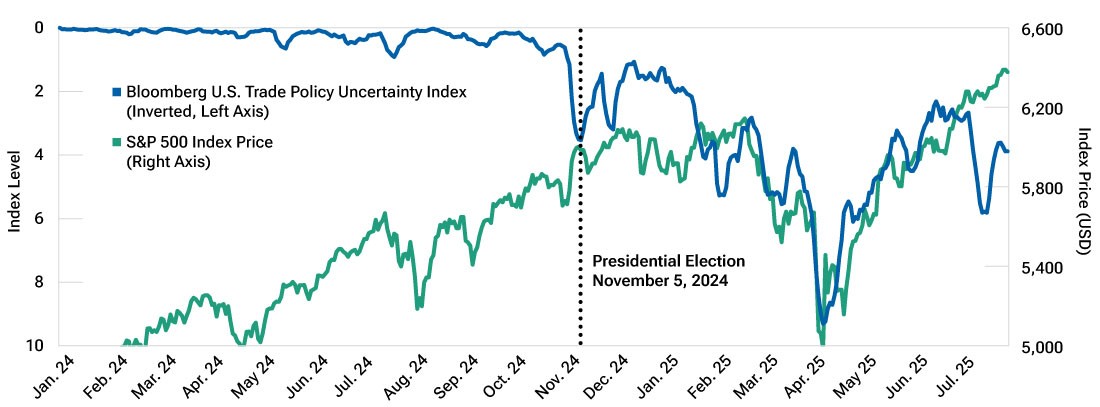
12 months ended July 29, 2025. Past performance is not a guarantee or a reliable indicator of future results.
*The Bloomberg U.S. Trade Policy Uncertainty Index has been inverted in this chart. A downward-sloping line indicates an increase in U.S. trade uncertainty; a rising line indicates a decline in U.S. trade uncertainty.
Sources: Bloomberg Finance L.P. and Standard & Poor’s. See Additional Disclosure.
A pivot to pragmatism on trade policy
The magnitude and breadth of the country‑specific tariffs that President Trump unveiled on April 2 roiled markets, as did the administration’s apparent willingness to accept near‑term economic weakness in exchange for longer‑term structural changes in the economy.
Although tariffs remain at the heart of the president’s trade policy, the administration’s initial dogmatism appears to have given way to a more pragmatic approach. Delays and rollbacks to extreme tariffs—as well as U.S. trade agreements with key partners (Figure 2)—have eased the market’s near‑term worries.
Critically, early trade deals provided a playbook for other countries seeking to negotiate with the Trump administration and helped to anchor the market’s expectations on where tariffs might land. Subsequent deals followed a similar pattern: a 10% to 20% tariff rate, along with purchase agreements for certain goods and/or pledges to invest in the U.S.
Talks between the U.S. and China also appear to be progressing. Both sides dropped the triple‑digit tariff rates that were bandied back and forth in the spring. And the U.S. has relaxed some of its restrictions on technology exports, while China has announced a time frame for resuming limited shipments of rare earth metals that are critical to modern industry.
Deals, deals, deals
(Fig. 2) U.S. has reached trade agreements with key partners
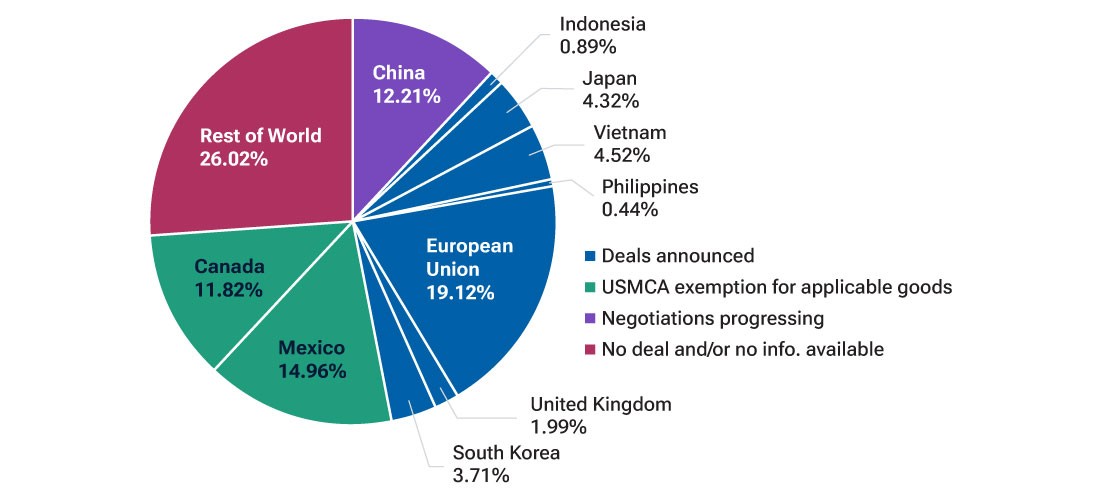
Trade agreement information is as of 12 p.m. ET, July 31, 2025.
Pie chart depicts the percentage of U.S. imports by value for the 12 months ended May 31, 2025.
USMCA is the United States-Mexico-Canada Agreement, a free trade deal that took effect in 2020.
Source: Macrobond/U.S. Census Bureau.
Fiscal stimulus and renewed AI enthusiasm
U.S. fiscal policy should also provide an offset to the potential economic drag from an effective tariff rate that is likely to increase to between 10% and 20%, from 2.5% at the start of the year.
The tax and spending legislation that Congress passed in July is expected to be modestly stimulative over the next few years. Here, the question is the extent to which favorable tax treatment of capital expenditures will prompt businesses to invest more in plants, equipment, and research and development.
These tax benefits should provide additional fuel to the spending boom on data centers and other infrastructure related to the artificial intelligence (AI) revolution—a key trend that has been propelling the market higher. However, further upside could be in the cards if capital spending were to accelerate in other parts of the economy.
Subscribe to T. Rowe Price Insights
Receive monthly retirement guidance, financial planning tips, and market updates straight to your inbox.
What to watch next for trade and markets
So far, higher tariffs haven’t shown signs of being a major problem for the economy. Measures of consumer and business confidence have rebounded significantly, which is encouraging for economic activity. We will be watching the incoming data closely to see whether this resilience continues or if inflation ticks up and cracks in the economy start to emerge.
On the trade front, ongoing negotiations with China remain a source of uncertainty. Discussions appear to be trending in the right direction, but a collapse in talks could be a headwind for the market. Conversely, any downward adjustment to the 30% tariff on Chinese goods would be an unexpected tailwind.
Tariffs targeting specific sectors are also on the horizon. Policies here are more likely to be driven by national security concerns in critical industries such as pharmaceuticals and semiconductors.
Bottom line: The health of the U.S. economy and progress on a potential trade agreement with China will be important to watch beyond the tariff deadline.
*On April 28, 2025, T. Rowe Price was named as one of the best financial advisory firms of 2025. The ranking of the best registered investment advisory firms (RIA Firms) was determined using a methodology that considered recommendations by clients, industry experts, and financial advisors, as well as the development of Assets under Management (AUM). Recommendations were gathered through an independent survey of over 30,000 individuals, with self-recommendations prohibited. AUM development was analyzed using publicly available data, with short-term development assessed over a 12-month period from January 2024 to January 2025, and long-term development over a five-year period from 2020 to 2025. The final score was calculated by weighting recommendations at 20% and AUM development at 80%, with a 30/70 ratio for short-term and long-term AUM growth. The data used for the analysis was collected up to January 2025. The award was presented by USA Today and Statista Inc., a leading statistics portal and industry ranking provider that tabulated the rating. T. Rowe Price is not affiliated with USA Today or Statista. T. Rowe Price provided no compensation either directly or indirectly in connection with obtaining or using this rating.
Additional Disclosure
CFA® and Chartered Financial Analyst® are registered trademarks owned by CFA Institute.
The S&P 500 Index is a product of S&P Dow Jones Indices LLC, a division of S&P Global, or its affiliates (“SPDJI”) and has been licensed for use by T. Rowe Price. Standard & Poor’s and S&P are registered trademarks of Standard & Poor’s Financial Services LLC, a division of S&P Global (“S&P”); Dow Jones is a registered trademark of Dow Jones Trademark Holdings LLC (“Dow Jones”). T. Rowe Price is not sponsored, endorsed, sold or promoted by SPDJI, Dow Jones, S&P, their respective affiliates, and none of such parties make any representation regarding the advisability of investing in such product(s) nor do they have any liability for any errors, omissions, or interruptions of the S&P 500 Index.
Important Information
Outside of the United States, this is intended for investment professional use only. Not for further distribution.
This material is being furnished for informational and/or marketing purposes only and does not constitute an offer, recommendation, advice, or solicitation to sell or buy any security.
Prospective investors should seek independent legal, financial and tax advice before making any investment decision. T. Rowe Price group of companies including T. Rowe Price Associates, Inc. and/or its affiliates receive revenue from T. Rowe Price investment products and services.
Past performance is not a guarantee or a reliable indicator of future results. All investments involve risk, including possible loss of principal.
Information presented has been obtained from sources believed to be reliable, however, we cannot guarantee the accuracy or completeness. The views contained herein are those of the author(s), are as of July 31, 2025 are subject to change, and may differ from the views of other T. Rowe Price Group companies and/or associates. Under no circumstances should the material, in whole or in part, be copied or redistributed without consent from T. Rowe Price.
All charts and tables are shown for illustrative purposes only. Actual future outcomes may differ materially from any estimates or forward‑looking statements provided.
The material is not intended for use by persons in jurisdictions which prohibit or restrict the distribution of the material and in certain countries the material is provided upon specific request.
USA—Issued in the USA by T. Rowe Price Investment Services, Inc., distributor and T. Rowe Price Associates, Inc., investment adviser, 1307 Point Street, Baltimore, MD 21231, which are regulated by the Financial Industry Regulatory Authority and the U.S. Securities and Exchange Commission, respectively.
View investment professional background on FINRA's BrokerCheck.
202507-4711694
Next Steps
Get timely perspectives on fluctuating markets at our Market Volatility Hub.
Contact a Financial Consultant at 1-800-401-1819.