

Choose your location
Austria
English
Belgium
Denmark
Estonia
Finland
France
Iceland
Ireland
Latvia
Lithuania
Luxembourg
Netherlands
Norway
Portugal
Sweden
United Kingdom
 26 October 2026
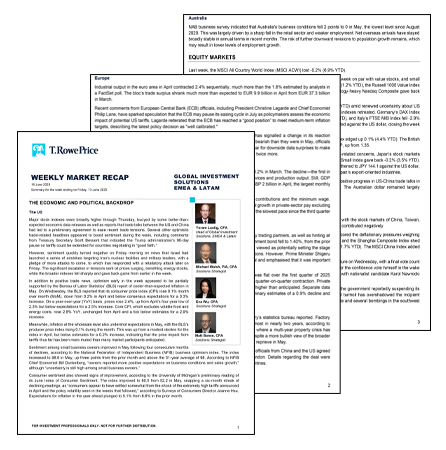
Weekly Market Recap
Our Global Investment Solutions team summarise the week's key market events and developments — with insights to support your client conversations and decision-making.
Key resources
Weekly Market article


Weekly Market data

Economic and political backdrop
The UK
UK unemployment fell unexpectedly to 4.7% in August, down from the 4.9% registered in July. Inflation rose to 3.5% in September, higher than expected and its highest level since last October. Transport contributed significantly to the rise, mainly due to higher motor fuel prices. The data helped strengthen expectations that the Bank of England’s Monetary Policy Committee could raise interest rates at its next meeting on 5 November.
Signs suggest UK consumers feel under pressure, with the GfK Consumer Confidence Index dropping sharply to -24 in October from -13 the previous month. This was the largest monthly fall in sentiment since the pandemic and was attributed to higher energy and borrowing costs, as well as uncertainty around this week's autumn Budget.
The US
The week's economic data highlighted continued pressure on the US housing market. On Monday, the National Association of Home Builders reported that its Housing Market Index fell three points to 29 in October, its lowest level since 2012, as “rising mortgage rates, energy and material costs, and worsening labour and lot conditions” continued to challenge builders.
Meanwhile, data released Tuesday showed that September pending home sales plunged 7.3% month over month (MoM) following a 0.3% rise in August. The decline brought the index to its lowest level since the series began in 2001. Housing starts also weakened from the prior month.
Labour market data were more encouraging. Initial jobless claims came in at 194,000 for the week ended 17 October, down from the prior week's revised reading of 200,000 and the lowest level since July. Continuing claims, however, increased by 25,000 to 1.728 million.
Elsewhere, S&P Global reported that US business activity growth slowed moderately but remained near a five-year high in October, with its Flash US Composite Purchasing Managers’ Index (PMI) coming in at 57.6 versus 58.4 in September (readings above 50 indicate expanding activity). Both the manufacturing and services sectors showed strength, though businesses reported the sharpest increase in selling prices since August 2022.
The economic calendar wrapped up Friday morning with the University of Michigan’s final reading of its October Index of Consumer Sentiment, which was little changed from September at 48, a decline of about 10% from a year ago. Consumers’ inflation expectations for the year ahead ticked up to 4.7%, while long-run inflation expectations also edged higher to 3.5%.
Europe
Cost-of-living protests turned into widespread riots and looting in major French cities last week, contributing to a sell-off in French equities and bonds. The yield on the government’s 10-year bonds, for example, rose to more than 5%, resulting in the widest yield spread since 2012 versus German bunds of equivalent maturity.
Third-quarter earnings season continued to gain momentum during the week. Some energy companies reported surging profits while others issued upbeat updates on commodity trading operations ahead of official results. In contrast, some luxury goods earnings disappointed. Semiconductor companies’ results appeared to be fundamentally solid, but their shares were volatile amid a midweek global sell-off in technology stocks.
The S&P Global Flash Eurozone Composite PMI Output Index indicated that eurozone growth slowed in October. PMI fell to 51.9 in October from 53.1 in September. This preliminary reading was weaker than a consensus estimate of 52.7.
The European Central Bank released its consumer survey, which showed inflation expectations among eurozone households rose in September. Respondents said they expected prices to rise by 3.1% over the next 12 months, up from 3.0% in August.
China
China's gross domestic product (GDP) grew 4.5% YoY in the third quarter, up from 4.3% in the second quarter and ahead of the 4.4% median forecast in a Reuters poll. According to the National Bureau of Statistics, September industrial production rose 5.5% YoY, and retail sales rose 1.1%, while fixed asset investment (excluding rural households) fell 7.2% over the first nine months compared with the same period last year. GDP increased 4.6% YoY in the first three quarters, leaving the government's 4.5% to 5.0% annual growth target within reach. The stronger headline GDP reading may reduce the urgency for broad-based stimulus, although subdued consumption and weak investment point to uneven domestic demand.
People's Bank of China (PBoC) Governor Pan Gongsheng said on Monday that the central bank was studying whether to make the overnight reverse repurchase rate, rather than the seven-day rate, its main policy benchmark to improve monetary policy transmission. No such change has been implemented. Separately, China's one-year and five-year loan prime rates were left unchanged at 3.00% and 3.50%, respectively, in line with expectations.
China's State Administration for Market Regulation said on Wednesday that it met with representatives from online platforms, including Taotian, JD.com, Pinduoduo, and Kuaishou, to discuss product quality and consumer protection. While acknowledging improvements following guidance issued in 2025, the regulator cited continuing concerns about counterfeit products, misleading advertising, and product descriptions, particularly in livestream commerce and instant retail. Hong Kong-listed e-commerce shares declined on Thursday amid the announcement and a broader technology sell-off. The statement did not specify new enforcement actions.
The US Treasury Department proposed updates on Thursday to rules governing certain US investments in sensitive technologies in countries of concern, including China. The proposed requirements would broaden the scope of transactions subject to notification or prohibition, adding specified biotechnology activities alongside areas such as advanced semiconductors and AI. Several Hong Kong-listed biotechnology shares fell on Friday, although the implications for individual companies and cross-border financing remain uncertain. The proposal is subject to public consultation and has not taken effect.
Japan
The yield on the 10-year Japanese government bond (JGB) fell to 2.80% from 2.92% at the end of the previous week. Bond prices rose as investors moved into lower-risk assets after the global equity sell-off, which also contributed to a rally in US government bonds. Demand for longer-dated JGBs strengthened considerably, with demand at a 20-year bond auction reaching a record, a result attributed to higher yields and demand for safer assets. Japan’s nationwide core consumer price index, excluding fresh food, rose 2.1% year over year (YoY) in September, up from 1.7% in August and marking the first reading above the Bank of Japan's (BoJ) 2% target since December 2025. This supported expectations of further rate increases, although the BoJ is reportedly favouring leaving rates unchanged at its 29 to 30 October meeting.
The yen appreciated over the week, trading JPY 156.9 against the US dollar on Friday, up from the prior week’s JPY 158.0. The currency moved out of the narrow range it held for several weeks as risk aversion supported demand for the yen. US Treasury yields fell sharply, and the dollar weakened broadly, narrowing the expected interest rate differential between the US and Japan.
Elsewhere, Japan’s exports rose 16.7% YoY in September, below the 21.3% consensus and slower than the 19.3% increase in August, marking the weakest growth since April, although chip-related products and autos remained supportive. Imports rose 18.9%, also below the 20.4% consensus and slower than the 28.0% increase in August.
Australia
Reserve Bank of Australia (RBA) Deputy Governor Andrew Hauser said on Wednesday that Australia's inflation outlook looked "materially worse" than the RBA's August forecast, citing higher AI and technology prices feeding through to consumer price inflation, as well as persistent domestic pressures. Hauser warned that the RBA cannot allow inflation expectations to drift away from target, signalling a possible fifth rate hike at the 2-3 November meeting. The Australian flash composite output PMI for October was weak, suggesting downside risks to near-term GDP growth.
Canada
At the Bank of Canada's (BoC) 28 October rate decision, the debate sharpened after Monday's Consumer Price Index (CPI) print showed headline inflation edging up to 3.1% in September — driven by a 27.8% annual surge in gasoline prices — while core measures came in softer than expected, initially bolstering the case for a hold. However, the BoC's simultaneous release of its third-quarter Business Outlook and Consumer Expectations surveys, which showed rising inflation expectations and firms planning to pass on higher input costs amid ongoing US trade tensions, shifted market sentiment, pushing consensus towards a 25bps increase to 2.5%. The Parliamentary Budget Office added to the cautious macro backdrop, cutting its 2026 GDP growth forecast to 0.9% (from 1.1%) and flagging higher federal debt as US tariffs and Canadian retaliatory measures weigh on the economy.
Markets
Equity markets
Last week, the MSCI All Country World Index (MSCI ACWI) lost -0.9% (11.9% YTD).
The S&P 500 Index finished the week down -0.5% (12.4% YTD) as concerns over artificial intelligence (AI)-related spending and financing weighed on large-cap technology shares, while small-cap and value-oriented stocks outperformed amid a rotation in market leadership. In the large-cap universe, value stocks outpaced growth for the third consecutive week. The Russell 1000 Growth Index returned -1.5% (1.5% YTD), the Russell Value Index returned 0.7% (23.9% YTD), and the Russell 2000 Index returned 2.0% (13.1% YTD). The technology-heavy Nasdaq Composite retreated -0.7% (12.2% YTD).
Oil prices rose late in the week amid reports of renewed tensions in the Middle East, reversing earlier declines tied to optimism about US-Iran diplomatic talks.
AI-related stocks had another volatile week as investors weighed generally positive demand signals against concerns about the scale and financing of capital expenditures. Technology shares rebounded early in the week following the prior week's sell-off, supported by optimism around data centre demand and anticipation of quarterly earnings from major technology companies. However, the recovery reversed course on Thursday as renewed scrutiny of AI investment and funding requirements weighed on sentiment.
Meta Platforms was among the notable decliners as investors focused on the company's substantial capital spending plans and potential financing needs, despite some favourable signs of AI-related demand. Other technology companies also faced heightened scrutiny as investors assessed whether earnings growth could justify elevated valuations and continued infrastructure investment.
In Europe, the MSCI Europe ex-UK Index gave back -1.3% (8.5% YTD). Soaring oil prices and Middle East tensions, heightened inflationary pressures, and domestic political unrest dampened sentiment in European markets. Among major stock indexes, Germany’s DAX Index declined -1.7% (2.8% YTD), France’s CAC 40 Index fell -2.2% (-1.6% YTD), and Italy’s FTSE MIB Index dropped -2.6% (11.4% YTD). Switzerland’s SMI put on 0.5% (12.4% YTD). The euro was little changed against the US dollar, closing the week at USD 1.12 per EUR.
The FTSE 100 Index in the UK lost -1.7% (10.5% YTD), while the FTSE 250 Index of smaller companies retreated -1.2% (10.8% YTD). The British pound strengthened against the US dollar for the week, closing at USD 1.34 per GBP, up from 1.33.
Japan’s stock markets lost ground over the week. The TOPIX Index fell -2.5% (18.8% YTD), and the TOPIX Small Index dropped -3.5% (16.8% YTD) as investors reassessed the AI investment outlook, questioning how data centre spending will be financed and whether it can be sustained. Global technology shares were volatile, and a sharp late-week fall in US semiconductor stocks was followed by weakness across Asia. Higher oil prices and Middle East tensions added to investor caution.
In Australia, the ASX 200 Index edged down -0.1% (4.8% YTD) as materials stocks came under pressure amid a global tech-driven risk-off tone and concerns over the sustainability of AI investment. Australian government bond longer-term yields eased on growth concerns, flattening the curve. The Australian dollar strengthened 1.1% against the US dollar, supported by hawkish RBA commentary and a softer US dollar.
In Canada, the S&P/TSX Composite finished the week down -1.1% (14.9% YTD).
Emerging markets and other markets
The MSCI Emerging Markets Index ended the week down -2.6% (14.4% YTD). China, Taiwan, South Korea, India and Brazil weighed on performance.
Chinese equities declined over the week, although a Friday rebound pared some losses following a technology-led sell-off. The CSI 300 Index, the main onshore benchmark, was down -1.5% (-9.5% YTD), while the Shanghai Composite Index declined -0.5% (-5.1% YTD). Hong Kong's benchmark Hang Seng Index fell -4.5% (-7.3% YTD). AI-linked shares weakened amid concerns about investment spending, financing needs, and corporate earnings, while losses in US tech stocks and higher oil prices added to market volatility. Hong Kong, closed Monday for the Chung Yeung Festival, underperformed amid selling in internet and biotechnology shares. Mainland bank shares were comparatively resilient. The MSCI China Index, which primarily comprises offshore-listed stocks, dropped -4.6% (-16.9% YTD).
Fixed income markets
Last week, the Bloomberg Global Aggregate Index (hedged to USD) returned 0.3% (-0.1% YTD), the Bloomberg Global High Yield Index (hedged to USD) -0.3% (0.4% YTD), and the Bloomberg Emerging Markets Hard Currency Aggregate Index -0.2% (-1.3% YTD).
US Treasury yields fell sharply during the week as the technology sell-off and heightened geopolitical uncertainty drove stronger demand for US government securities. Over the week, the 10-year Treasury yield decreased by -8bps to 5.00% from 5.08% (up 83bps YTD). The 2-year Treasury yield decreased by -3bps, ending the week at 4.68% from 4.71% (up 121bps YTD).
Over the week, the 10-year German Bund yield declined by -8bp, ending at 3.34% from 3.42% (up 49bps YTD). The 10-year UK gilt yield decreased by -1bp, ending the week at 5.36% from 5.37 (up 88bps YTD).
Our Weekly Market Recap is designed to keep you updated on the previous week's major events and developments. It includes:
- Concise summaries of key market events and trends
- Insights and analysis from our expert team
- Market perspectives to aid your client conversations
Global Investment Solutions Team
 Yoram Lustig, CFA, PRM™
Head, Global Investment Solutions, EMEA
Yoram Lustig is the head of Global Investment Solutions, EMEA, and a portfolio manager in the Multi-Asset Division. He also is the chair of the UK and European Investment Committees and a member of the Multi-Asset Steering Committee.
 Michael Walsh, CFA, CAIA®, FIA
Solutions Strategist
Michael Walsh is a London-based solutions strategist on the Multi-Asset Solutions team for EMEA. He is a vice president of T. Rowe Price Group, Inc., and T. Rowe Price International Ltd.
 Eva Wu, CFA
Associate Solutions Strategist
Eva Wu is an associate solutions strategist on the Multi-Asset Solutions team in the Multi-Asset Division. She is a vice president of T. Rowe Price International Ltd.
 Matt Bance, CFA
Solutions Strategist
Matt Bance is a solutions strategist and portfolio manager on the Multi-Asset Solutions team for the Europe, Middle East, and Africa region. He is a vice president of T. Rowe Price International Ltd.
202610 - 6054154
Notes
All data and index returns cited herein are the property of their respective owners, and provided to T. Rowe Price under license via data sources including Bloomberg Finance L.P., FactSet & RIMES, MSCI, FTSE and S&P. All rights reserved. T. Rowe Price seeks to cite data from sources it deems to be accurate, but it cannot guarantee the accuracy of any data cited herein. Neither T. Rowe Price, nor any of its third-party data vendors make any express or implied warranties or representations and shall have no liability whatsoever with respect to any data and index returns contained herein. The data and index returns cited herein may not be further redistributed or used as the basis for other indices, as a benchmark or as the basis for any other financial product.
The specific securities identified and described are for informational purposes only and do not represent recommendations.
CFA® and Chartered Financial Analyst® are registered trademarks owned by CFA Institute.
Important Information
The specific securities identified and described are for informational purposes only and do not represent recommendations.
This material is being furnished for general informational and/or marketing purposes only. The material does not constitute or undertake to give advice of any nature, including fiduciary investment advice, nor is it intended to serve as the primary basis for an investment decision. Prospective investors are recommended to seek independent legal, financial and tax advice before making any investment decision. T. Rowe Price group of companies including T. Rowe Price Associates, Inc. and/or its affiliates receive revenue from T. Rowe Price investment products and services. Past performance is not a guarantee or a reliable indicator of future results. The value of an investment and any income from it can go down as well as up. Investors may get back less than the amount invested.
The material does not constitute a distribution, an offer, an invitation, a personal or general recommendation or solicitation to sell or buy any securities in any jurisdiction or to conduct any particular investment activity. The material has not been reviewed by any regulatory authority in any jurisdiction.Information and opinions presented have been obtained or derived from sources believed to be reliable and current; however, we cannot guarantee the sources’ accuracy or completeness. There is no guarantee that any forecasts made will come to pass. The views contained herein are as of the date written and are subject to change without notice; these views may differ from those of other T. Rowe Price group companies and/or associates. Under no circumstances should the material, in whole or in part, be copied or redistributed without consent from T. Rowe Price.The material is not intended for use by persons in jurisdictions which prohibit or restrict the distribution of the material and in certain countries the material is provided upon specific request. It is not intended for distribution to retail investors in any jurisdiction.
Information and opinions presented have been obtained or derived from sources believed to be reliable and current; however, we cannot guarantee the sources’ accuracy or completeness. There is no guarantee that any forecasts made will come to pass. The views contained herein are as of the date written and are subject to change without notice; these views may differ from those of other T. Rowe Price group companies and/or associates. Under no circumstances should the material, in whole or in part, be copied or redistributed without consent from T. Rowe Price.
The material is not intended for use by persons in jurisdictions which prohibit or restrict the distribution of the material and in certain countries the material is provided upon specific request. It is not intended for distribution to retail investors in any jurisdiction.