Withdrawal Options

Take a withdrawal, roll over, or learn about other options for your savings.

View Transcript

We understand people change jobs, and people retire. Sometimes when there’s a change in our lives and we’re busy we forget to tie up loose ends, such as deciding what to do with retirement savings from a former employer. And making good decisions about those loose ends may require some time and a bit of assistance. 

At T. Rowe Price we’re here to help you make good choices, so that your account is there for you when you retire.  We know that you worked hard to save. That’s why you should know that keeping your money in a tax-deferred account is important. When you keep your money in a tax-deferred account, as in your former employer’s retirement plan, your new employer’s plan or in an individual retirement account called an IRA, you won’t pay taxes on any of it until you begin withdrawals. And you may be in a lower tax bracket when you make those withdrawals during your retirement years.

Withdrawing your money or moving it to a taxable account, like a personal checking or savings account, has consequences. For example, if a retirement saver has $100,000 in a tax-deferred account and withdrawals that money, then reinvests that $100,000 in a taxable account before the age of 59 ½, the $100,000 is cut nearly in half, leaving the participant with just $59,000 due to taxes and penalties. And here’s another example. If a 30-year old participant has $1,000 in a retirement account and leaves it there for 35 years, over time that money could grow to over $10,500.

When you’re ready, here are a few options to help you maintain these tax-deferred benefits.  Leave your money where it is.  Roll over your vested account balance to an IRA or your current employer’s retirement plan. If you have company stock in your plan you should discuss your options with your tax advisor.  We want you to know that you have the power to help control how your savings will grow and that we’re here to help you create a sound savings strategy.

Explore the options you have in your plan through the online Withdrawal Center or call 1-866-262-5565 to speak to a T. Rowe Price representative. We’ll be pleased to help you understand your options.

The cost of cashing out

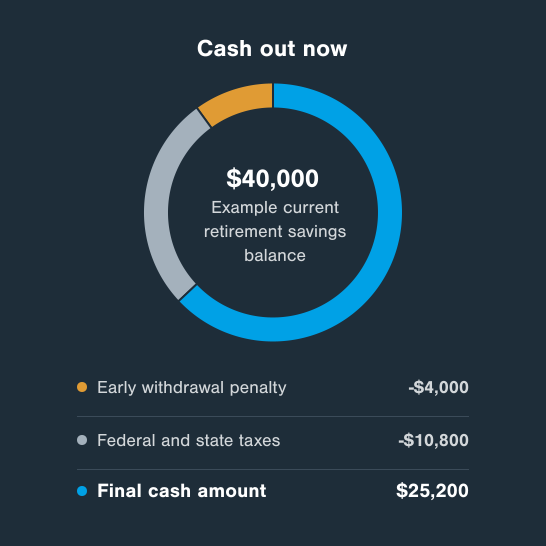
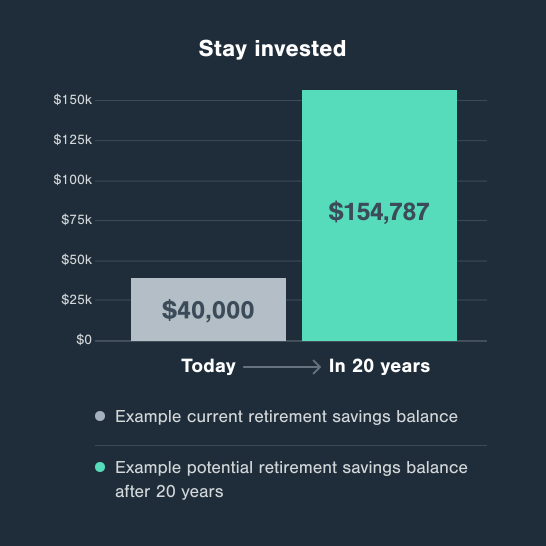
See the potential future impact of withdrawing $40,000 today versus keeping it invested for 20 years.

Donut chart illustrating that taking out $40,000 will provide $25,200 after penalty fee and taxes.
Bar chart showing that leaving $40,000 in the account could grow to $154,787 in 20 years.
How is this calculated?

Assumes a 10% penalty for withdrawing before the age of 59½ and a tax rate of 27% (federal and state) in the year of distribution. Actual check received will be $32,000. The figure $25,200 is net of the assumed tax rate and the application of a 10% penalty. This chart is for illustrative purposes only and does not represent the performance of any of your plan’s investment options. Ending balances assume money is invested in pretax savings and calculations are based on a 7% annual rate of return net of fees, compounded annually. All investments involve risk, including loss of principal. When money is withdrawn from retirement savings, it is subject to taxes and possible penalties following withdrawal.

Compare your options

Keeping your money in a tax-deferred retirement account will help grow your savings for the future. Learn if staying in your plan, rolling your money over, or withdrawing your savings may be right for you.

  KEEP MONEY IN YOUR EXISTING PLAN ROLL OVER TO AN IRA ROLL OVER TO A NEW EMPLOYER’S PLAN WITHDRAW YOUR SAVINGS*
Penalty-Free Withdrawals After Age 59.5 check-mark check-mark check-mark N/A
Continue Making Contributions that Grow Tax-Deferred cross-check-mark check-mark check-mark N/A
Investment Options Limited options carefully curated by your plan that may be available at a lower cost, when compared to similar investments in an IRA Wide range of options Limited options carefully curated by your plan that may be available at a lower cost, when compared to similar investments in an IRA N/A
Potential to Consolidate Accounts Depends on your plan
(see your plan rules)
check-mark Depends on your new plan N/A
Access to Loans Depends on your plan
(see your plan rules)
cross-check-mark Depends on your new plan N/A
Protection From Creditors check-mark Some check-mark cross-check-mark
Immediate Access to Cash cross-check-mark cross-check-mark cross-check-mark check-mark
Additional considerations
  • Carefully consider the fees, features, and services of each option before making a decision.
  • After reaching age 73, you’ll generally have to take annual required minimum distributions (RMDs). Most employers do not require that you take RMDs while you're still working. Beginning in 2024, RMDs are not required from Roth accounts held in retirement plans. (The SECURE 2.0 Act of 2022 changed the RMD age from 72 to 73 for those born after December 31, 1950.)
  • You may be able to roll after-tax contributions, Roth contributions, and Roth earnings into a Roth IRA without incurring tax liability. If you hold significantly appreciated stock, you may want to consult a tax professional before completing a distribution to help determine if you should take advantage of a special tax benefit that could be lost by rolling over the value of company stock to another plan or IRA. Review the Rollover Options Notice (PDF) for more information.


* The withdraw your savings option assumes you’re withdrawing your savings as cash and not reinvesting it.

† There is no 10% penalty if you terminate employment with the employer that sponsors your plan after attaining age 55 and you request a distribution. The 10% penalty generally does not apply to distributions from governmental 457(b) plans (regardless of age).

Federal law may protect savings in most plans (such as 401(k) plans) from civil lawsuits, creditors, and bankruptcy proceedings. Federal law protects savings in IRAs from bankruptcy only. Additional protections may be available to plans and IRAs under state law.

Compare Your Options

Keeping your money in a tax-deferred retirement account will help grow your savings for the future. Learn if staying in your plan, rolling your money over, or withdrawing your savings may be right for you.

Expand All
PENALTY-FREE WITHDRAWALS AFTER AGE 59.5†
Keep your money in your existing plan Correct Check Mark
Roll over to an IRA Check Mark
Roll over to a new employer’s plan Check Mark
Withdraw your savings* N/A
CONTINUE MAKING CONTRIBUTIONS THAT GROW TAX-DEFERRED
Keep your money in your existing plan InCorrect Check Mark
Roll over to an IRA Correct Check Mark
Roll over to a new employer’s plan Correct Check Mark
Withdraw your savings* N/A
INVESTMENT OPTIONS
Keep your money in your existing plan Limited options carefully curated by your plan that may be available at a lower cost, when compared to similar investments in an IRA
Roll over to an IRA Wide range of options
Roll over to a new employer’s plan Wide range of options based on institution
Withdraw your savings* N/A
POTENTIAL TO CONSOLIDATE ACCOUNTS
Keep your money in your existing plan Depends on your plan (see your plan rules)
Roll over to an IRA Correct Check Mark
Roll over to a new employer’s plan Depends on your new plan
Withdraw your savings* N/A
ACCESS TO LOANS
Keep your money in your existing plan Depends on your plan (see your plan rules)
Roll over to an IRA InCorrect Check Mark
Roll over to a new employer’s plan Depends on your new plan
Withdraw your savings* N/A
PROTECTION FROM CREDITORS‡
Keep your money in your existing plan InCorrect Check Mark
Roll over to an IRA InCorrect Check Mark
Roll over to a new employer’s plan InCorrect Check Mark
Withdraw your savings* Correct Check Mark
IMMEDIATE ACCESS TO CASH
Keep your money in your existing plan InCorrect Check Mark
Roll over to an IRA InCorrect Check Mark
Roll over to a new employer’s plan InCorrect Check Mark
Withdraw your savings* Correct Check Mark
ADDITIONAL CONSIDERATIONS
  • Carefully consider the fees, features, and services of each option before making a decision.
  • After reaching age 73, you’ll generally have to take annual required minimum distributions (RMDs). Most employers do not require that you take RMDs while you're still working. Beginning in 2024, RMDs are not required from Roth accounts held in retirement plans. (The SECURE 2.0 Act of 2022 changed the RMD age from 72 to 73 for those born after December 31, 1950.)
  • You may be able to roll after-tax contributions, Roth contributions, and Roth earnings into a Roth IRA without incurring tax liability. If you hold significantly appreciated stock, you may want to consult a tax professional before completing a distribution to help determine if you should take advantage of a special tax benefit that could be lost by rolling over the value of company stock to another plan or IRA. Review the Rollover Options Notice (PDF) for more information

* The withdraw your savings option assumes you’re withdrawing your savings as cash and not reinvesting it

† There is no 10% penalty if you terminate employment with the employer that sponsors your plan after attaining age 55 and you request a distribution. The 10% penalty generally does not apply to distributions from governmental 457(b) plans (regardless of age).

‡ Federal law may protect savings in most plans (such as 401(k) plans) from civil lawsuits, creditors, and bankruptcy proceedings. Federal law protects savings in IRAs from bankruptcy only. Additional protections may be available to plans and IRAs under state law.

Photo of a happy family of four playing outdoors.

Are you on track for retirement?


Schedule a free call to discuss your goals with a retirement specialist.


The Confidence Check-In® Conversation may result in discussion of products or services unrelated to your plan which are distributed or provided by T. Rowe Price Investment Services, Inc. or its affiliates; any such products or services are not overseen by your plan or your former employer. Confidence Check-In is a registered trademark of T. Rowe Price Group, Inc.

Explore additional resources