
RMDs: Required Minimum Distributions
Get answers to questions about withdrawals you’re required to take starting at age 73.*
What's an RMD?
An RMD, or required minimum distribution, is the minimum amount of money the IRS mandates you withdraw each year from most tax-deferred retirement accounts, generally once you turn age 73.*
Accounts that require RMDs include:
- Traditional, Rollover, SEP or SIMPLE IRAs
- Most employer-sponsored retirement plans, including 401(k) and 403(b) plans
- Please note different RMD rules apply to inherited IRAs and are not covered here. For questions related to inherited IRA RMDs, please speak with your tax or legal professional.
Looking to manage your RMD for accounts at T. Rowe Price?
We're here to help. Call 1-866-264-5579.
How do I withdraw an RMD at T. Rowe Price?
As a T. Rowe Price client, you have access to easy-to-use tools designed to help simplify and automate RMDs from your eligible T. Rowe Price retirement accounts.**
From preparation to management, your RMD dashboard has what you need to stay on top of your RMDs from your eligible T. Rowe Price retirement accounts.
- Gain access at age 70 to help you get RMD-ready.
- See how much your RMD amount will be for the year—already calculated for you.
- View your RMD status at a glance.
- Take or automate your distributions.
Once you reach a certain age, the IRS requires you to take annual withdrawals from most of your retirement accounts. These mandatory withdrawals are known as required minimum distributions, or RMDs.
At T. Rowe Price, we make it easy to set up, manage, and stay informed about your T. Rowe Price RMD—all in one convenient, secure place.
Welcome to your RMD dashboard.
You’ll gain access to a basic version of your RMD dashboard when you turn age 70.
This ensures you have time to get familiar with RMDs and consider taking preliminary steps to help you prepare for your first RMD.
You can even estimate how much your RMD might be by using our RMD calculator.
Beginning the year you reach RMD age, your RMD dashboard will evolve to be your one-stop destination for all things RMD.
Here, you’ll be able to get a clear view of your RMD status, including:
- Your RMD deadline
- Your total and remaining RMD amounts for the year.
- You can also easily enable Auto-RMD from your dashboard.
With this simple, free tool, you can:
- Choose where you want to send your RMD. Next, you’ll need to establish automatic distributions from each of your eligible T. Rowe Price retirement accounts.
- Set up multiple payments or take your RMD all in one distribution.
- Rest assured knowing your RMD will be correctly calculated and distributed according to the IRS RMD rules each and every year.
If you don’t need your RMD for living expenses, T. Rowe Price can help you reinvest in a general investing account, contribute to a 529 college savings plan, or explore qualified charitable distributions.
Start taking advantage of your RMD dashboard today at troweprice.com/myRMD.
Or, simply log in to your T. Rowe Price account and click on the RMD tab.
With your RMD dashboard, preparing for and managing your RMDs is easier than ever. There’s no additional paperwork and no need for long phone calls. But if you need us, we’re always here to help.
 close
close
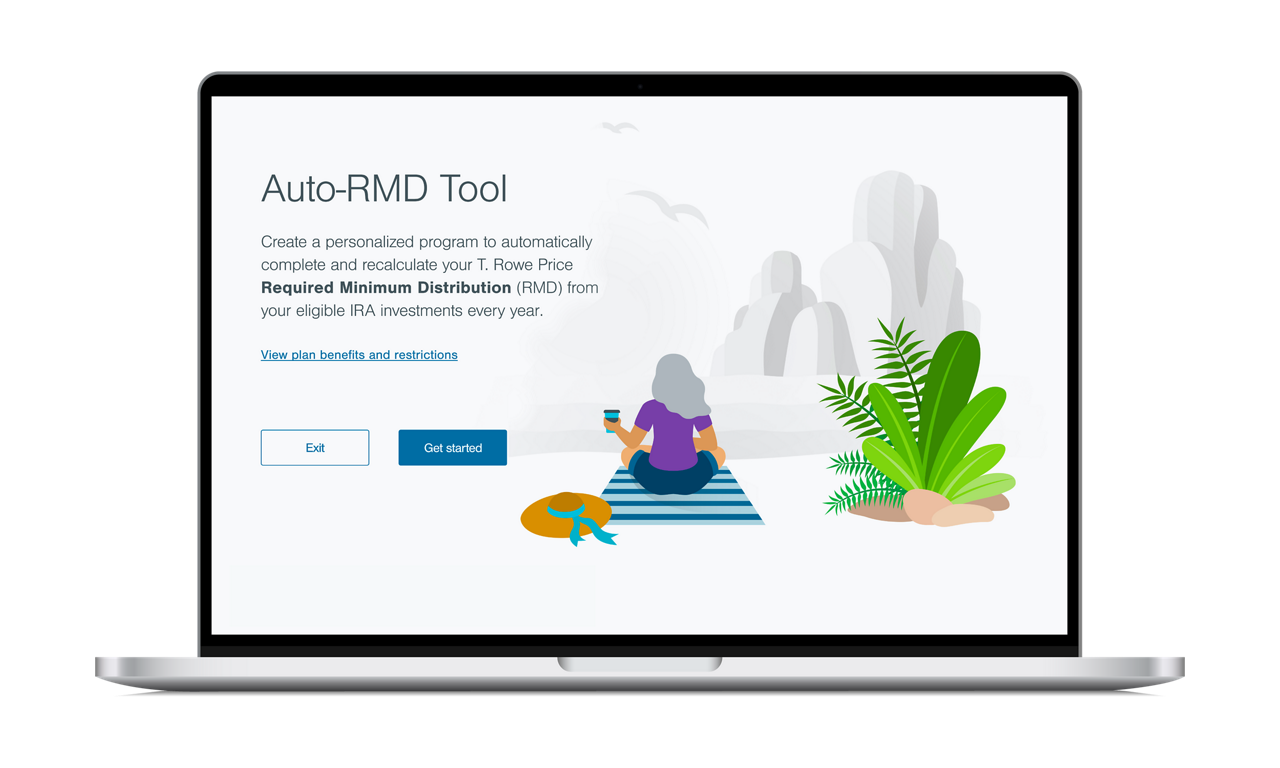
Create a personalized program to automatically calculate and complete your RMD from your eligible T. Rowe Price retirement accounts every year.
- Set up multiple payments or take it all in one distribution.
- Prevent missing or miscalculating your RMD from T. Rowe Price.
- It’s quick, easy, and recalculates annually.
What's the deadline for taking an RMD?
- Your first RMD: Must be taken by April 1 of the year after the year you turn age 73.
- Keep in mind: If you defer your first RMD until April 1, you’ll also need to take your second RMD In the same year. This additional income could have significant tax implications to consider.
- Subsequent RMDs: Must be taken by December 31 of each year.
- Avoid costly penalties. RMDs aren’t optional. If you don’t take your RMD, or take out too little, you may be faced with an IRS penalty tax up to 25% of the amount not distributed.***
SECURE 2.0 and your RMDs
The SECURE 2.0 Act of 2022 changed the rules associated with RMDs. It's important to make sure you understand the rules and update your RMD strategy accordingly.
What should I do with my RMD?
If you don’t need your RMD for living expenses, here are three ways you could potentially put your RMD to work for the things that matter most to you.
Reinvest your RMD.
Use it to potentially grow your investment portfolio. Simply reinvest the distribution into a new or existing general investing account to help you save for a wide variety of goals—without limits, penalties, or restrictions.
Save for a loved one's education.
You can use your RMD to invest in a 529 college savings plan. These funds can be used for college costs, K-12 expenses, and student loan repayment. Any earnings are tax-free when used for qualified expenses.†
Support a charity you believe in.
Satisfy your RMD by donating to one or more eligible charities. This type of gift is know as a qualified charitable distribution (QCD) and up to $105,000 for 2024 (indexed for inflation) is excluded from income.
What are some other common questions about RMDs?
How do I calculate my RMD?
The RMD for a year is determined by dividing the previous year-end's fair market value (on December 31) by the applicable distribution period (from the appropriate IRS life expectancy table). The year-end value may need to be adjusted for certain events.
Your RMD changes each year, based on your balance and age. If you don’t take the correct RMD amount, IRS penalties may apply. If you're a T. Rowe Price client with an RMD eligible account, log in to manage your RMD.
How can I take my distributions?
You can satisfy your RMD through a one-time transaction or automatic withdrawals from eligible accounts. As a T. Rowe Price client, you can log in and set up your RMD with our Auto-RMD tool.
What if I have multiple accounts?
If you have more than one IRA, you must calculate the appropriate RMD for each individually. However, you can take your total distribution from any one or more of the IRAs. Similar rules apply to 403(b) accounts. However, RMDs from other types of retirement plans, such as 401(k) plans, must be taken separately from each of those plan accounts.
What if I have a workplace retirement account?
You will have to contact your current and/or prior employer to calculate the RMD and request a distribution. If your workplace account is with T. Rowe Price, you can log in now to learn more about your RMD.
How should I plan for required minimum distributions in retirement?
Planning ahead can help you decide how RMDs fit with other income sources, such as Social Security, pensions, or taxable investment accounts. Personalized advice can help you determine how much income you may need, which accounts to draw from in which order, and how your portfolio should be managed over time.
Need support from a financial advisor? Learn more about Retirement Advisory Service™.
Have more RMD questions?
Speak with a T. Rowe Price Financial Consultant at 1-888-421-0563.
*The SECURE Act of 2019 changed the RMD age requirement from 70½ to 72 and is applicable to those who turned 70½ on or after January 1, 2020. The Secure 2.0 Act of 2022 changed the RMD age to 73 in 2023 only for individuals who turn 72 on or after January 1, 2023. The new law also provides that the RMD age will change again to 75 in 2033.
**Distributions using Auto-RMD are not yet available for Retirement Advisory Services and ActivePlus Portfolio® clients. For Retirement Advisory Services clients, your advisor will reach out to you personally to help handle your RMD. For ActivePlus Portfolios clients, you can take a distribution from your ActivePlus Portfolios account by logging into your T. Rowe Price account.
***Penalty tax may be further reduced to 10% if corrected within 2 years.
All investments are subject to market risk including possible loss of principal. T. Rowe Price does not provide tax advice. Please consult your tax or financial professional regarding questions specific to your situation.
This material has been prepared for general and educational purposes only. This material does not provide recommendations concerning investments, investment strategies, or account types. It is not individualized to the needs of any specific investor and is not intended to suggest that any particular investment action is appropriate for you, nor is it intended to serve as the primary basis for investment decision-making. Any tax-related discussion contained in this material, including any attachments/links, is not intended or written to be used, and cannot be used, for the purpose of (i) avoiding any tax penalties or (ii) promoting, marketing, or recommending to any other party any transaction or matter addressed herein. Please consult your independent legal counsel and/or tax professional regarding any legal or tax issues raised in this material.
†Be sure to review any 529 college savings plan offered by your home state or your beneficiary’s home state, as there may be state tax or other state benefits, such as financial aid, scholarship funds, and protection from creditors that are only available for investments in the home state’s plan. Be sure to read the college savings plan’s disclosure document, which includes investment objectives, risks, fees, charges and expenses, and other information you should read and consider carefully before investing. Tax benefits may be conditioned on meeting certain requirements, such as residency, purpose for or timing of distributions, or other factors, as applicable.
While distributions from 529 college savings plans for elementary or secondary education tuition expenses are federally tax-free, state tax treatment will vary and could include state income taxes assessed, the recapture of previously deducted amounts from state taxes, and/or state-level penalties.
202606-5550025