

PRICE PERSPECTIVE - IN DEPTH
Interest Rate Decoupling Creates Global Opportunities
July 2014
Arif Husain
, Head of International Fixed Income
EXECUTIVE SUMMARY
Interest rates in the developed countries are decoupling, as central banks find themselves at different points in their domestic economic cycles. Monetary policies in the emerging markets, never that closely linked to begin with, also continue to diverge.
Interest rate decoupling is freeing the world’s sovereign bond markets to go their separate ways—as shown in their varying reactions to the Federal Reserve’s moves to taper its massive bond purchases. This differentiation is creating relative value opportunities across markets.
Investors seeking higher-yielding alternatives to Australian government bonds, but without increased correlation to volatile equity markets, may want to consider the merits of a diversified global sovereign bond strategy that uses dynamic country selection and yield curve positioning in an effort to improve yield and enhance returns.
For the first time since the 2008 global financial crisis, the world’s major central banks—and the sovereign bond markets tied to them—appear poised to move in different directions. The result is likely to be a more complex fixed income environment, but also one in which active country selection, backed by strong fundamental research skills, can potentially enhance returns.
Over the past year, many bond investors and analysts have focused on the U.S. Federal Reserve, which has begun to “taper” the extraordinary liquidity support it provided to the U.S. economy and markets in the wake of the financial crisis. This has fed a widely shared broad perception that interest rates are heading higher globally, with bearish implications for bonds, especially government bonds.
Less mentioned has been the fact that not all central banks have followed the Fed’s lead on quantitative easing (QE). Nor have all sovereign bond markets reacted to the Fed’s initial tapering moves to the same degree, or even in the same way. Meanwhile, global interest rates—and, even more so, interest rate expectations—have already started to decouple.
Since 2007, policy rates in most developed countries generally have moved either down or sideways as central banks have struggled to contain financial distress and stimulate growth. While monetary developments in the emerging markets (EM) have been more varied, with some countries lifting rates to cool inflation, EM sovereign yields also have largely followed a downward trend, driven by the flow of excess liquidity from the developed world.
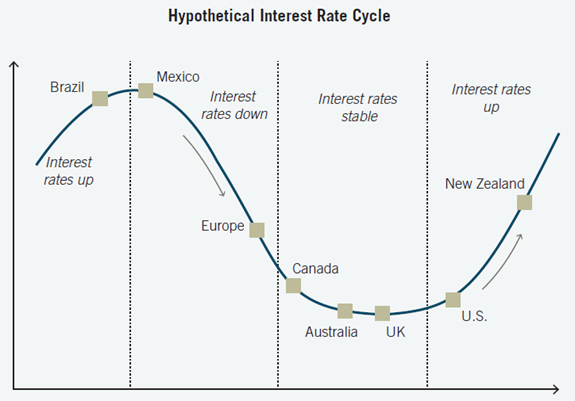
Our expectations, however, are that the next few years will not look like the last seven. In a more “normal” post-crisis world, central banks again are likely to move at different speeds along their respective interest rate cycles (Figure 1, below). Even in the developed world, where disinflationary pressures still linger in a number of countries, monetary decoupling is in progress:
- While the Fed looks to taper its liquidity injections, the Bank of Japan (BoJ) is expanding its efforts and the European Central Bank (ECB) is contemplating a QE program of its own.
- With a construction boom driving solid economic growth, the Reserve Bank of New Zealand raised rates in March and again in June. Interest rate futures signal expectations that the key lending rate—now at 3.25%—may reach 4.5% by the end of 2015.
- Sweden’s Riksbank, by contrast, cut rates by 25 basis points in early July, following a 25-basis-point cut last December, as consumer inflation remained stubbornly below the bank’s official target.
Figure 1: Interest Rate Trends Are Diverging Across Major Global Markets
Data as of 30 June 2014
Source: T. Rowe Price
DYNAMIC STRATEGIES FOR A DECOUPLING WORLD
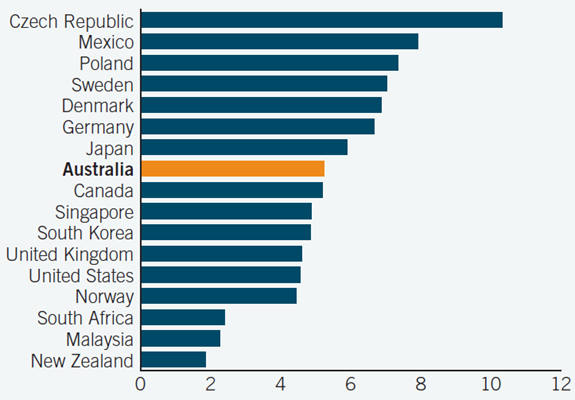
The decoupling of global interest rates also has allowed sovereign bond markets to go their own way, producing considerable cross-country variation in returns. (Figure 2, below). This environment creates potential opportunities for Australian investors looking to improve returns on their fixed income allocations via dynamic country selection.
Figure 2: Global Sovereign Bond Performance
12-Month Returns as of 30 June 2014
Hedged into Australian Dollars
Source: Barclays
By tactically diversifying across the global opportunity set of investment grade sovereign issuers, and by hedging currency risk back into Australian dollars, investors may be able to earn higher yields than those currently available on Australian government debt—but with lower equity correlations compared with other income enhancement strategies, such as adding or expanding allocations to corporate bonds or other credit instruments.
What’s more, diversifying exposure to duration—a measure of interest rate risk—across global sovereign markets should produce a fixed income portfolio that is more likely to generate positive returns even in a risk-averse environment. Dynamic strategies for achieving this objective might include:
- Rotating duration exposure among countries that are at different points in the interest rate cycle. By purchasing duration risk in some markets and by selling duration risk in other markets based on close macroeconomic analysis, investors may be able to improve risk-adjusted returns (i.e., return per unit of duration) while maintaining relatively low exposure to interest rate risk overall.
- Capturing income opportunities in steep yield curves. Many sovereign markets currently feature unusually wide spreads between shorter-term and longer-term maturities. In some countries, the steep shape of the curve can often provide substantial protection against rising rates, especially in cases where, in our view, markets are overestimating the near-term risk of central bank tightening.
- Extracting value from yield curve changes. By taking duration exposures at different points on the yield curves of different sovereign markets, investors may be able to profit from changes in the shapes of those curves, whether flattening (narrowing spreads between longer and shorter maturities) or steepening (widening spreads).
AN AGNOSTIC APPROACH TO SOVEREIGN QUALITY
One of the most persistent themes in global fixed income investing in recent years has been the blurring of traditional boundaries between emerging and developed sovereign markets. Improved fiscal and economic fundamentals have greatly expanded the number of investment-grade EM issuers, while sovereign quality ratings generally have deteriorated in the developed world.
In a world where interest rate cycles are decoupling, we believe it can be especially useful for investors to take an agnostic approach to conventional asset class categories, seeking quality—in terms of yield, rating quality, and return potential—wherever it can be found.
Relative value opportunities currently can be found not only in the developed markets but also in selected high-quality EM countries. However, going forward, the trend toward interest rate decoupling is likely to be most pronounced in the developed world, as regions and countries emerge at different paces from the prolonged economic sluggishness that followed the 2008 financial crisis (and, in Europe, the 2010–2011 euro crisis).
CENTRAL BANK POLICY OVERVIEW
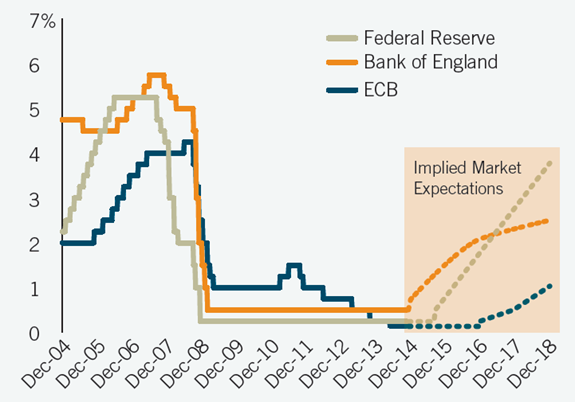
Among the major developed central banks, the Fed and the Bank of England appear furthest ahead in terms of winding down liquidity measures and moving (eventually) to raise rates (Figure 3, below).
Figure 3: The Developed World is Decoupling
Key Central Bank Policy Rates, Actual and Projected _rough 2018
Based on Market Expectations as of 30 June 2014
Sources: Reuters and T. Rowe Price
Although the U.S. bond market is becoming increasingly sensitive to signs of accelerating inflation, the Fed has not altered its tapering pace, and market expectations are that the first U.S. rate hike will not arrive before the middle of 2015. However, in our view, the market also appears to be underestimating the speed with which the Fed might move after that initial increase.
By contrast, the ECB and the BoJ are still in easing mode and likely to remain that way into 2015 as both banks seek to raise inflation toward their policy targets:
- In the Eurozone, disinflationary pressures are easing as the economic recovery slowly broadens to the peripheral countries. However, consumer price inflation is likely to remain around 1%—well below the ECB’s presumed target. A dysfunctional banking system still struggling with high levels of bad debt continues to require extraordinary liquidity support, and the ECB is expected to initiate its own formal QE program, although probably not until early next year.
- With Japan’s economy growing at a reasonable pace by recent standards and consumer inflation in positive territory, market expectations for the BoJ to expand QE have been pushed out to this fall—or even into 2015. The BoJ has concentrated its purchases of Japanese government bonds (JGBs) in the middle of the yield curve and, in our view, is likely to continue to do so, leading to some upward readjustment of the curve.
- Interest rate decoupling is not as obvious in emerging sovereign markets—if only because these diverse and relatively segmented markets have not been highly correlated in recent years.
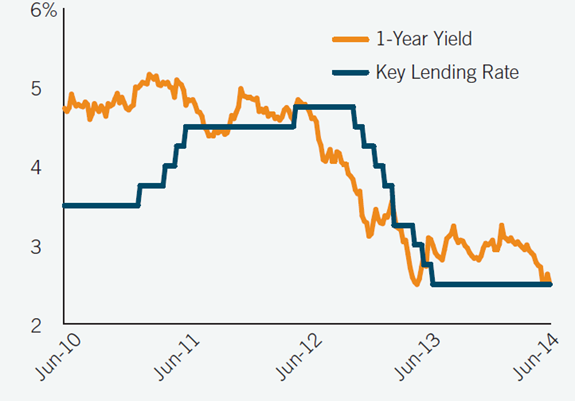
Central banks in some EM countries—such as Brazil— appear to be at or near the top of their interest rate cycles (Figure 4), creating attractive opportunities in those markets. Others—such as Poland—are probably at or near their low points (Figure 4, lower panel), suggesting negative duration views and opportunities to short these markets in expectation of future rate increases.
Figure 4: Some EM Sovereign Markets Appear To Be Near the Tops of Their Interest Rate Cycles...
Brazilian Interest Rates as of 30 June 2014
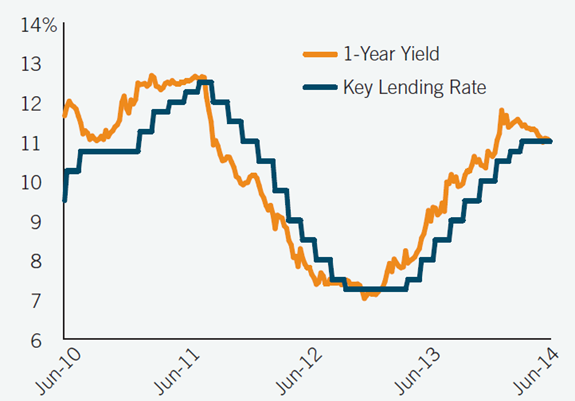
... While Others Appear Close to Their Lows.
Polish Interest Rates as of 30 June 2014
Source: Reuters
RELATIVE VALUE OPPORTUNITIES
For investors, interest rate decoupling creates a rich opportunity set for country selection. Sovereign markets in Mexico, Israel, Malaysia, and South Africa appear especially attractive on a relative basis:
- Israel and Malaysia both offer unusually steep yield curves, in our view more than adequately compensating investors for interest rate risk. While market consensus currently anticipates at least one more rate hike in Malaysia before the end of the year, this move is fully priced into the longer end of the curve. The Bank of Israel, by contrast, appears on hold, but the market is pricing in a slight chance of a near-term rate cut.
- In Mexico, relatively weak economic growth, benign inflation results, and the Fed’s dovish tilt all appear to give the Bank of Mexico additional room to cut rates. Lower rates might be a headwind for the Mexican peso, but expectations for a rebound in growth is likely to offset that effect. Meanwhile, Mexican government bonds offer an attractive pickup over Australian dollar cash yields on a currency-hedged basis.
- The long end of the curve in South African local-currency bonds has also started to look attractive. A recent rating downgrade by S&P, coupled with a higher-than-expected May inflation, has brought forward the chance of an early interest rate increase and pushed the entire yield curve higher.
Sovereign markets that appear to offer opportunities to improve relative performance by taking underweight or outright short positions currently include Poland, Canada, and Japan.
- Further easing by the BoJ may provide less support for bonds. Meanwhile, Japanese financial institutions continue to rotate out of JGBs and into equities and other riskier assets.
- Poland is a prime example of a country where we would expect a correction in the government bond market. A very flat yield curve offers little protection, and markets currently anticipate only limited rate hikes, even though inflation is expected to reach 2.1% by 2015.
- Real yields on Canadian government bonds appear relatively unattractive based our analysis. The market also appears to have not priced in a shift to a tightening bias by the Bank of Canada, which we expect to see later this year as growth continues to materialize.
THE TIME IS RIGHT FOR SOVEREIGN DIVERSIFICATION
Six years after the worst financial crisis since the Great Depression triggered a massive shift to monetary easing across most of the developed world, pushing sovereign yields to historic lows in many countries, the world’s central banks increasingly are going their separate ways. As interest rate cycles decouple, investors seeking fixed income alternatives to low-yielding Australian government bonds—but without increased correlation to volatile equity markets—may want to consider the benefits of diversified exposure to global sovereigns.
A dynamic strategy that seeks relative value opportunities in both developed and emerging markets may be able to enhance yield and improve returns, while providing a measure of protection against rate increased in countries, such as the United States, that appear to be moving into the tightening phase of their domestic economic cycle.
While an increasingly diverse monetary policy environment is creating opportunities for country selection and yield curve positioning across markets, investment success requires in-depth macroeconomic and fundamental analysis, backed by deep research resources. A sophisticated trading platform—one that can handle potential liquidity issues in smaller, more thinly traded markets—may also provide a vital performance edge.
2014-GL-940
IMPORTANT INFORMATION
This material is being furnished for general informational and/or marketing purposes only. The material does not constitute or undertake to give advice of any nature, including fiduciary investment advice, nor is it intended to serve as the primary basis for an investment decision. Prospective investors are recommended to seek independent legal, financial and tax advice before making any investment decision. T. Rowe Price group of companies including T. Rowe Price Associates, Inc. and/or its affiliates receive revenue from T. Rowe Price investment products and services. Past performance is not a reliable indicator of future performance. The value of an investment and any income from it can go down as well as up. Investors may get back less than the amount invested.
The material does not constitute a distribution, an offer, an invitation, a personal or general recommendation or solicitation to sell or buy any securities in any jurisdiction or to conduct any particular investment activity. The material has not been reviewed by any regulatory authority in any jurisdiction.
Information and opinions presented have been obtained or derived from sources believed to be reliable and current; however, we cannot guarantee the sources' accuracy or completeness. There is no guarantee that any forecasts made will come to pass. The views contained herein are as of the date noted on the material and are subject to change without notice; these views may differ from those of other T. Rowe Price group companies and/or associates. Under no circumstances should the material, in whole or in part, be copied or redistributed without consent from T. Rowe Price.
The material is not intended for use by persons in jurisdictions which prohibit or restrict the distribution of the material and in certain countries the material is provided upon specific request.
It is not intended for distribution retail investors in any jurisdiction.
