

PRICE PERSPECTIVE - IN DEPTH
A Changing Fixed Income Environment. When Stable Income and Downside Protection Matter
01
April 2014
WHAT ROLE SHOULD FIXED INCOME PLAY IN A DIVERSIFIED PORTFOLIO?
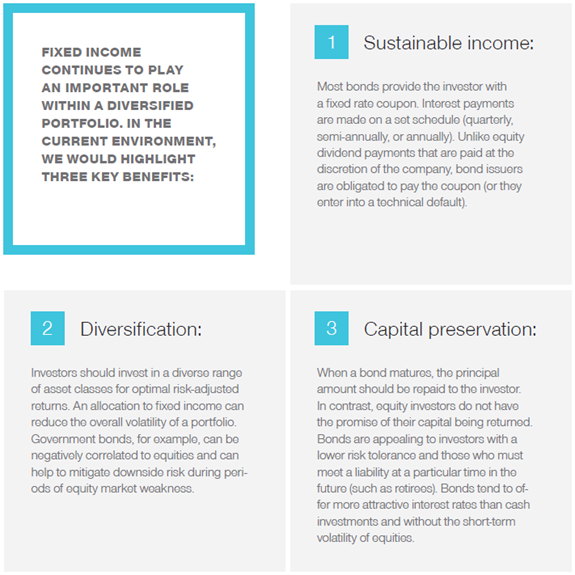
As the name suggests, fixed income is an asset class that should deliver a stable stream of income over the life of an investment. At the end of the life cycle of that investment, the capital should be returned. The asset class has served investors well over the last 30 years, during a time when fixed income markets have enjoyed an extended bull market.
We are now sitting at a new juncture, however. Interest rates and bond yields reside at historic lows, thanks to massive injection of monetary stimulus provided by developed economies’ central banks in the aftermath of the 2008 financial crisis. The U.S. economic recovery cycle is progressing at the point where the Federal Reserve has already started to reduce market liquidity. U.S. interest rates are expected to increase later this year. Developments in the U.S. are likely to have ramifications for other major fixed income markets. It leaves Australian investors with a conundrum: Can fixed income still add value to a diversified investment portfolio?
The short answer is yes. At T. Rowe Price, we hold strongly to the view that investors should always consider a broad range of asset classes when constructing a diversified portfolio. Different asset classes serve different purposes in different market environments. Fixed income is a core holding for its ability to deliver income and diversify and preserve capital, given its lower correlation to higher-risk asset classes, such as equities. These benefits are discussed in more detail below. But how should investors approach fixed income in the current environment?
In our view, a global approach—fixed income without borders—provides access to a diverse range of countries and reduces the risk of a home country bias. The global fixed income market is the largest securities market in the world (totaling $50 trillion1), its growth fueled by globalisation trends over the past 25 years. Global fixed income provides an expansive range of country opportunities. Many of these markets perform based on their own interest rate or economic characteristics, and will behave independently to the U.S. and other major markets. Investors can also delve deeper by incrementally adding value through the non-government sectors. Below, we provide an overview of the range of global fixed income opportunities available to investors.
Finally, the changing fixed income environment and the expanse of the global fixed income universe demands an investment solution that is dynamic and active. Investors need the tools to respond quickly in a world of multi-speed economic growth profiles and interest rate cycles. Investors can still retain a high-quality portfolio, but they need to be agile to manage risks. A portfolio built on the best investment ideas, which is less constrained by the benchmark, should fulfill fixed income’s role as a diversifier and a contributor of sustainable income and capital preservation.
In addition to the above, fixed income markets can offer potential capital appreciation opportunities. Bond prices can be affected by a number of factors, including changes to interest rates or the creditworthiness of an issuer. Price gains can be realised by selling bonds before they mature. If a bond is held until maturity, any price gains over the life of the bond are not realised; the bond price reverts back to par (its issue price) as it nears maturity.
THE FIXED INCOME LANDSCAPE
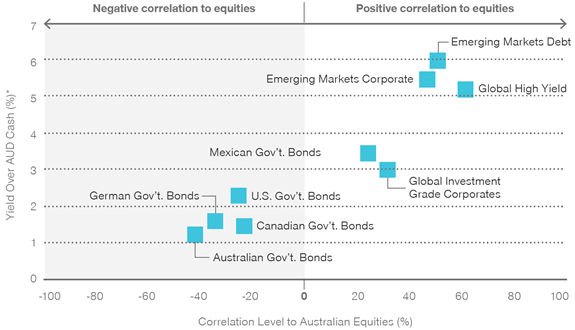
Risk tolerance varies even within a fixed income allocation. Figure 1 shows that lower-risk fixed income assets, such as high-quality government bonds (Australia, U.S., and Germany, for example), have a lower or even negative correlation to equities. This inverse relationship helps to smooth a portfolio’s volatility during periods of equity market weakness.
Additional income gains and potential capital appreciation opportunities can be achieved as investors move higher up the fixed income risk spectrum. High yield and emerging market debt have a higher correlation to equities (see Figure 1). These markets have a lower credit quality rating, reflecting the ability and willingness of issuers to pay back debt. During times of market stress, they may not provide the same level of diversification as higher-quality fixed income assets.
There are many different types of fixed income securities to choose from with varying degrees of risk. Deciding upon which investment depends on where investors are in their investment life cycle and their tolerance for risk.
Figure 1
CURRENT YIELD ABOVE CASH VS. HISTORICAL CORRELATION (LAST 10 YEARS)
Data as of 28 Feb 2014 | Source: J.P. Morgan
GOING GLOBAL
Globalisation has led to the tremendous expansion of opportunities available to fixed income investors. In the context of the global fixed income marketplace, regional, domestic-only approaches can be restrictive. Without access to different country bond markets, each one having its own distinct economic and interest rate cycles, investors could miss potential performance enhancement and diversification.
The expanding global opportunity set has also seen the rise of new fixed income sectors, which are continuing to evolve and develop. Since the 2008 financial crisis, more companies in Europe are accessing the public debt markets for their financing needs, leading to the significant growth of the euro high yield asset class. Similarly, these trends are also occurring among companies in the emerging markets; the emerging market corporate debt market is the fastest growing fixed income asset class.
SOURCES OF VALUE
Country
The U.S., Europe, and Japan are the largest issuers in the government bond market. As global economic growth has rebalanced in the last few years, more developing economies have issued government debt in their domestic currencies. Many of these countries have improving economic and fiscal profiles and offer attractive yields— for example, Mexico, Israel, and Romania.
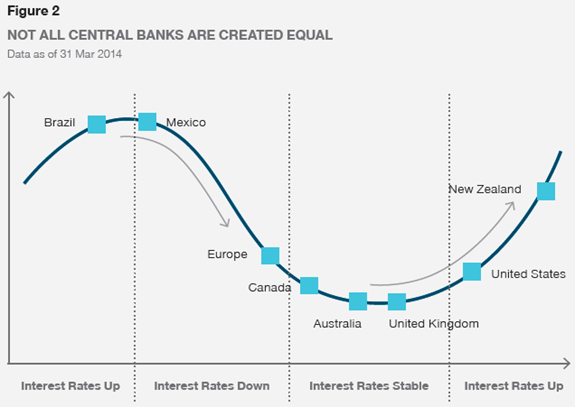
Figure 2 illustrates a hypothetical interest rate cycle between developed markets and the larger emerging markets (Brazil and Mexico). It shows how investors can take advantage of countries at different stages of the interest rate cycle. Essentially, an investor can take advantage of relative country exposures in markets where interest rates are falling or stable versus countries where interest rates are rising.
Active portfolio management not only allows investors to exploit interest rate differentials between countries, but investors can also adjust duration (a measure of interest rate sensitivity to changes in price or yield) and yield curve exposures within the individual countries. Currency risk can be neutralised to focus exclusively on country selection.
Figure 2: NOT ALL CENTRAL BANKS ARE CREATED EQUAL
Data as of 31 Mar 2014
Credit
CORPORATE
The global corporate bond market offers a wide range of investment opportunities. The U.S. corporate bond market is well established. However, more companies in Europe and the emerging markets are accessing the public markets as trends in traditional bank-led financing decline.
There are a variety of reasons for corporations to issue debt. It could be to finance new ventures or to expand operations. Corporate bonds are priced off the risk-free rate (i.e., the equivalent bond maturity in the government sector) and offer investors an additional premium; otherwise known as the credit spread.
Corporate bonds are assigned a rating by credit rating agencies, which assess a company’s financial health. Investment-grade corporate bonds are higher in quality than sub-investment-grade bonds (also known as high yield, junk, or speculative). Lower-quality bonds in the sub-investment-grade category are perceived to carry a higher risk of default. Investors are compensated for this additional credit risk through higher coupons. Credit ratings can be upgraded or downgraded through the life of the bond to reflect the improvement or deterioration of company fundamentals.
EMERGING MARKET DEBT
The emerging market (EM) debt asset class has been evolving and developing since the mid-1990s. It was dominated by the hard-currency bonds (or external debt) that tended to be issued in U.S. dollar. But over the last few years, the significant improvement in countries’ fiscal balances has contributed to the shrinking supply of external debt. In its place, EM local bonds (i.e., bonds are issued in the domestic currency) and EM corporate bond markets are evolving. The EM corporate market is the fastest growing asset class within fixed income. EM bonds offer capital appreciation opportunities, diversification, and potentially attractive risk-adjusted returns.
SECURITISED
Securitised debt is high-quality debt that provides diversity and a higher yield over duration-matched governments. The U.S. mortgage-backed securities and asset-backed securities sectors are the largest securitised debt markets. Bonds backed by mortgages in Germany are known as Pfandbriefe, while other European countries have been issuing similar structures called covered bonds. The process of securitization involves the bundling of cash flows from various types of loans (for example, mortgage payments, car payments, or credit card payments), which are then resold to investors as bonds. The securitised debt market is highly sensitive to interest rate movements and pre-payment risk.
Currency
Currencies can provide uncorrelated sources of return and add diversification to a portfolio. However, performance can be volatile and this creates pricing inefficiencies. Valuation anomalies need to be considered alongside fundamental factors. Economic growth, trade flows, or monetary policy actions can be important indicators of potential currency strength or weakness. Investors can take currency exposure either directly or through investing in the bond market.
DYNAMIC ACTIVE MANAGEMENT
Navigating through the global fixed income landscape requires adeptness and agility. Investors need the tools to respond quickly to an environment where there are many moving parts, including central bank policy actions, multi-speed economic growth profiles, and movement of capital flows. That does not mean investors have to shun quality and take on more risk in achieving the goals of sustainable income, diversification, and capital preservation.
- Quality income: Although the outlook in some developed markets is for moderately higher rates, access to a broader opportunity set allows investors to explore other high-quality government bond markets, which are rated investment grade and where interest rates are expected to fall or remain stable. In addition, investors can also consider markets that are benefiting from improving fiscal and economic profiles. Within individual markets, opportunities can be found across the yield curve. For example, in markets where rates are due to move higher, longer-dated maturity bonds may have already priced in higher interest rate expectations and may provide attractive opportunities.
- Playing defense: High-quality fixed income opportunities that have a lower correlation to equity market performance can help to diversify a portfolio and protect against capital loss during times of market stress. Access to a broader opportunity set provides investors with the tools to respond quickly. With interest rates in the U.S. expected to move higher, market conditions could be more volatile and unpredictable in the future.
- Best ideas: A changing fixed income environment demands flexibility and a go-anywhere approach. Traditional approaches to bond market investing are constrained to benchmarks that are dominated by the largest issuers of debt. That is not always the most optimal way to invest. Investors can fully express their highest convictions based on fundamental research through a best-ideas approach.
WHY T. ROWE PRICE?
T. Rowe Price is a leading, independent investment manager with $773.9 billion AUD under management1 across a broad range of strategies, styles, and asset classes.
Depth and breadth: We have managed fixed income on behalf of our clients since 1971. T. Rowe Price manages $173.7 billion AUD2 in fixed income.
Global fixed income expertise: We have 30 years of experience managing global fixed income portfolios.
High-quality, global research and a disciplined investment process: Our worldwide network of fixed income analysts uses rigorous fundamental processes and robust quantitative research.
Integrated risk management: Risk management is essential to all stages of our investment process.
Collaborative, stable organisation: The T. Rowe Price culture is defined by collaboration, stability, and experience.
IMPORTANT INFORMATION
This material is being furnished for general informational and/or marketing purposes only. The material does not constitute or undertake to give advice of any nature, including fiduciary investment advice, nor is it intended to serve as the primary basis for an investment decision. Prospective investors are recommended to seek independent legal, financial and tax advice before making any investment decision. T. Rowe Price group of companies including T. Rowe Price Associates, Inc. and/or its affiliates receive revenue from T. Rowe Price investment products and services. Past performance is not a reliable indicator of future performance. The value of an investment and any income from it can go down as well as up. Investors may get back less than the amount invested.
The material does not constitute a distribution, an offer, an invitation, a personal or general recommendation or solicitation to sell or buy any securities in any jurisdiction or to conduct any particular investment activity. The material has not been reviewed by any regulatory authority in any jurisdiction.
Information and opinions presented have been obtained or derived from sources believed to be reliable and current; however, we cannot guarantee the sources' accuracy or completeness. There is no guarantee that any forecasts made will come to pass. The views contained herein are as of the date noted on the material and are subject to change without notice; these views may differ from those of other T. Rowe Price group companies and/or associates. Under no circumstances should the material, in whole or in part, be copied or redistributed without consent from T. Rowe Price.
The material is not intended for use by persons in jurisdictions which prohibit or restrict the distribution of the material and in certain countries the material is provided upon specific request.
It is not intended for distribution retail investors in any jurisdiction.
Equity Trustees Limited (EQT) (ABN 46 004 031 298/AFSL 240975) and T. Rowe Price International Ltd (TRPIL) (ABN 84 104 852 191) are, respectively, the responsible entity and investment manager of the T. Rowe Price Australian Unit Trusts. TRPIL is exempt from the requirement to hold an Australian financial services licence in respect of the financial services it provides in Australia and is regulated by the Financial Conduct Authority under UK laws, which differ from Australian laws. For Wholesale Clients only.
PRICE PERSPECTIVE - IN DEPTH