 FALL 2026
OHA Outlook on Software and AI Disruption

Summary
Recent advancements in artificial intelligence have increased investor concerns over potential disruption to software business models, contributing to heightened volatility across software equity and credit markets.
Enterprise software remains one of the largest and most attractive sectors within leveraged finance, offering compelling opportunities to pick credits with highly recurring revenue, strong cash flow generation, and defensiveness across cycles.
OHA believes the market’s recent sell-off was largely indiscriminate and expects increasing differentiation between software companies with fundamentally different risk profiles, well-suited for active credit selection based on disciplined underwriting.
Drawing on more than two decades of software investing experience, OHA focuses on mission-critical businesses with durable competitive advantages, and resilient business models that are better positioned to adapt alongside technological innovation.
Understanding the Market’s Concerns
Separating AI Headlines from Credit Fundamentals
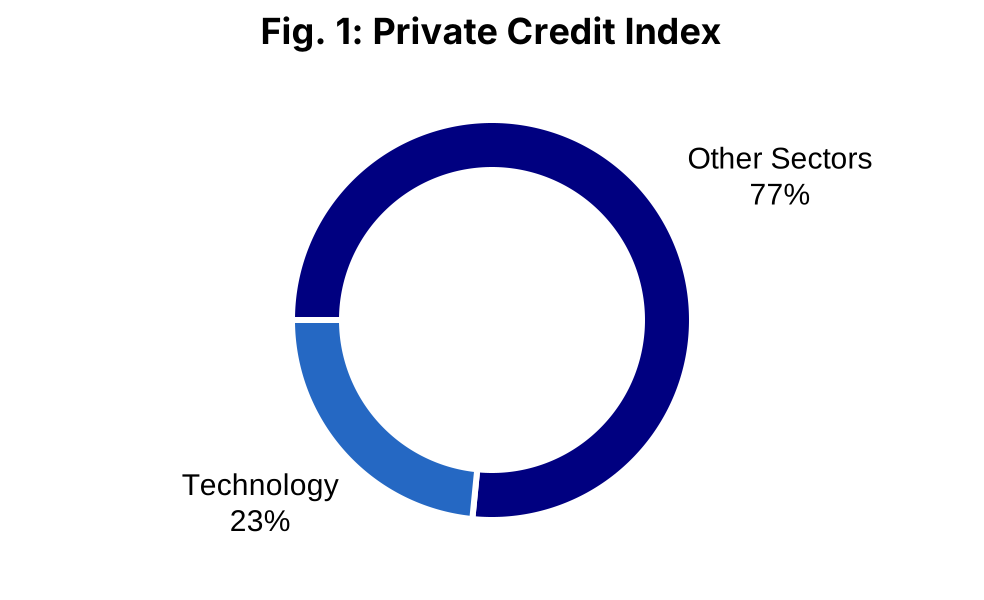
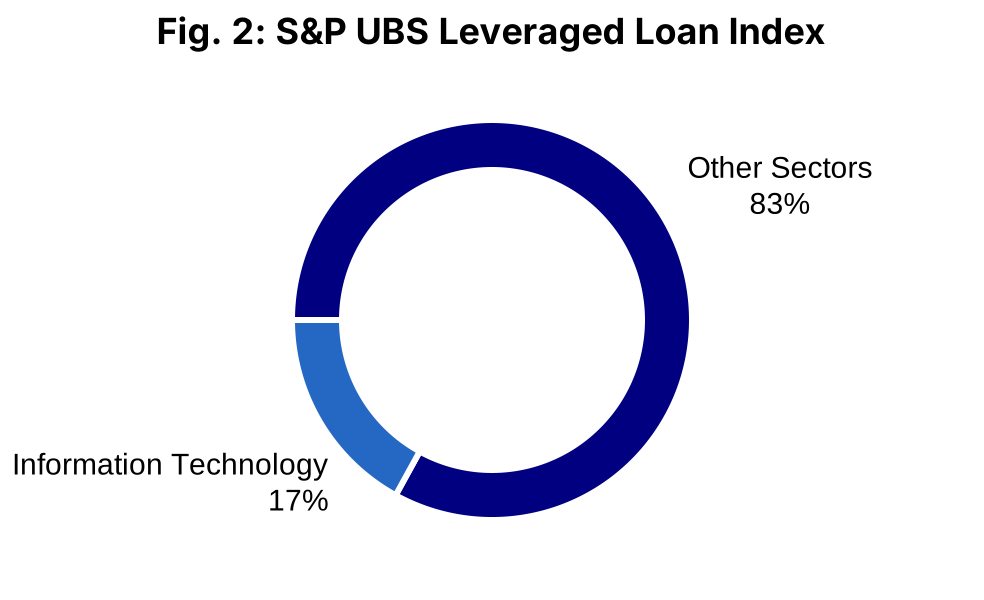
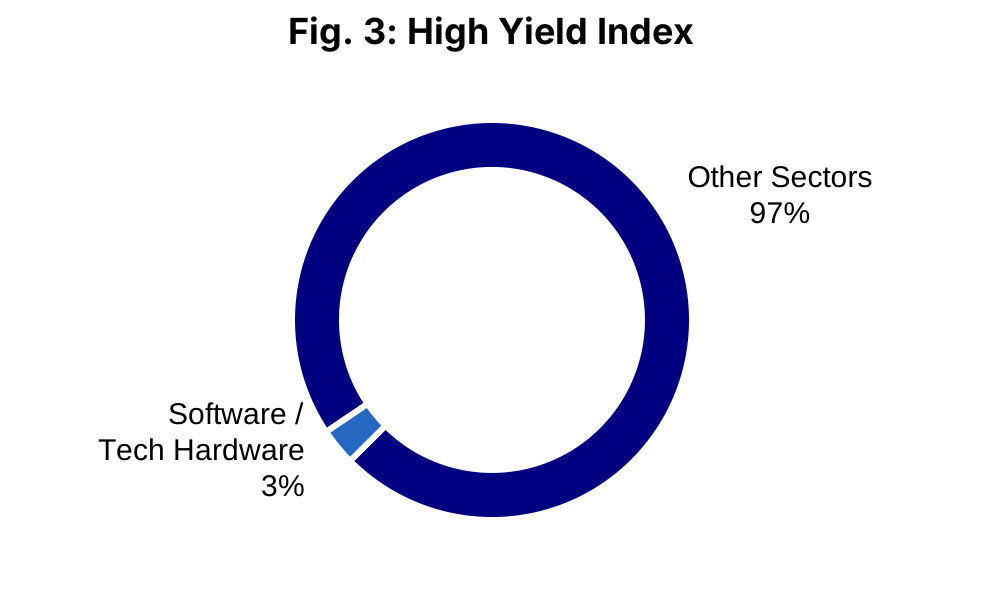
Recent advancements in artificial intelligence have intensified investor scrutiny on software businesses, particularly around the durability of existing business models, competitive positioning, and the long-term sustainability of software-as-a-service (SaaS) economics. As investors evaluated the potential impact of AI-driven disruption, volatility spread across software equity and credit markets. Software’s relevance to these markets led to broad-based selloffs. Software represents the largest industry within the leveraged loan and direct lending index, as shown in Figures 1, 2 and 3, magnifying the impact of investor fears.(1)
While OHA expects AI to have transformative effects on the economy over time, we believe the market’s initial response largely failed to distinguish between the underlying fundamentally different risk profiles of varying software companies. Rather than a uniform disruptive force, we expect AI to have significantly different impacts across issuers within software and adjacent sectors, such as segments of business services and healthcare. OHA foresees the current software and AI disruption creating clear winners and losers across the sector based on the comparative mission-criticality of company products, competitive moats, contractual recurring revenue, correlation to end markets, and ability to adapt to technological change.
OHA’s Software Investment Framework
OHA has invested over $40 billion in software credit since 2004(2). Our investment philosophy in software has been consistent over that time. Figure 2 is a summary of profiles we favor and avoid in our software investment thesis.
We have an extensive history of lending to vertically-focused software companies serving large industries such as healthcare, banking, insurance, the public sector and manufacturing. We avoid direct-to-consumer businesses and generic software that lacks meaningful differentiation, given their weaker competitive moats. We focus on businesses in mission critical workflows, with larger competitive moats and contractual, recurring revenue. We lend based on cash flow, not revenue, and therefore avoid annual recurring revenue (“ARR”) loans, which represent an estimated 20% of private software loans.[3]
As one of the longest standing investors in software credit, we have been highly attuned to the implications of AI in our credit underwriting long before the advent of ChatGPT in November 2022. We have successfully invested through several technological evolutions over our history. While rapidly evolving, AI is not a new theme. In fact, AI was known as “machine learning” before it entered the popular consciousness in recent years. Through historical technology shifts we have observed that mission critical, system of record software vendors have been generally best positioned to guide customers through innovation rather than be displaced by new entrants.
Fig. 2: OHA Software Investment Thesis[4]
|
|
OHA’s AI Risk Framework
OHA systematically assesses AI disruption risk through an internal framework developed and used by our investment team. These AI risk ratings score portfolio companies on two dimensions: (1) AI replacement or displacement risk and (2) revenue model or unit economics sensitivity to AI. Issuers are scored on a 1-10 scale across four categories as summarized below and in Figure 3.
Low (1-3): AI impact is negligible or long-dated; the model is anchored in physical assets, regulated pricing, or specialized labor. Moderate (4-6): workflows can be partially automated but still require a human-in-the-loop, and labor or pricing may compress over time. High (7-8): revenue is tied to tasks generative AI can replicate directly, and margins or pricing are commonly already pressured. Acute (9-10): AI can deliver the product or service natively today and directly threatens the primary value creation model.Notably, we score investments across all industries using this framework, as potential AI disruption is a risk to companies across sectors. Across our portfolios, the weighted average AI risk score is “Low”.(5)
Fig. 3: OHA Portfolio AI Risk Assessment:
| Lower Risk | Higher Risk |
| 1 – 3 Low Risk |
4 – 6 Moderate Risk |
7 – 8 High Risk |
9 – 10 Acute Risk |
| • Mission Critical • Low Displacement |
• Incumbent Advantage • Slow AI Monetization |
• Pricing Pressure • Competitive Threat |
• Labor Substitution • High Displacement |
Enterprise IT, Enterprise
Resource Planning & Infrastructure Software Vertical SaaS
|
Logistics Optimization &
Supply Chain Planning Observability Platforms
|
SMB Go-To-Market Stack
Business Intelligence &
Analytics / Dashboards HR / Talent Tools
|
Business Process Outsourcing & Services |
Looking Ahead
We believe our software investment experience and target profiles, focused on mission critical enterprise solutions, have created a portfolio defensively positioned against AI disruption risk. See our “Industry Spotlight: Software Credit” white paper, first published in 2024, for a more detailed discussion of our software investment thesis and target profiles.
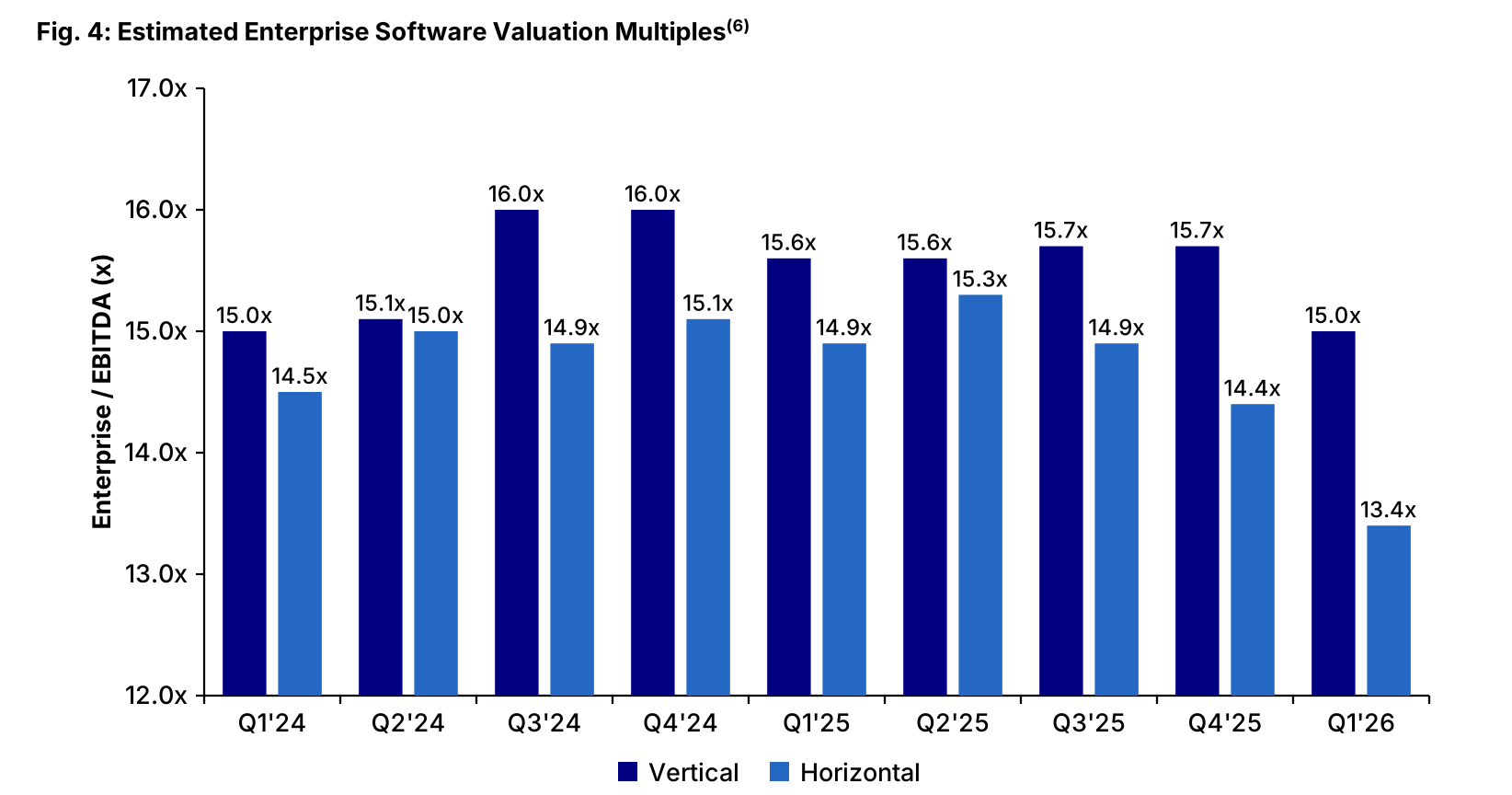
We recognize investor fears and believe AI will have transformational impacts across the economy over time. However, we view the recent sell-off as largely indiscriminate and believe differentiation will emerge between issuers with direct AI exposure and business models that prove more insulated or adaptable. We expect AI to drive meaningful dispersion in fundamental and asset performance over time, producing clear winners and losers as this technology cycle evolves. Recent valuation trends further support this view, with vertical software companies continuing to command a premium to horizontal software peers, reflecting the market’s preference for businesses with specialized workflows, embedded customer relationships, and higher switching costs, see Figure 4.
Looking ahead, we expect AI to act as a catalyst for innovation and a source of differentiation within software rather than a uniform disruptive force, with adoption progressing unevenly across industries, business models and workflows. Historical technology transitions suggest that established, mission-critical software vendors are often able to adapt and incorporate innovation rather than be displaced by it. As illustrated by SAP’s successful transition toward cloud-based offerings, technology shifts frequently reward businesses that evolve toward customer needs while maintaining their core strategic relevance. We believe the market will increasingly distinguish between companies that can leverage AI to enhance productivity while retaining core business integrity—a differentiation already beginning to shape investor sentiment and capital allocation.

- Fall 2026
Why Invest in Real Asset Credit?
Discover how real asset credit can provide diversification, downside protection and attractive risk-adjusted return potential through mission-critical infrastructure investments.

- SUMMER 2026
5 Big Investor Questions and Key Takeaways
Explore five key investor questions shaping today’s credit markets, from AI disruption and geopolitical uncertainty to private credit fundamentals, credit risk, and emerging dislocation opportunities.
Appendix and Endnotes
1 As of June 30, 2026. Represents the % of par for the loan and high yield indices. Leveraged Loan Index represents the S&P UBS Leveraged Loan Index. Private Credit Market represents the Cliffwater Direct Lending Index as of March 31, 2026 and shows the % of direct lending deals. High Yield Index represents the ICE BofA U.S. High Yield Index. An investor cannot invest directly in an index.
2 As of December 31, 2025. Based on total capital Invested for firmwide investments in software companies from 2004-2025 including private and syndicated investments.
3 As of Q4 2025. Reflects ARR loan percentage of private software loans valued by Lincoln International.
4 OHA analysis as of June 30, 2026.
5 OHA analysis as of June 30, 2026.
6 Source: Lincoln International as of March 31, 2026.
Index Definitions
1. The S&P UBS Leveraged Loan Index is designed to mirror the investable universe of the USD denominated leveraged loan market. Loans must be rated “5B” or lower. That is, the highest Moody’s/S&P ratings are Baa1/BB+ or Ba1/BBB+. If unrated, the initial spread level must be a minimum spread of base rate plus 125 basis points or higher. 2) Only fully-funded term loan facilities are included. 3) The tenor must be at least one year. 4) Issuers must be domiciled in developed countries; issuers from developing countries are excluded.
2. The Cliffwater Direct Lending Index (the “CDLI”) seeks to measure the unlevered, gross of fees performance of U.S. middle market corporate loans, as represented by the underlying assets of Business Development Companies (“BDCs”), including both exchange-traded and non-traded BDCs, subject to certain eligibility requirements. The CDLI is asset-weighted by reported fair value.
3. The ICE BofA U.S. High Yield Index tracks the performance of USD denominated below investment grade corporate debt publicly issued in the U.S. domestic market. Qualifying securities must have a below investment grade rating (based on an average of Moody’s, S&P and Fitch), at least 18 months to final maturity at the time of issuance, at least one year remaining term to final maturity as of the rebalancing date, a fixed coupon schedule and a minimum amount outstanding of $100 million.
Key risks and disclosures
This document is for informational purposes only and does not constitute an offer to sell or a solicitation of an offer to buy any securities or partnership interests. Any investor who subscribes, or proposes to subscribe, for an investment in a fund or separately managed account must be able to bear the risks involved and must meet relevant suitability requirements. Fixed-income securities are subject to credit risk, liquidity risk, call risk, and interest-rate risk. As interest rates rise, bond prices generally fall. Investments in high-yield bonds involve greater risk of price volatility, illiquidity, and default than higher-rated debt securities. International investments can be riskier than U.S. investments due to the adverse effects of currency exchange rates, differences in market structure and liquidity, as well as specific country, regional, and economic developments. Some or all alternative investments may not be suitable for certain investors. No assurance can be given that a fund or separately managed account’s investment objectives will be achieved. Alternative investments are speculative and involve a substantial degree of risk. Opportunities for withdrawal/redemption and transferability of interests are generally restricted, so investors may not have access to capital when it is needed. The use of leverage will magnify the potential for loss on amounts invested. The use of a single advisor applying generally similar trading programs could mean lack of diversification and, consequently, higher risk. The use of leverage and other speculative practices may increase the risk of investment loss or make investment performance volatile. In addition, the fees and expenses charged may be higher than the fees and expenses of other investment alternatives, which will reduce profits. There can be no assurance that an advisor will be able to implement its strategy or avoid incurring any losses.
Opinions and estimates offered herein constitute the judgment of OHA as of June 30, 2026 (unless otherwise noted) and are subject to change, as are statements about market trends. These views may differ from those of other OHA and T.RowePrice associates. All opinions and estimates are based on assumptions, all of which are difficult to predict and many of which are beyond the control of OHA in addition, any calculations used to generate the estimates were not prepared with a view towards public disclosure or compliance with any published guidelines. In preparing this document, OHA has relied upon and assumed, without independent verification, the accuracy and completeness of all information. OHA believes that the information provided herein is reliable; however, it does not warrant its accuracy or completeness.
This document may contain, or may be deemed to contain, forward-looking statements, which are statements other than statements of historical facts. By their nature, forward-looking statements involve risks and uncertainties because they relate to events and depend on circumstances that may or may not occur in the future. The future of investment results of the investments described herein may vary from the results expressed in, or implied by, any forward-looking statements included in this document, possibly to a material degree.
The recipient may contact OHA at (212) 326-1500 to obtain additional information or ask questions about any information, including the methodology used for any calculations and details concerning any of the summary charts or information provided herein.
© 2026 Oak Hill Advisors. All Rights Reserved. OHA is a trademark of Oak Hill Advisors, L.P. All other trademarks shown are the property of their respective owners. Use does not imply endorsement, sponsorship, or affiliation of Oak Hill Advisors with any of the trademark owners.
Important Information
This information is not intended to reflect a current or past recommendation concerning investments, investment strategies, or account types, advice of any kind, or a solicitation of an offer to buy or sell any securities or investment services. The opinions and commentary provided do not take into account the investment objectives or financial situation of any particular investor or class of investor. Please consider your own circumstances before making an investment decision.All investments are subject to market risk, including the possible loss of principal. All charts and tables are shown for illustrative purposes only.
T. Rowe Price Investment Services, Inc. OHA is a T. Rowe Price company.
© 2026 T. Rowe Price. All Rights Reserved.
202608-5879628