
How to maximize Social Security survivor benefits for couples
April 2026, Personal Finance
- Key Insights
-
- To ensure the greatest range of options for their surviving spouse, the higher-earning spouse should delay claiming their own benefits until age 70.
- A surviving spouse can receive only one set of benefits at a time. Available benefit amounts will depend on various factors, including age and claiming status.
- By considering trade-offs and complexities, couples can implement a thoughtful claiming strategy to make the most of available benefits—in life and in death.
Social Security benefits play an important role in retirement planning, as they represent a major source of income for many retirees. While investors have likely thought about when to claim their own benefits, they may not have considered what will happen when one spouse passes away or how their choices today could substantially impact their surviving spouse’s income options in the future. Understanding who is eligible for survivor benefits, as well as when and how much they can receive, may help provide some clarity and allow for a wider range of choices in the future.
What are survivor benefits?
Part of the taxes paid into Social Security are intended to support certain surviving family members when a taxpayer passes away—perhaps most importantly, widows and widowers. Monthly survivor benefits are based, in part, on the deceased taxpayer’s earnings record. The amount a surviving spouse receives depends on many factors, including their age, whether they are eligible for benefits of their own, their earnings record, and the claiming status of the deceased spouse, among other factors.
An individual can only receive one set of benefits at a time. If both spouses receive Social Security, the surviving spouse will get the larger benefit, not both. This can lead to a significant income loss when one spouse dies, so planning ahead to maximize the surviving spouse’s benefits is important.
Plan ahead as a couple
As a couple, deciding when each spouse should claim benefits is crucial. Generally, the higher-earning spouse should delay claiming until age 70 to maximize income. This aids the household by ensuring that the surviving spouse can receive the largest possible benefit, regardless of who passes away first. (For more on the process of claiming, see “How to apply for survivor benefits.”)
Social Security planning, especially for survivor benefits, is complex due to the many variables and implications involved. For instance:
- If both spouses have claimed benefits and the surviving spouse is at full retirement age (FRA) or older,1 they will receive the larger benefit. If not yet at FRA, they can continue receiving their own reduced benefits and switch to survivor benefits at FRA, if higher. This may lead to substantial income loss for the survivor, so if cash flow is needed, they can opt for the larger available benefit immediately.
- If only the surviving spouse has claimed benefits and is FRA or older, they will receive the larger of their own or survivor benefits. If not at FRA, they can continue receiving their own reduced benefits and switch to survivor benefits at FRA, which equals the deceased’s benefits at death or their FRA benefits, whichever is higher.
- If the surviving spouse hasn’t claimed benefits, considerations, including the spousal age gap and whether the deceased spouse had claimed their own benefits, and when, become slightly more nuanced.
In the first two scenarios, the survivor’s choices are limited to receiving the larger existing benefit or switching to higher survivor benefits at FRA. The third scenario is more complex since the survivor hasn’t claimed their own benefits. The next section will explore variables affecting benefits and offer a hypothetical example of payment options.
Factors that influence survivor benefits
Here are key considerations for survivor benefits:
- Spousal age gap. Different FRAs due to age gaps affect benefits. Survivor benefits are based on the survivor’s FRA. Claiming survivor benefits before FRA reduces the amount; claiming after doesn’t increase it.
- Deceased’s claiming status and age at death: The deceased’s age (and whether and when they had claimed benefits) will affect survivor benefits. The longer the deceased spouse delayed collecting their own benefits, the higher the survivor benefits could be.
- The widow(er) limit. The “widow(er) limit” provision places a cap on survivor benefits if the deceased claimed early retirement. The cap is either the benefits the deceased spouse was receiving while alive or 82.5% of their FRA benefits, whichever is higher.
- Actuarial reductions for survivors between age 60 and FRA. The surviving spouse can claim as early as age 60,2 but their survivor benefits may be reduced by as much as 28.5% if they claim these benefits before they reach FRA.
- Working status of the surviving spouse (if younger than their own FRA). If the survivor is under FRA and working, benefits are reduced by $1 for every $2 earned over the annual earnings test (AET) limit, which is $23,400 in 2025.3 Therefore, if the survivor is still working, it may be wise to delay claiming until retirement or FRA.
- Survivor benefits after divorce. If an ex-spouse had been married for at least 10 years and the survivor remained unmarried at least until reaching age 60, the survivor can claim survivor benefits.
How to apply for survivor benefits
Surviving spouses must apply in person for their survivor benefits.
First, the Social Security Administration (SSA) must be notified of the taxpayer’s death, either by the funeral home or the surviving spouse. Upon notification, no further benefits on the deceased’s record will be paid until the surviving spouse applies and is approved. If the survivor hasn’t claimed their own benefits and intends to claim one set of benefits (retirement or survivor) then switch to the other higher benefit later, they must file a restricted application for the first set of benefits to let the other benefit continue to grow.
To apply for survivor benefits, you must:
- Schedule an in-person visit at your nearest SSA office and
- Bring banking information to set up direct deposit (if desired).
Provide appropriate documentation to support your claim application, including but not limited to:
- a death certificate for your spouse,
- a marriage certificate, and
- your birth certificate or proof of U.S. citizenship or lawful alien status.
For individuals who initiate survivor benefits immediately upon their spouse’s passing, any benefits owed during the period between death and approval will be paid in full.
Optimizing survivor benefits
Given the many variables involved in the calculation of survivor benefits, it may be helpful to consider a hypothetical example. While this example is particularly illustrative of the third scenario mentioned previously, the options available to the surviving spouse (with regard to survivor benefits) are applicable to the other two scenarios as well.
Daniel, the older spouse, has passed away. His FRA was 66, and his FRA benefit was $24,000 per year. His widow, Susan, is 60 years old and is, therefore, ineligible to collect her own benefits. Her FRA is 67.4
The chart “Claiming status and age impact on survivor benefits” illustrates Susan’s survivor benefits depending on the following factors:
- How old Daniel was when he initially claimed his own benefits (in case he had claimed prior to death)
- How old Daniel was when he died (in case he had not yet claimed)
- Susan’s age when she claims her survivor benefits
In all instances, the longer Daniel had delayed claiming his own benefits (up to age 70) and the longer Susan can delay claiming her survivor benefits (up to her FRA), the higher Susan’s potential survivor benefits will be.
If Susan is still working and earning more than the $23,400 AET limit for 2025, she might consider holding off on claiming survivor benefits. There is a chance that all of her benefits, or at least a significant portion, would be withheld based on her earned income.
For example, if Susan earns $60,000 per year, $18,300 of her benefits would be withheld. While every full and partial month of withheld credits is eventually factored back into the benefits calculation once she reaches her FRA, it is not paid back in one lump sum. Therefore, because Susan’s earned income would limit receipt of her full survivor benefits, she may consider holding off until she stops working or reaches her FRA of 67. Once Susan retires and/or reaches age 67 (whichever comes first), she is no longer subject to the AET and can claim her own or her survivor benefits.
Another critical choice Susan may face depends on whether she is eligible to collect Social Security benefits on her own earnings record.
If she is no longer working, she might consider collecting her own reduced benefits at age 62 and then switching to full survivor benefits at FRA (if higher). Alternatively, if her own benefits at age 70 would be higher than the survivor benefits, she could collect her reduced survivor benefits as early as age 60 and then switch to her own benefits at age 70. Since only one set of benefits can be received at a time, it may make sense to claim one of the benefits early, even if at a reduced rate, to enable the other benefits to continue to grow.
Claiming status and age impact on survivor benefits
Susan’s annual survivor benefits amount will depend on whether and when her spouse, Daniel, had claimed his own benefits, how old he was when he died (in case he had not yet claimed), and her age when she claims her survivor benefits.
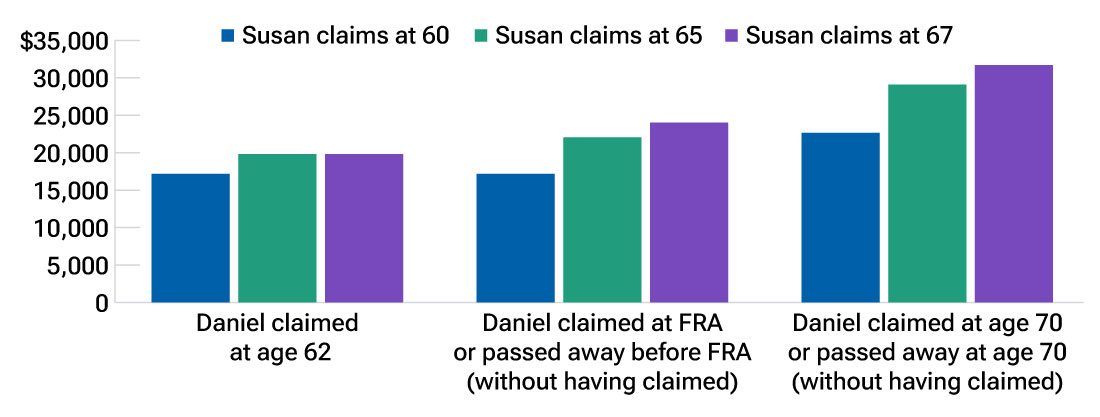
For illustration purposes only. For simplicity, we are assuming no cost-of-living adjustment (COLA).
close
If Daniel claimed his own benefits before his FRA, Susan is subject to the “widow limit.” In this case, since Daniel claimed at age 62, Susan will realize no additional increase in her survivor benefits for delaying beyond age 62 and 8 months, which is when she will reach her cap of $19,800 (equal to 82.5% of Daniel’s FRA benefits). Note that if Daniel had claimed early, but close enough to his FRA that the amount he was receiving was greater than 82.5% of his FRA benefits, the widow limit would be higher, and there may be additional incentive for Susan to delay claiming her survivor benefits.
If Daniel passed away any time before his FRA without having claimed his benefits, Susan is entitled to receive 100% of his FRA benefits—provided she waits until her own FRA (age 67) to claim.
If Daniel claimed his own benefits at FRA (or later) or passed away any time after his FRA without having claimed his benefits, Susan is entitled to receive 100% of the amount Daniel was receiving (or would have received if he had claimed on his date of death)—again, provided she waits until her own FRA (age 67) to claim.
If Susan claims survivor benefits at age 65, the survivor benefits will still be reduced but by incrementally less than the full 28.5% reduction that would have applied if she claimed at age 60.5
Making the best choice for you
Your decision about when and whether to claim survivor benefits will ultimately depend on your needs and your situation. As with many aspects of a financial plan, the choices you make early on can affect your options down the road.
Planning how to claim your Social Security benefits as a couple allows you to provide a surviving spouse with better options later. By understanding the trade-offs and complicating factors involved, you can implement a more thoughtful claiming strategy that makes the most of the benefits available to you both.
 Lindsay Theodore, CFP®
Thought Leadership Senior Manager
Lindsay Theodore, CFP®
Thought Leadership Senior Manager

Confidence runs deeper with a trusted advisor by your side
Get expert advice on investing, retirement, and tax-smart approaches, so you can have greater clarity and confidence in your financial future.
1 For most individuals, your FRA for survivor benefits is the same as your FRA for your own benefits. However, for those born between 1955 and 1961, your FRA for survivor benefits is between two and four months prior to your FRA for your own benefits. For simplicity, throughout this article, FRA will refer to FRA for survivor benefits (unless otherwise noted). For details on your FRA for your own benefits, visit: ssa.gov/oact/progdata/nra.html. For details on your FRA for survivor benefits, visit: ssa.gov/benefits/survivors/survivorchartred.html.
2 In most cases, a surviving spouse cannot claim survivor benefits before they turn age 60—two years younger than eligibility for their own benefits. However, survivors who are disabled, have minor children, or care for children with disabilities may have the option to claim before they turn 60.
3 In the year an individual reaches FRA, a separate AET applies. Benefits may be reduced by $1 for every $3 of earned income above $62,160 in 2025.
4 Susan’s FRA is 67 for both her own and her survivor benefits.
5 The reduction would be 8.14% (2/7 x 28.5%) because she claimed her survivor benefits two years before her FRA and there are seven years between age 60 and her FRA of 67.
Important Information
This material is provided for informational purposes only and is not intended to be investment advice or a recommendation to take any particular investment action.
The views contained herein are those of the authors as of June 2025 and are subject to change without notice; these views may differ from those of other T. Rowe Price associates.
This information is not intended to reflect a current or past recommendation concerning investments, investment strategies, or account types, advice of any kind, or a solicitation of an offer to buy or sell any securities or investment services. The opinions and commentary provided do not take into account the investment objectives or financial situation of any particular investor or class of investor. Please consider your own circumstances before making an investment decision.
Information contained herein is based upon sources we consider to be reliable; we do not, however, guarantee its accuracy. Actual future outcomes may differ materially from any estimates or forward-looking statements provided.
Past performance is no guarantee or a reliable indicator of future performance. All investments are subject to market risk, including the possible loss of principal. All charts and tables are shown for illustrative purposes only.
T. Rowe Price Investment Services, Inc., distributor. T. Rowe Price Associates, Inc., investment adviser. T. Rowe Price Investment Services, Inc., and T. Rowe Price Associates, Inc., are affiliated companies.
© 2025 T. Rowe Price. All Rights Reserved. T. ROWE PRICE, INVEST WITH CONFIDENCE, the Bighorn Sheep design, and related indicators (see troweprice.com/ip) are trademarks of T. Rowe Price Group, Inc. All other trademarks are the property of their respective owners.
- 202506-4548967