
Are U.S. small-caps finally back?
February 2026, Equity
- Key Insights
-
- U.S. small‑cap stocks have outperformed large‑cap stocks recently, reversing a prolonged period of underperformance. Fundamentals suggest this is not just a short‑term bounce.
- Small‑cap earnings have accelerated, driven by lower interest rates, reduced trade uncertainty, improved lending, fiscal stimulus, and artificial intelligence.
- T. Rowe Price’s Asset Allocation Committee believes the U.S. small‑cap rally is durable, and has gradually increased its overweight position in recent months.
U.S. small-cap stocks have staged a notable comeback in recent months, marking a sharp reversal after a prolonged period of underperformance. Since October 2025, small-caps have outperformed large-caps in a meaningful way, raising an important question for investors: Is this just a short-term bounce or something more durable?
A Sharp Turn in Performance
For nearly three years, U.S. small-cap stocks steadily lost ground relative to U.S. large-caps.
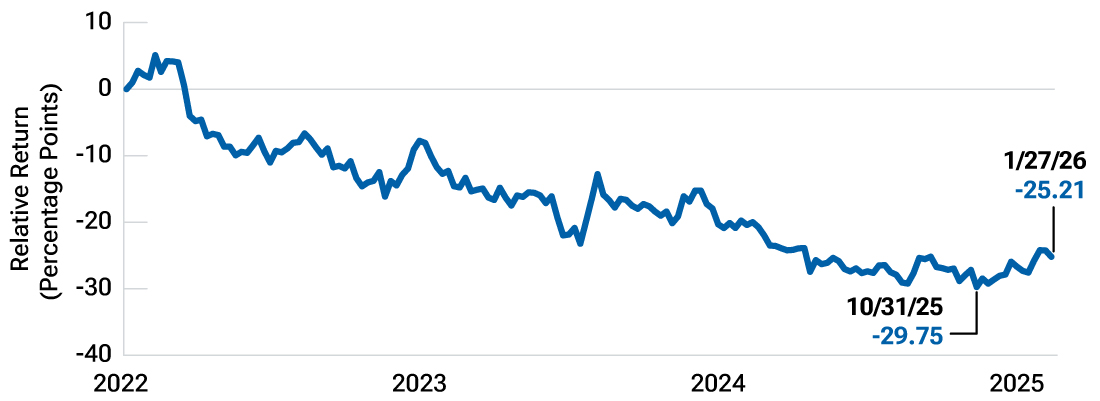
From December 31, 2022, through October 31, 2025, the S&P SmallCap 600 Index underperformed the S&P 500 Index by almost 30 percentage points on a cumulative basis.
That trend changed abruptly in late 2025. From the end of October through January 27 of this year, small-caps returned 8.95%, while large-caps gained just 2.33%.
As a result, the cumulative small-cap underperformance since the end of 2022 narrowed to roughly 25 percentage points. This sudden shift has understandably drawn investor attention.
An Earnings-Driven Pivot
Importantly, the small-cap rebound has not been driven by sentiment alone. Beneath the surface, fundamentals have also turned.
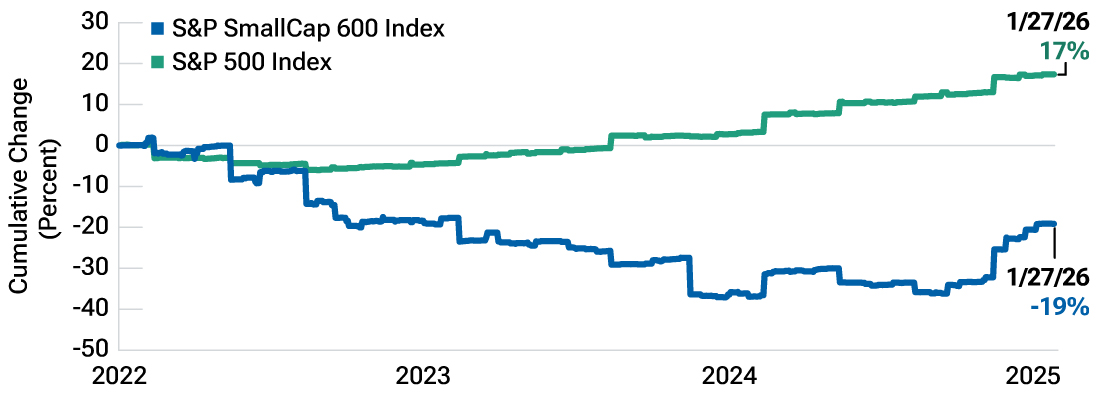
After falling sharply for almost three years, small-cap earnings began to rapidly improve in late 2025. While trailing 12-month earnings for the S&P 600 fell 36% from the end of 2022 through September 19, 2025, they rebounded 27% through January 27, 2026, leaving them only 19% lower than their 2022 peak.
This earnings inflection represents a meaningful shift from the past several years, when deteriorating fundamentals were a persistent headwind for small-cap performance.
Why Have Earnings Improved?
Several forces now appear to be working in small-caps’ favor.
First, Federal Reserve rate cuts have resumed. The Fed resumed cutting interest rates in September, easing pressure on rate-sensitive businesses. Small-cap companies tend to be more highly leveraged than large-cap firms and also carry a greater share of short-term and floating rate debt. So, they tend to benefit disproportionately when the Fed eases.
Second, tariff uncertainty has faded. As trade policy risks have receded, both consumers and businesses have become more confident about spending and investment decisions. Many smaller companies are more directly exposed to trade flows, and their revenues have begun to recover. A weaker U.S. dollar also has provided an additional tailwind for small-cap firms with foreign currency revenues.
Third, the regional banking environment has improved. A more normalized yield curve, signs of regulatory easing, solid credit quality, and improving loan demand all have helped to stabilize regional banks. Smaller companies rely more heavily on regional banks for their financing than large multinational firms do, so improving bank fundamentals can directly support small-cap business activity. Regional banks themselves also represent a meaningful share of the U.S. small-cap universe. As conditions improve for these institutions it can provide a direct tailwind for small-cap earnings and performance.
Fourth, AI benefits are beginning to broaden. While the early stages of the AI build-out primarily favored large-cap technology companies, we are increasingly seeing demand spill over to smaller firms. Some small-cap companies are benefiting directly from AI-related infrastructure spending, while others are seeing productivity gains from implementing AI within their own business processes.
Finally, fiscal stimulus is beginning to provide support. The recently enacted One Big Beautiful Act has helped ignite economic activity, particularly through increased government spending and incentives for domestic investment. While the near-term impact appears modest, the effects are likely to become more pronounced as we move further into 2026, providing an additional tailwind for small-cap earnings.
Conclusion
After nearly three years of poor relative performance, there is now clear evidence that U.S. small-cap stocks are experiencing a renaissance. Performance has improved and, more importantly, earnings growth has pivoted in a supportive direction.
In anticipation of this shift, our Asset Allocation Committee has maintained an overweight position in U.S. small-cap stocks relative to U.S. large-cap stocks—and we have gradually increased that overweight over the past several months. We believe an improving fundamental backdrop provides a durable foundation for small-cap performance going forward.
Outside of the United States, this is intended for investment professional use only. Not for further distribution.
Small‑cap stocks in the U.S. market have staged a notable comeback in recent months, marking a sharp reversal after a prolonged period of underperformance. Since October 2025, small‑caps have outperformed large‑caps in a meaningful way, raising an important question for investors: Is this just a short‑term bounce or something more durable?
For nearly three years, U.S. small‑cap stocks steadily lost ground relative to U.S. large‑caps. From December 31, 2022, through October 31, 2025, the S&P SmallCap 600 Index underperformed the S&P 500 Index by almost 30 percentage points on a cumulative basis. That trend changed abruptly in late 2025. From the end of October through January 27 of this year, small‑caps returned 8.95%, while large‑caps gained just 2.33%.
As a result, the cumulative underperformance since the end of 2022 narrowed to roughly 25 percentage points (Figure 1). This sudden shift has understandably drawn investor attention.
A small‑cap renaissance?
(Fig. 1) Cumulative total returns on the S&P SmallCap 600 Index relative to the S&P 500 Index
December 31, 2022, through January 27, 2026.
Past performance is not a guarantee or a reliable indicator of future results.
Sources: T. Rowe Price analysis using data from FactSet Research Systems Inc. All rights reserved. FTSE Russell. Visit troweprice.com/marketdata for additional legal notices and disclaimers.
close
An earnings‑driven pivot
Importantly, the small‑cap rebound has not been driven by sentiment alone. Beneath the surface, fundamentals also have turned.
After falling sharply for almost three years, small‑cap earnings began to rapidly improve in late 2025. While trailing 12‑month earnings for the S&P 600 fell 36% from the end of 2022 through September 19, 2025, they rebounded 27% through January 27, 2026, leaving them only 19% lower than their 2022 peak (Figure 2).
Small‑cap earnings growth has rebounded sharply
(Fig. 2) Cumulative change in trailing 12‑month earnings per share
December 31, 2022, to January 27, 2026.
Past performance is not a guarantee or a reliable indicator of future results.
Sources: T. Rowe Price analysis using data from FactSet Research Systems Inc. All rights reserved. FTSE Russell. Visit troweprice.com/marketdata for additional legal notices and disclaimers.
close
This earnings inflection represents a meaningful shift from the past several years, when deteriorating fundamentals were a persistent headwind for small‑cap performance. Several forces now appear to be working in small‑caps’ favor.
- Federal Reserve rate cuts have resumed. The Fed resumed cutting interest rates in September, easing pressure on rate‑sensitive businesses. Small‑cap companies tend to be more highly leveraged than large‑cap firms and also carry a greater share of short‑term and floating rate debt. So, they tend to benefit disproportionately when the Fed eases.
- Tariff uncertainty has faded. As trade policy risks have receded, both consumers and businesses have become more confident about spending and investment decisions. Many smaller companies are more directly exposed to trade flows, and their revenues have begun to recover. A weaker U.S. dollar also has provided an additional tailwind for small‑cap firms with foreign currency revenues.
- The regional banking environment has improved. A more normalized yield curve, signs of regulatory easing, solid credit quality, and improving loan demand all have helped to stabilize regional banks. Smaller companies rely more heavily on regional banks for their financing than large multinational firms do, so improving bank fundamentals can directly support small‑cap business activity. Regional banks themselves also represent a meaningful share of the U.S. small‑cap universe. As conditions improve for these institutions it can provide a direct tailwind for small‑cap earnings and performance.
- AI benefits are beginning to broaden. While the early stages of the artificial intelligence (AI) build‑out primarily favored large‑cap technology companies, we increasingly are seeing demand spill over to smaller firms. Some small‑cap companies are benefiting directly from AI‑related infrastructure spending, while others are seeing productivity gains from implementing AI within their own business processes.
- Fiscal stimulus is beginning to provide support. The recently enacted One Big Beautiful Bill Act has helped ignite economic activity, particularly through increased government spending and incentives for domestic investment. While the near‑term impact appears modest, the effects are likely to become more pronounced as we move further into 2026, providing an additional tailwind for small‑cap earnings.
Conclusion
After nearly three years of poor relative performance, there is now clear evidence that U.S. small‑cap stocks are experiencing a renaissance. Performance has improved and, more importantly, earnings growth has pivoted in a supportive direction.
In anticipation of this shift, our Asset Allocation Committee has maintained an overweight position in U.S. small‑cap stocks relative to U.S. large‑caps—and we have gradually increased that overweight over the past several months. We believe an improving fundamental backdrop provides a durable foundation for small‑cap performance going forward.
 Timothy C. Murray, CFA
Capital Markets Strategist
Timothy C. Murray, CFA
Capital Markets Strategist
Experience you can act on.
See how our approach to planning and investing can help guide your progress toward achieving your financial goals.
Risks: Small‑cap stocks have generally been more volatile in price than the large‑cap stocks.
Additional Disclosure
For U.S. investors, visit troweprice.com/glossary for definitions of financial terms.
Important Information
Outside of the United States, this is intended for investment professional use only. Not for further distribution.
This material is being furnished for informational and/or marketing purposes only and does not constitute an offer, recommendation, advice, or solicitation to sell or buy any security.
Prospective investors should seek independent legal, financial and tax advice before making any investment decision. T. Rowe Price group of companies including T. Rowe Price Associates, Inc. and/or its affiliates receive revenue from T. Rowe Price investment products and services.
Past performance is not a guarantee or a reliable indicator of future results. All investments involve risk, including possible loss of principal.
Information presented has been obtained from sources believed to be reliable, however, we cannot guarantee the accuracy or completeness. The views contained herein are those of the author(s), are as of February 2026, are subject to change, and may differ from the views of other T. Rowe Price Group companies and/or associates. Under no circumstances should the material, in whole or in part, be copied or redistributed without consent from T. Rowe Price.
All charts and tables are shown for illustrative purposes only. Actual future outcomes may differ materially from any estimates or forward‑looking statements provided.
The material is not intended for use by persons in jurisdictions which prohibit or restrict the distribution of the material and in certain countries the material is provided upon specific request.
USA—Issued in the USA by T. Rowe Price Investment Services, Inc., distributor and T. Rowe Price Associates, Inc., investment adviser, 1307 Point Street, Baltimore, MD 21231, which are regulated by the Financial Industry Regulatory Authority and the U.S. Securities and Exchange Commission, respectively.
© 2026 T. Rowe Price. All Rights Reserved. T. Rowe Price, INVEST WITH CONFIDENCE, the Bighorn Sheep design, and related indicators (see troweprice.com/ip) are trademarks of T. Rowe Price Group, Inc. All other trademarks are the property of their respective owners. Use does not imply endorsement, sponsorship, or affiliation of T. Rowe Price with any of the trademark owners.
202602‑5164890