

Choose your location
Ireland
English
Belgium
Denmark
Estonia
Finland
France
Iceland
Ireland
Latvia
Lithuania
Luxembourg
Netherlands
Norway
Portugal
Sweden
United Kingdom
 23 November 2026
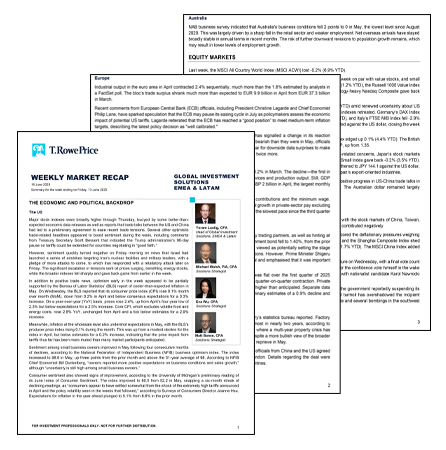
Weekly Market Recap
Our Global Investment Solutions team summarise the week's key market events and developments — with insights to support your client conversations and decision-making.
Key resources
Weekly Market article


Weekly Market data

Economic and political backdrop
The UK
Headline inflation accelerated to 3.6% in October from 3.5% in September, driven partly by higher transport and fuel costs, but came in slightly below the 3.7% consensus. Core inflation held at 2.8% and services inflation at 3.7%, leading investors to trim bets on a back-to-back Bank of England (BoE) rate increase in December. Separately, retail sales volumes rose 0.7% in October after a revised 0.6% decline in September, helped by stronger supermarket and non-food store sales. The mixed data highlight the challenge for policymakers in balancing stubborn inflation against the growth outlook.
The US
Minutes from the Federal Reserve’s (Fed) October policy meeting, released on Wednesday, indicated that almost all participants believed additional rate increases would likely be appropriate to bring inflation back towards the 2% target. Several Fed officials kept a hawkish tone during the week, including Governor Christopher Waller, who reiterated his concerns about inflation and his view that a 50bps increase in December could be appropriate.
October retail sales rose 0.2% month-on-month (MoM), down from 0.8% in September and broadly in line with consensus. Control group sales, which exclude several volatile categories and feed into gross domestic product (GDP) calculations, rose a stronger-than-expected 0.6%, suggesting consumer spending remains resilient. The University of Michigan’s consumer sentiment index rose 7.3% to 51.5 in November, led by substantial post-election gains in expected business conditions, while one-year inflation expectations fell a full percentage point to 3.7%.
Housing data were mixed. The National Association of Home Builders’ Housing Market Index fell to a 14-year low of 25 in November, weighed down by high mortgage rates, cost pressures and labour shortages, and pending home sales fell 4.7% in October, against expectations of a 1.8% decline. Housing starts, by contrast, rose 9.9% to a seasonally adjusted annual rate of 1.31 million, ahead of estimates of around 1.27 million. Elsewhere, the Philadelphia Fed manufacturing index fell sharply to 6.3 in November from 20.9, and initial jobless claims edged up to 203,000.
Europe
Final Eurostat data confirmed that eurozone inflation rose to 4.0% year-on-year (YoY) in October from 3.8% in September, while core inflation, which excludes energy, food, alcohol and tobacco, was revised up to 2.6% from a preliminary 2.5%, pointing to persistent underlying price pressures. The data reinforced expectations that the European Central Bank (ECB) will raise rates again in December. ECB policymakers also highlighted financial stability risks from elevated equity valuations, fiscal pressures and geopolitical uncertainty.
Investor sentiment nonetheless improved. The ZEW economic sentiment index for Germany rose to 35.6 in November from 28.1, well above the 29.0 expected, and the eurozone index climbed to 26.5 from 18.5, although assessments of current conditions remained weak. Brent crude fell 3.4% to around USD 93 per barrel as the risk-off mood weighed on demand expectations.
China
The US Commerce Department announced new rules requiring licences for certain shipments of advanced AI chips to overseas data centres that provide substantial computing power to specified Chinese entities. Separately, the Financial Times reported that Taiwan Semiconductor Manufacturing Company (TSMC) and Samsung Electronics had suspended some chip shipments to Chinese customers pending US licences, while Reuters reported that TSMC was halting certain advanced-node manufacturing orders for affected Chinese chip designers. The developments added to uncertainty over China’s access to advanced semiconductors.
Economic activity weakened more than expected in October. Industrial production growth slowed to 4.8% YoY from 5.5% in September, below the 5.3% consensus, and retail sales rose just 0.4%, down from 1.1% and half the 0.8% expected. Fixed-asset investment contracted 8.1% YoY in the first ten months of the year, compared with a 7.2% decline in January to September, with property development investment down 21.6%. Continued weakness in consumption and investment contrasted with resilience in high-tech manufacturing, reinforcing expectations of further policy support.
On Thursday, President Xi Jinping hosted US President Donald Trump and Russian President Vladimir Putin in Shenzhen, alongside the Asia-Pacific Economic Cooperation (APEC) summit, in the first meeting of the three leaders.
Japan
The yen strengthened to JPY 158.6 against the US dollar on Friday from JPY 159.7 at the end of the prior week, as the equity sell-off drove safe-haven demand and Japanese authorities issued firm verbal warnings against excessive depreciation. Gains were limited, however, as hawkish Fed comments supported the dollar. With the yen still close to the previous week’s level, there was some concern that another round of intervention could trigger profit-taking in long-yen positions and prove counterproductive.
The yield on the 10-year Japanese government bond fell to 2.79% from 2.87%, marking a fourth consecutive decline as safe-haven demand outweighed expectations of further Bank of Japan (BoJ) tightening. Governor Kazuo Ueda said on Thursday that financial conditions remained accommodative and that the BoJ should keep raising rates, describing the recent slowdown in consumption as temporary.
Consumer prices rose 2.3% YoY in October, up from 2.1% in September, while core inflation, which excludes fresh food, edged up to 2.2% from 2.1%, slightly below the 2.3% consensus. Third-quarter GDP unexpectedly contracted at an annualised rate of 0.1%, against expectations of around 0.2% growth, as private consumption declined. In contrast, exports rose 20.5% YoY in October, above the 20.0% consensus, to a record high.
Australia
Wages rose 1.1% quarter-on-quarter (QoQ) in the third quarter, above consensus and the strongest quarterly increase since December 2023. Private sector wages rose 1.0%, while public sector wages increased 1.3%, supported by state government agreements. Employment fell by 43,500 in October, well below expectations of a 30,000 increase, driven mainly by part-time jobs (-40,600). The unemployment rate rose to 4.86% from 4.74%, its highest level since October 2021, and the participation rate fell to 66.59% from 66.78%.
Canada
Softer-than-expected inflation data dominated the week. The October consumer price index (CPI) held at 3.1% YoY, below the 3.2% consensus and unchanged from September, while core measures also surprised to the downside: CPI-trim fell to 1.8% (consensus 1.9%), and the average of the trim and median measures slipped to 1.9% from 2.0%. The data materially shifted expectations for the Bank of Canada’s (BoC) 9 December meeting, with overnight index swaps implying roughly a 50% probability of a further 25bps increase and economists describing the case for a December move as “increasingly challenging”.
Markets
Equity markets
Last week, the MSCI All Country World Index (MSCI ACWI) lost -8.1% (2.3% YTD).
The S&P 500 Index fell -8.6% (2.0% YTD), its worst week since April 2025, closing in correction territory, as concerns about AI-related investments and expectations of tighter Fed policy weighed on sentiment. All 11 sectors declined, with information technology and communication services posting the steepest losses, while consumer staples and utilities held up best.
Value stocks held up better than growth stocks. The Russell 1000 Growth Index returned -11.4% (-13.6% YTD), the Russell 1000 Value Index -6.1% (18.9% YTD), and the Russell 2000 Index -7.4% (5.3% YTD). The technology-heavy Nasdaq Composite fell -10.0% (-2.2% YTD), erasing its gains for the year.
Technology and AI-related segments faced sustained selling pressure amid concerns about elevated valuations, the financing of infrastructure investment, and tighter restrictions on advanced semiconductor exports. Nvidia shares fell sharply over the week, as strong quarterly results failed to ease broader concerns about AI investment and uncertainty over the company’s leadership following Jensen Huang’s departure; on Friday, the shares dropped 14% following reports of a Securities and Exchange Commission (SEC) probe. The highly anticipated initial public offering (IPO) of AI lab Anthropic, which raised a record USD 81 billion, did little to calm fears around the AI trade. The shares opened well above their offering price on Thursday but then pulled back and continued to slide on Friday, alongside the broad sell-off in technology stocks. The VIX volatility index jumped to 35.9 from 19.3.
In Europe, the MSCI Europe ex-UK Index lost -5.9% (7.4% YTD), its steepest weekly decline since March. Among major stock indexes, Germany’s DAX Index declined -7.3% (1.3% YTD), France’s CAC 40 Index dropped -5.3% (0.2% YTD), and Italy’s FTSE MIB Index fell -6.1% (11.8% YTD). Switzerland’s SMI lost -3.5% (13.2% YTD). The euro weakened by 0.5% against the US dollar, closing the week at USD 1.10 per EUR.
Technology, industrials, miners and banks were among the hardest hit, while healthcare and food and beverage names fared better. European technology shares came under pressure as investors reassessed valuations and growth expectations after US market volatility, with semiconductor companies such as ASML and Infineon Technologies hit by concerns about tighter US chip export restrictions and the sustainability of AI-related spending. Broader risk aversion weighed on industrial, commodity-related and other cyclical businesses.
The FTSE 100 Index in the UK lost -5.0% (7.3% YTD), while the FTSE 250 Index of smaller companies fell -4.6% (8.4% YTD). The British pound weakened by 1.0% against the US dollar, closing the week at USD 1.31 per GBP.
In Japan, the TOPIX Index fell -6.8% (10.1% YTD), and the TOPIX Small Index dropped -6.5% (8.9% YTD). The Nikkei 225 Index declined -7.7% as the unwinding of the AI trade intensified. Selling accelerated on Friday, when the Nikkei fell to its lowest close since April, and more than 90% of stocks on the Tokyo Stock Exchange Prime Market declined. Anthropic’s record IPO failed to restore confidence amid concerns over elevated AI valuations and financing risks, while leadership turmoil at Nvidia added to the pressure. Technology and AI-related shares led the declines.
In Australia, the ASX 200 Index dropped -5.4% (2.8% YTD), its worst weekly performance since June 2022. All 11 sectors declined, with materials hit hardest as copper prices slumped and the global AI trade unwound sharply. Australian government bond yields fell meaningfully, driven by the weaker-than-expected employment data and a shift in rate expectations for the Reserve Bank of Australia (RBA) towards cuts. The Australian dollar weakened by 2.1% against the US dollar.
In Canada, the S&P/TSX Composite fell -8.0% (6.7% YTD).
Emerging markets and other markets
The MSCI Emerging Markets Index ended the week down -8.4% (3.2% YTD). Taiwan, South Korea and China weighed on performance, while India contributed positively.
In China, the CSI 300 Index, the main onshore benchmark, fell -1.5% (-12.7% YTD), while the Shanghai Composite Index dropped -2.7% (-9.0% YTD). Hong Kong’s benchmark Hang Seng Index lost -5.1% (-10.0% YTD). The MSCI China Index, which primarily comprises offshore-listed stocks, declined -5.3% (-21.3% YTD).
Chinese equities fell as the global sell-off in AI-related shares, tighter US semiconductor export controls and weaker-than-expected October data weighed on sentiment, with losses extending on Friday after Thursday’s sharp retreat in US technology shares. Hong Kong underperformed the mainland as several internet companies reported disappointing results. Tencent fell on Thursday after third-quarter revenue grew 8% YoY but missed expectations, with adjusted operating profit declining amid higher investment in new AI products. On Friday, NetEase and Kuaishou fell sharply after both reported weaker-than-expected third-quarter results.
In Taiwan, the TAIEX plunged -17.5% (26.4% YTD), its worst weekly drop in nearly three decades, as chipmakers sold off. In South Korea, the KOSPI Index lost -7.9% (17.1% YTD). India’s Sensex bucked the trend, rising 2.9% (-0.1% YTD).
Fixed income markets
Last week, the Bloomberg Global Aggregate Index (hedged to USD) returned 0.7% (0.5% YTD), the Bloomberg Global High Yield Index (hedged to USD) lost -1.1% (-0.1% YTD), and the Bloomberg Emerging Markets Hard Currency Aggregate Index declined -0.7% (-2.2% YTD).
US Treasuries generated positive returns as the equity sell-off drove demand for safer assets, pushing yields lower across most maturities despite hawkish Fed signalling, and a well-received midweek auction added support. Investment-grade corporate bonds also advanced, with issuance remaining strong, while high-yield bonds came under pressure from deteriorating risk sentiment and expectations of tighter monetary policy: the yield spread of global high-yield bonds over US Treasuries widened by 56bps to 360bps. Elsewhere, gold fell -8.9% and bitcoin -13.8% as investors reduced risk across asset classes.
Over the week, the 10-year Treasury yield fell by -19bps to 4.95% from 5.14% (up 78bps YTD). The 2-year Treasury yield fell 20bps to 4.65% from 4.84% (up 117bps YTD).
Over the week, the 10-year German Bund yield declined by -7bps to 3.30% from 3.38% (up 45bps YTD). The 10-year UK gilt yield decreased by -10bps to 5.24% from 5.33% (up 76bps YTD).
Our Weekly Market Recap is designed to keep you updated on the previous week's major events and developments. It includes:
- Concise summaries of key market events and trends
- Insights and analysis from our expert team
- Market perspectives to aid your client conversations
Global Investment Solutions Team
 Yoram Lustig, CFA, PRM™
Head, Global Investment Solutions, EMEA
Yoram Lustig is the head of Global Investment Solutions, EMEA, and a portfolio manager in the Multi-Asset Division. He also is the chair of the UK and European Investment Committees and a member of the Multi-Asset Steering Committee.
 Michael Walsh, CFA, CAIA®, FIA
Solutions Strategist
Michael Walsh is a London-based solutions strategist on the Multi-Asset Solutions team for EMEA. He is a vice president of T. Rowe Price Group, Inc., and T. Rowe Price International Ltd.
 Eva Wu, CFA
Associate Solutions Strategist
Eva Wu is an associate solutions strategist on the Multi-Asset Solutions team in the Multi-Asset Division. She is a vice president of T. Rowe Price International Ltd.
 Matt Bance, CFA
Solutions Strategist
Matt Bance is a solutions strategist and portfolio manager on the Multi-Asset Solutions team for the Europe, Middle East, and Africa region. He is a vice president of T. Rowe Price International Ltd.
202610 - 6054154
Notes
All data and index returns cited herein are the property of their respective owners, and provided to T. Rowe Price under license via data sources including Bloomberg Finance L.P., FactSet & RIMES, MSCI, FTSE and S&P. All rights reserved. T. Rowe Price seeks to cite data from sources it deems to be accurate, but it cannot guarantee the accuracy of any data cited herein. Neither T. Rowe Price, nor any of its third-party data vendors make any express or implied warranties or representations and shall have no liability whatsoever with respect to any data and index returns contained herein. The data and index returns cited herein may not be further redistributed or used as the basis for other indices, as a benchmark or as the basis for any other financial product.
The specific securities identified and described are for informational purposes only and do not represent recommendations.
CFA® and Chartered Financial Analyst® are registered trademarks owned by CFA Institute.
Important Information
The specific securities identified and described are for informational purposes only and do not represent recommendations.
This material is being furnished for general informational and/or marketing purposes only. The material does not constitute or undertake to give advice of any nature, including fiduciary investment advice, nor is it intended to serve as the primary basis for an investment decision. Prospective investors are recommended to seek independent legal, financial and tax advice before making any investment decision. T. Rowe Price group of companies including T. Rowe Price Associates, Inc. and/or its affiliates receive revenue from T. Rowe Price investment products and services. Past performance is not a guarantee or a reliable indicator of future results. The value of an investment and any income from it can go down as well as up. Investors may get back less than the amount invested.
The material does not constitute a distribution, an offer, an invitation, a personal or general recommendation or solicitation to sell or buy any securities in any jurisdiction or to conduct any particular investment activity. The material has not been reviewed by any regulatory authority in any jurisdiction.Information and opinions presented have been obtained or derived from sources believed to be reliable and current; however, we cannot guarantee the sources’ accuracy or completeness. There is no guarantee that any forecasts made will come to pass. The views contained herein are as of the date written and are subject to change without notice; these views may differ from those of other T. Rowe Price group companies and/or associates. Under no circumstances should the material, in whole or in part, be copied or redistributed without consent from T. Rowe Price.The material is not intended for use by persons in jurisdictions which prohibit or restrict the distribution of the material and in certain countries the material is provided upon specific request. It is not intended for distribution to retail investors in any jurisdiction.
Information and opinions presented have been obtained or derived from sources believed to be reliable and current; however, we cannot guarantee the sources’ accuracy or completeness. There is no guarantee that any forecasts made will come to pass. The views contained herein are as of the date written and are subject to change without notice; these views may differ from those of other T. Rowe Price group companies and/or associates. Under no circumstances should the material, in whole or in part, be copied or redistributed without consent from T. Rowe Price.
The material is not intended for use by persons in jurisdictions which prohibit or restrict the distribution of the material and in certain countries the material is provided upon specific request. It is not intended for distribution to retail investors in any jurisdiction.