
Why company size matters in direct lending
Enjoy the flexibility to build additional savings for you and your family’s financial future with full access to your investments anytime.

From the Field | Q2 2026
Summary
- OHA believes lending to larger companies mitigates downside risk for credit investors and leads to better risk-adjusted returns
- Features of larger borrowers such as greater scale, better pricing power, more experienced management and deeper financial resources combine to better position borrowers to successfully compete in their sectors and contribute to better financial outcomes
- As a result, larger companies have exhibited higher margins and stronger resilience through multiple market cycles, which position these companies to better service their debt and decrease prevalence of defaults
 Eric Muller
Portfolio Manager and Partner, Chief Executive Officer – Business Development Companies
Eric Muller
Portfolio Manager and Partner, Chief Executive Officer – Business Development Companies
 Thomas S. Wong
Portfolio Manager and Partner
Thomas S. Wong
Portfolio Manager and Partner
The private credit market has grown significantly in recent years as borrowers have found sourcing capital from private lenders increasingly attractive and as investors search for higher income. Direct lending, through which companies borrow from a smaller group of lenders without a bank intermediary, now represents the largest portion (44%) of the $2.1trillion private creditmarket.1
Not all direct lending is created equal, however. The size of the borrower may significantly impact the potential risk and ultimate returns for end investors, with smaller borrowers more vulnerable to default in economic slowdowns. By contrast, larger corporate borrowers—often defined as those with earnings before interest, tax, depreciation, and amortization (EBITDA) in excess of $50million—have advantageous features that better position them to avoid financial stress and retain their value for lenders in challengingenvironments.
Larger borrowers have also benefited in recent years from the growth of private markets, which are now robust enough to provide complete, scaled solutions to larger borrowers. These solutions offer borrowers several benefits, including greater customization of loan structures, certainty of execution and terms, direct partnership with lenders, and access to financing through volatile markets.
Typical features of larger borrowers
Several features may better position larger companies to service debt obligations through challenging market environments and better protect the investments made by lenders. Theseadvantages include:
Scale/breadth
Larger borrowers typically have greater market share and more diversified revenue streams, which may enhance their resilience to economic slowdowns, high inflation, and external shocks such as the onset of the COVID-19 pandemic.

Pricing power
Through their size, larger borrowers typically are better positioned to negotiate with customers and suppliers to implement price increases and otherwise manage costs through various economic cycles.

Experienced management
Larger borrowers typically have more experienced management teams that are better positioned to execute on strategic and financial objectives and manage through operating and market challenges.

Economies of scale
As borrowers grow in size, they often benefit from economies of scale that may boost operating margins and enhance cash flows and profits. These efficiencies may enhance the credit worthiness of a larger borrower.

Operational flexibility
Larger borrowers may have a greater ability to adapt and manage their supply chains to enhance and sustain operations through potential disruptions along with typically greater resources for research and development.

Financial resources
Larger companies are more likely to have access to deeper and more diversified financial resources that better position them to operate as market conditions evolve.

We believe these advantages combine to better position larger companies to service debt and enhance their value for lenders. Over the next few pages, we review several metrics—including higher EBITDA margins, stronger EBITDA resilience, and lower default histories—that evidence the relative strength of larger companies.
Higher EBITDA margins
Recent data points for private debt issuance show that larger companies consistently have higher EBITDA margins compared with smaller companies.2 As demonstrated in Figure 1, EBITDA margins for larger companies have been 1.2x to 1.6x higher than smaller companies that generate less than $50million in EBITDA annually. Businesses with higher EBITDA margins generally have more efficient cost structures and are more cash generative. As a result, we believe these companies are better able to service debt and are likely to benefit from greater financial stability and the ability to withstand potential economic headwinds.
Fig. 1: EBITDA Margin3
1Q 2019 – 3Q 2024

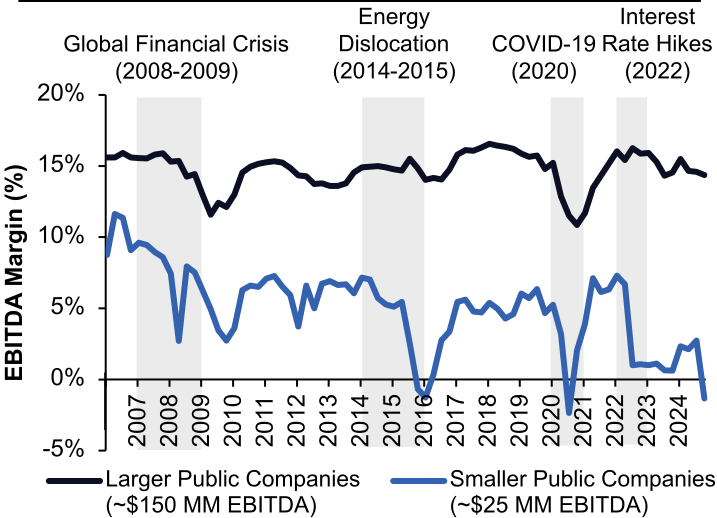
For a longer historical perspective across a broader range of companies, considering the financial performance of equity index constituents is helpful. In the following analysis, Larger Public Companies reflects constituents of the Russell Midcap Index which have a median EBITDA of approximately $150million.4 Smaller Public Companies reflects companies in the Russell Microcap Index which have a median EBITDA of approximately $25million per year.5 Figure2 shows that larger companies have generated consistently higher margins compared with smaller companies. Between 2006 and 4Q 2024 margins for larger public companies averaged 14.7% vs. 5.0% for smaller public companies. These stronger margins we believe are evidence for superior market shares, more control over supply chains, better pricing power, and economies of scale for larger companies. Larger company margins have also been more stable over time, including through periods of market turbulence.
Fig. 2: EBITDA Margin6
1Q 2006 – 4Q 2024
Stronger EBITDA resilience
Larger companies are typically better positioned to withstand challenging economic and market conditions. In each of the four key periods of economic dislocation over the past two decades, the EBITDA declines of smaller companies have significantly exceeded those of larger companies (Figure 3) in the same equity indices referenced above. The cash flows of smaller companies were hit particularly hard during the energy dislocation in 2014 to 2015 and the COVID-19 pandemic. With quarterly EBITDA declines greater than 100% during these two economic shocks, smaller companies went cash flow negative compared with larger companies which remained cash flow positive across dislocations, illustrated by an EBITDA decline of less than 100%. This strongly indicates there is generally lower potential downside from lending to larger companies.
Fig. 3: EBITDA Performance During Downturns6
Largest % Quarterly EBITDA Decline7

Lower loan default rates
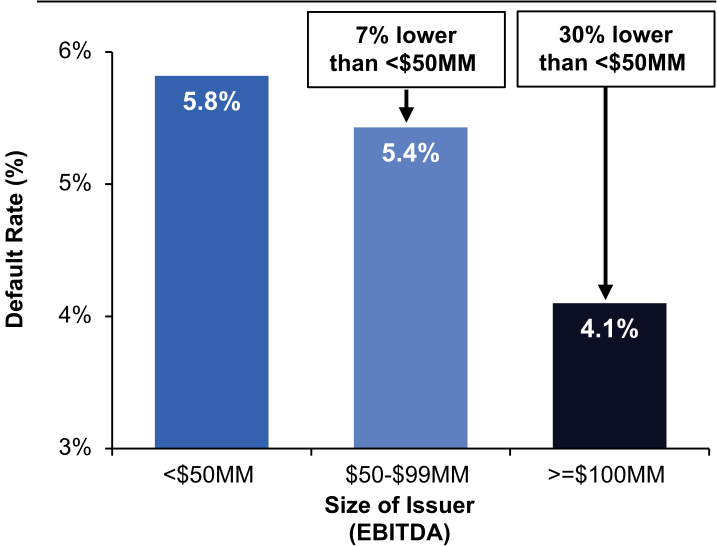
Default losses are usually a significant driver of return and differentiation to investors in private credit and avoidance of credit losses is an essential objective of all lenders. Since 1995 data suggests that larger companies have enjoyed a meaningful advantage versus smaller companies and produced meaningfully lower defaults. Figure 4 shows that through multiple credit cycles borrowers with greater than $100 MM in EBITDA had a 30% lower default rate compared with smaller borrowers between 1995 and 4Q 2024. We believe these long-term results demonstrate that larger companies have better navigated through market cycles than smaller companies and better protected lenders.
Fig. 4: Loan Defaults by Borrower Size8, 9
(1Q95 – 4Q24)
Lower private loan default rates
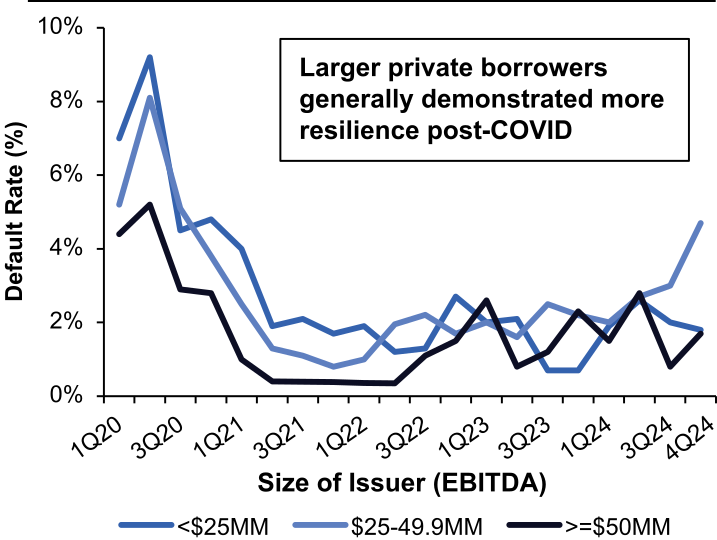
As private credit continues to mature as an asset class, better and more granular default data for private financings is now available. In private credit, larger borrowers also consistently have demonstrated lower default rates post-pandemic as interest rates and inflation rose (Figure 5). Since 2020, including the onset of the COVID-19 pandemic and ensuing economic and market volatility, default rates for larger borrowers averaged 25% less than defaults for borrowers with less than $25 MM in EBITDA. We believe these lower default rates for larger borrowers are indicative of the better credit risks these companies represent and, consequently, also indicative of the better investment opportunity available to investors in private credit.
Fig. 5:Private Credit Defaults by Borrower Size10, 11
(1Q20 – 4Q24)
Conclusion
Investing in direct lending that focuses on larger companies could be advantageous compared to smaller companies. Historical performance across multiple credit cycles suggests that larger companies would be less susceptible to default through challenging market environments driven by stronger and more resilient cash flow profiles compared to smaller companies.
Past performance is not indicative of future results. Please refer to the Appendix for additional endnotes.

- Summer 2024
- Video
Industry spotlight: software credit
Read more to learn why OHA believes software companies can offer attractive all-weather investment profiles and inherent diversification as an “industry of industries”.

- Spring 2024
Credit market observations
Delve into OHA's analysis of credit markets, covering a wide range of assets including private, liquid, and structured credit.