
Private credit’s persistent premium

Q2 2025
Key insights
- Private credit historically offers a spread premium that persists through various base interest rate environments
- The private credit spread premium over liquid credit has ranged from 150 to 300 basis points (1.5-3%) over time
- This premium is composed principally of an “illiquidity premium” and “complexity premium”
- Private credit investors can capture the spread premium in exchange for committing capital longer term and providing lenders valuable execution and structural benefits
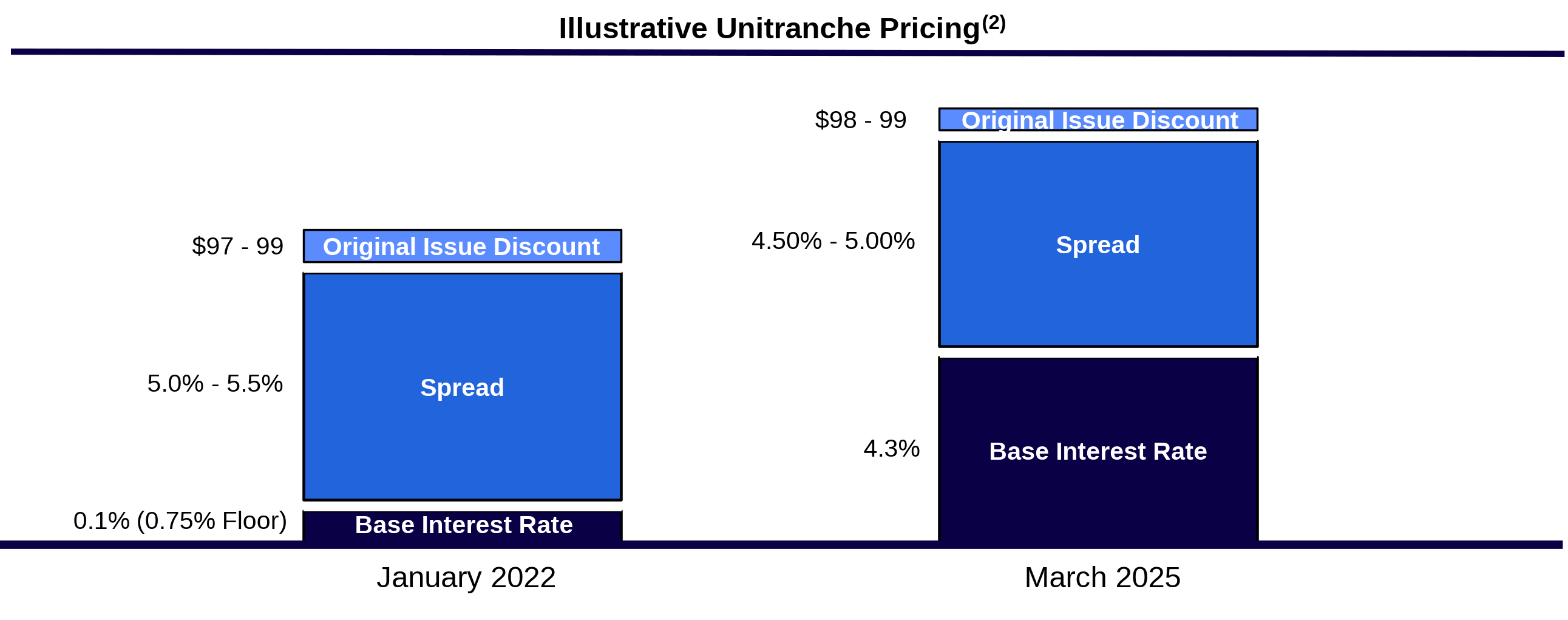
Private credit yields have three components—a floating base interest rate, coupon spread and original issue discount, as shown in the figure below. As a floating rate asset class, private credit yields move with the base interest rate, significantly reducing the volatility associated with longer term fixed income. In September, the Federal Reserve reduced its Fed Funds rate by 50 basis points to commence an expected monetary easing cycle after over two years of interest rate increases, the first such reduction in four years.(1) Given the potential for further declines in interest rates, OHA is frequently asked for its outlook on private credit returns in a falling interest rate environment.
Does private credit remain attractive in a falling interest rate environment?
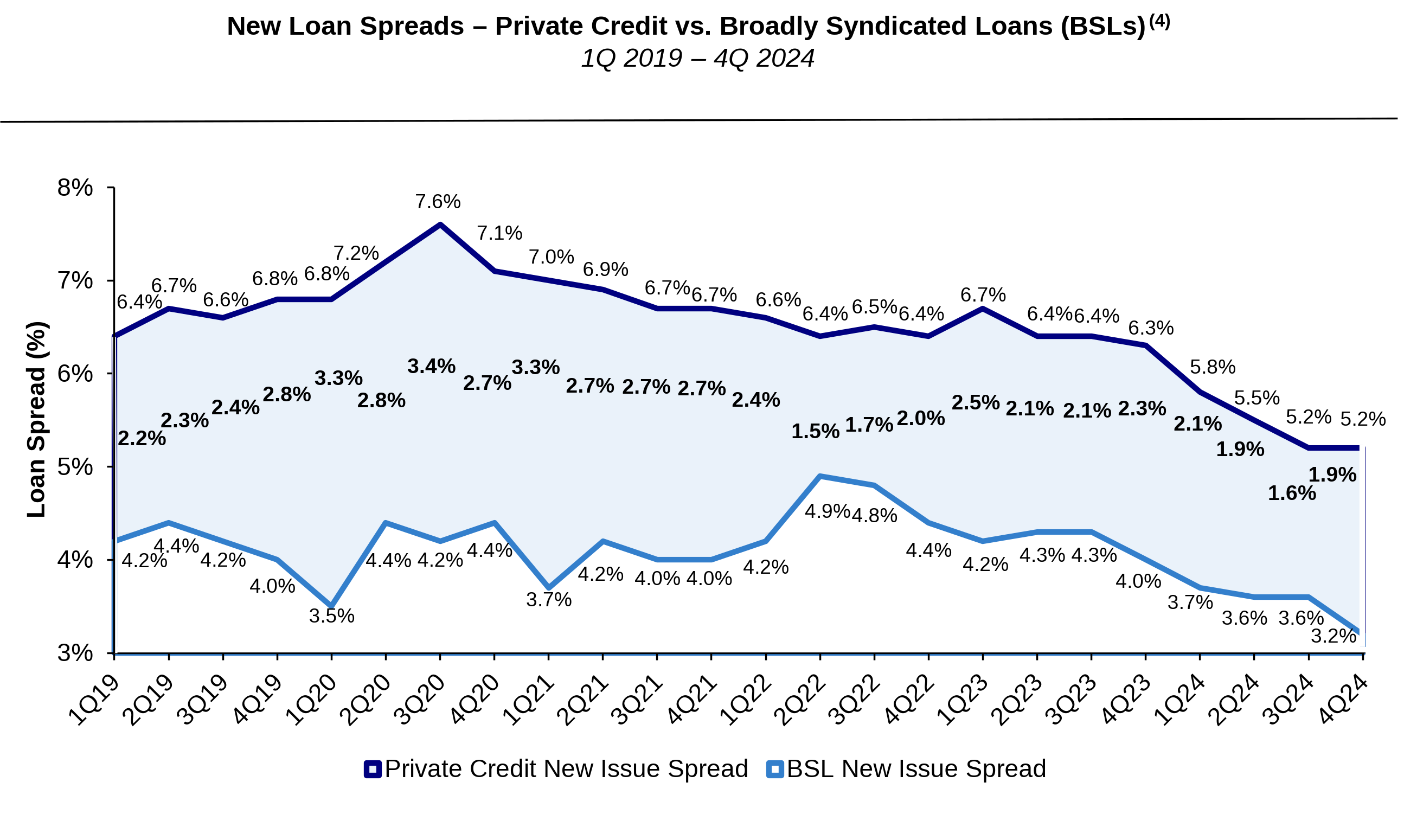
OHA believes that the attractiveness of private credit in a given rate or market environment should be assessed relative to comparable asset classes. The market most commonly compares pricing of private credit in the form of senior direct lending (first lien and unitranches) to broadly syndicated loans (“BSLs”), also known as bank loans or liquid loans, which are also floating rate and senior secured in the capital structure. The below chart shows that private credit has maintained a persistent spread premium over new issuances in the BSL market over time, irrespective of base interest rates. Private credit new issue spreads were 1.5% to 3.4% greater than BSL new issue spreads since 2019.(1) During this time period, base interest rates ranged from 0.0% to 5.3%.(2)
The private credit return premium is principally composed of two parts:
1) An “illiquidity premium” which compensates investors for locking up their capital for a longer period of time.
2) A “complexity premium” which results from the costs borrowers are willing to pay in connection with the many attributes private credit provides as discussed on the next page. These features are typically only available in the private market.
Taken together, the combination of these premia offer an attractive additional return to lenders while at the same time offering borrowers a compelling and feature rich financing alternative.
Why do borrowers choose the private markets?
OHA believes private credit is a more customized financing solution for borrowers compared to traditional syndicated loans. Private credit has accounted for approximately 83% of leveraged buy-outs (LBOs) since 2022.(4) Some of the reasons why private credit has become a preferred form of financing include:
Execution efficiency, simplicity and certainty: Private lenders can move with greater speed and can offer more certain pricing during time sensitive acquisition processes. Syndicated loan processes often have lengthy “road show” sales processes where banks market the loan to prospective buyers and may build in “flex” to increase pricing during the syndication process

Customization: Features and terms not typically available in the public market are made possible in private credit solutions. These include loans with delay draw features where private lenders can commit capital for future company growth

Consistent access to financing: Private markets have proven to be more reliable than traditional capital markets where traditional capital markets may close for business during periods of market turbulence, restricting a borrower’s ability to access capital

Confidentiality: During the often competitive bidding process for an acquisition, there is less risk of transaction details becoming publicly available given the smaller number of financing parties in a private credit transaction

Ratings independence: Private loans typically do not require a public rating from a rating agency and therefore may have greater ability to digest complex transactions. In contrast, syndicated loans are often ratings sensitive and may face difficulty in refinancing in the case of a ratings downgrade

Direct partnership with lenders: Borrowers are incentivized to build long-term, direct relationships with their smaller lender group, reducing the likelihood of activist investors entering the capital structure and lowering mark-to-market(5) volatility of borrower valuations

Streamlined lender coordination: Private lending streamlines operational processes such as ongoing diligence demands and potential future amendments, refinancings, or upsizes to the existing capital structure

Conclusion
OHA believes the benefits of private credit justify a premium price compared to syndicated loans. At the same time, syndicated loans remain the financing source of choice for borrowers seeking lower cost of capital for less complex financing needs, such as refinancings. OHA believes this dynamic reinforces the long-term coexistence of private credit and syndicated loans.
Given the premium afforded by private credit and its durable attractive relative value proposition, OHA believes private credit will remain a compelling borrower and investor solution in a falling rate environment or if interest rate moves prove more volatile as monetary policy adjusts over time.
- Fall 2024
- Video
The 'Magnificent Seven' lender protections
Learn more about the key lender protections that OHA negotiates in its credit agreements to enhance protections for investors.

- Spring 2024
Credit market observations
Delve into OHA's analysis of credit markets, covering a wide range of assets including private, liquid, and structured credit.
Appendix and Endnotes
1) Source: OHA analysis as of September 30, 2026. Illustrative unitranche pricing representative of market pricing. “Base Interest Rates” represents the three-month Secured Overnight Financing Rate (“SOFR”) as of September 30, 2026. Estimated spread and original issue discount has been prepared by OHA to reflect pricing of actual unitranche investments made as of the beginning of 2022 versus the current market. Original Issue Discount is the discount August 31, 2026. Base interest rates represented by the Secured Overnight Finance Rate (SOFR).
2) Source: Bloomberg as of September 30, 2026. Base interest rates represented by the Secured Overnight Finance Rate (SOFR).
3) Past performance is not indicative of future results. Source: KBRA DLD, CreditSights as of August 31, 2026.
4) Source: PitchBook LCD as of June 30, 2026.
5) Mark-to-market refers to the process of valuing assets and liabilities at their current market price, rather than original cost or historical value.
Key Risks and Disclosures
This document is for informational purposes only and does not constitute an offer to sell or a solicitation of an offer to buy any securities or partnership interests. Any investor who subscribes, or proposes to subscribe, for an investment in a fund or separately managed account must be able to bear the risks involved and must meet relevant suitability requirements. Fixed-income securities are subject to credit risk, liquidity risk, call risk, and interest-rate risk. As interest rates rise, bond prices generally fall. Investments in high-yield bonds involve greater risk of price volatility, illiquidity, and default than higher-rated debt securities. International investments can be riskier than U.S. investments due to the adverse effects of currency exchange rates, differences in market structure and liquidity, as well as specific country, regional, and economic developments. Some or all alternative investments may not be suitable for certain investors. No assurance can be given that a fund or separately managed account’s investment objectives will be achieved. Alternative investments are speculative and involve a substantial degree of risk. Opportunities for withdrawal/redemption and transferability of interests are generally restricted, so investors may not have access to capital when it is needed. The use of leverage will magnify the potential for loss on amounts invested. The use of a single advisor applying generally similar trading programs could mean lack of diversification and, consequently, higher risk. The use of leverage and other speculative practices may increase the risk of investment loss or make investment performance volatile. In addition, the fees and expenses charged may be higher than the fees and expenses of other investment alternatives, which will reduce profits. There can be no assurance that an advisor will be able to implement its strategy or avoid incurring any losses.
Diversification cannot assure a profit or protect against loss in a declining market.
Opinions and estimates offered herein constitute the judgment of OHA as of the date this document is provided to you (unless otherwise noted) and are subject to change, as are statements about market trends. All opinions and estimates are based on assumptions, all of which are difficult to predict and many of which are beyond the control of OHA in addition, any calculations used to generate the estimates were not prepared with a view towards public disclosure or compliance with any published guidelines. In preparing this document, OHA has relied upon and assumed, without independent verification, the accuracy and completeness of all information. OHA believes that the information provided herein is reliable; however, it does not warrant its accuracy or completeness.
This document may contain, or may be deemed to contain, forward-looking statements, which are statements other than statements of historical facts. By their nature, forward-looking statements involve risks and uncertainties because they relate to events and depend on circumstances that may or may not occur in the future. The future of investment results of the investments described herein may vary from the results expressed in, or implied by, any forward-looking statements included in this document, possibly to a material degree.
The recipient may contact OHA at (212) 326-1500 to obtain additional information or ask questions about any information, including the methodology used for any calculations and details concerning any of the summary charts or information provided herein.
© 2026 Oak Hill Advisors. All Rights Reserved. OHA is a trademark of Oak Hill Advisors, L.P. All other trademarks shown are the property of their respective owners. Use does not imply endorsement, sponsorship, or affiliation of Oak Hill Advisors with any of the trademark owners.
Important Information
This material is provided for informational purposes only and is not intended to be investment advice or a recommendation to take any particular investment action.
The views contained herein are those of the authors as of July 2024 and are subject to change without notice; these views may differ from those of other T. Rowe Price associates.
This information is not intended to reflect a current or past recommendation concerning investments, investment strategies, or account types, advice of any kind, or a solicitation of an offer to buy or sell any securities or investment services. The opinions and commentary provided do not take into account the investment objectives or financial situation of any particular investor or class of investor. Please consider your own circumstances before making an investment decision.
Past performance is not a reliable indicator of future performance. All investments are subject to market risk, including the possible loss of principal. All charts and tables are shown for illustrative purposes only.
T. Rowe Price Investment Services, Inc. OHA is a T. Rowe Price company.
© 2026 T. Rowe Price. All Rights Reserved. T. ROWE PRICE, INVEST WITH CONFIDENCE, and the Bighorn Sheep design are, collectively and/or apart, trademarks of T. Rowe Price Group, Inc.
202611-6092832