
Why Invest in Real Asset Credit?
Discover how real asset credit can provide diversification, downside protection and attractive risk-adjusted return potential through mission-critical infrastructure investments.

Fall 2026
Summary
Real asset credit includes financing solutions for mission-critical infrastructure assets which are essential to the operation of the broader economy.
These include telecom, energy and transportation assets such as cell towers, power plants, ports, bridges, tunnels, data centers and fiber networks.
Core real asset markets are undergoing a transformational investment cycle (e.g. AI, densification of telecom grids, increasing demand for power, midstream buildout, replacement of aging infrastructure). These large expenditures are creating funding gaps and attractive opportunities for real asset credit.
OHA believes real asset credit offers investment features including low correlation, inflation protection, tangible collateral, contractual cash flows and structural protections which may provide attractive risk-adjusted returns.
 Greg Leveto
Portfolio Manager and Partner, CEO of OFLEX
What is Real Asset Credit?
Historically, real assets have included cell towers, power plants and transportation infrastructure such as ports, bridges and tunnels. Ongoing transformational growth in areas such as data centers, digital grid densification and replacing aging infrastructure are significantly expanding long term capital needs in these markets. These assets are mission critical to the operation of the broader physical and digital economy. OHA considers financing solutions for these types of assets examples of real asset credit.
OHA believes the opportunity set for infrastructure investment is rapidly expanding with an estimated $100+ trillion need for capital over the next decade.(2) Record private equity dry powder and bank retrenchment from infrastructure assets create a significant funding gap for private infrastructure credit to fill.(3)
OHA believes real asset credit offers attractive risk-adjusted returns with downside protection supported by underlying durable cash flows and long-term contracts. Return streams are typically uncorrelated to other asset classes due to limited sensitivity to market and interest rate cycles. Figure 1 shows the low correlation of infrastructure credit compared to other major asset classes.
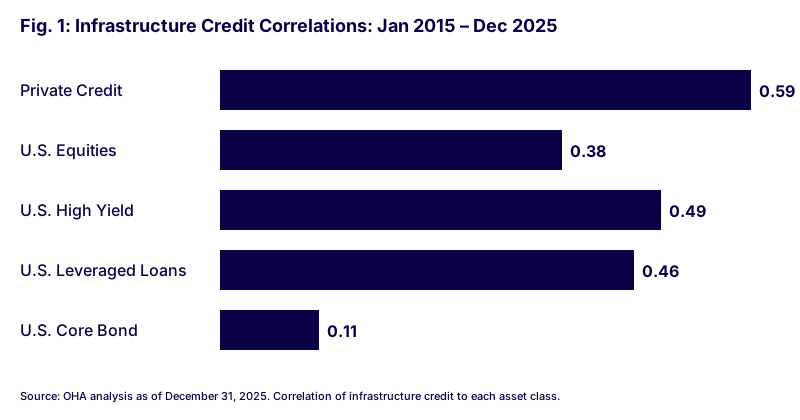
OHA believes an allocation to infrastructure credit may serve as a key portfolio diversifier while capturing attractive risk-adjusted returns for investors.
Typical Features of Real Assets(4)
OHA believes that several features of real asset credit, particularly infrastructure credit, position the asset class to generate attractive risk-adjusted returns that complement existing traditional and alternative asset allocations. OHA seeks to target these investment characteristics when evaluating real asset credit investments.

Low
Correlation
Borrower revenue is often tied to essential public services with inelastic and generally non-cyclical demand. Assets like power plants, cell towers, bridges and tunnels are used regardless of the state of the economy, creating a return stream which can be differentiated from other asset classes, particularly during market downturns.

Inflation
Protection
Infrastructure projects often benefit from explicit contractual protections against inflation, creating the ability to pass-through rising prices to counter-parties and increase revenues over time. Additionally, the infrastructure assets themselves have typically appreciated with inflation. This feature may favorably position infrastructure debt to navigate periods of high inflation, like in 2022 as the economy emerged from COVID-19.

Tangible
Collateral
Real asset credit investments are generally secured by identifiable, hard assets that underpin mission-critical operations and the broader economy. These assets provide a layer of downside protection by increasing the valuation floor of the investment in the event a credit becomes challenged. OHA believes this feature leads to higher recovery rates for real asset credit compared to other credit asset classes.

Contracted
Cash Flows
Real assets typically generate revenue through long-term contracts. These contracts often create barriers to entry while providing strong visibility into future cash flow. This feature may contribute to greater stability of infrastructure investments compared to businesses operating in more competitive environments with more elastic and unpredictable demand.

Structural
Protections
OHA typically targets senior infrastructure financings with an ample equity cushion designed to provide downside protection for investor returns.(5) Additionally, lenders are typically able to negotiate enhanced structural protections compared to other forms of credit since the investment is designed around a specific asset, allowing lenders to exercise more control.
OHA’s Real Asset Investment Philosophy(4)
Real assets credit is a large and evolving asset class offering significant potential for manager differentiation. OHA focuses on customized financing solutions for high-quality real assets in developed markets where it has a competitive edge.
Investments We Seek To Target
High-caliber, well-capitalized owners & developers
with meaningful equity commitments
Developed Markets
North America and Western Europe – creditor-friendly jurisdictions
Large-scale businesses / projects
institutional-quality scale(6)
Proven technologies
no adoption risk
Established management teams
with proven track records
Low correlation to broader economy
essential-service revenues
Investments We Seek To Avoid

- SUMMER 2026
5 Big Investor Questions and Key Takeaways
Explore five key investor questions shaping today’s credit markets, from AI disruption and geopolitical uncertainty to private credit fundamentals, credit risk, and emerging dislocation opportunities.
- Spring 2026
Credit Investor’s Checklist
Nascent technologies
unproven performance or adoption
Emerging markets
jurisdictional & enforcement risks
Complex construction risk
cost, timeline & completion exposure
Consumer risk
credit cards, auto loans, etc.
Forward flow / Asset based financial-style risk
high-velocity origination models
Real Estate
offices, hotels and other vacancy-driven risk
Low
Correlation
Borrower revenue is often tied to essential public services with inelastic and generally non-cyclical demand. Assets like power plants, cell towers, bridges and tunnels are used regardless of the state of the economy, creating a return stream which can be differentiated from other asset classes, particularly during market downturns.
Inflation
Protection
Infrastructure projects often benefit from explicit contractual protections against inflation, creating the ability to pass-through rising prices to counter-parties and increase revenues over time. Additionally, the infrastructure assets themselves have typically appreciated with inflation. This feature may favorably position infrastructure debt to navigate periods of high inflation, like in 2022 as the economy emerged from COVID-19.
Tangible
Collateral
Real asset credit investments are generally secured by identifiable, hard assets that underpin mission-critical operations and the broader economy. These assets provide a layer of downside protection by increasing the valuation floor of the investment in the event a credit becomes challenged. OHA believes this feature leads to higher recovery rates for real asset credit compared to other credit asset classes.
Contracted
Cash Flows
Real assets typically generate revenue through long-term contracts. These contracts often create barriers to entry while providing strong visibility into future cash flow. This feature may contribute to greater stability of infrastructure investments compared to businesses operating in more competitive environments with more elastic and unpredictable demand.
Structural
Protections
OHA typically targets senior infrastructure financings with an ample equity cushion designed to provide downside protection for investor returns.(5) Additionally, lenders are typically able to negotiate enhanced structural protections compared to other forms of credit since the investment is designed around a specific asset, allowing lenders to exercise more control.
Appendix and Endnotes
1) Source: OHA analysis as of December 31, 2025. Correlations are based on total return and include the reinvestment of dividends and interest. Infrastructure Credit represented by the Preqin Global Infrastructure Debt Closed-End Fund Index. Private Credit represented by the Cliffwater Direct Lending Index. U.S. Equities represented by the S&P 500 Index. U.S. High Yield represented by the ICE BofA US High Yield Index. U.S. Leveraged Loans represented by the S&P UBS Leveraged Loan Index. U.S. Core Bond represented by the Bloomberg US Aggregate Index. An investor cannot invest directly in an index.
a) Index Definitions:
i. The Preqin Global Infrastructure Debt Closed-End Fund Index is a reporting-grade market reference benchmark that tracks the net performance of closed-end, unlisted private infrastructure debt funds from the perspective of limited partners (LPs).
ii. The Cliffwater Direct Lending Index ("CDLI") seeks to measure the unlevered, gross of fees performance of U.S. middle market corporate loans, as represented by the underlying assets of Business Development Companies ("BDCs"), including both exchange-traded and unlisted BDCs, subject to certain eligibility criteria.
iii. S&P 500 Index is a stock market benchmark that tracks the performance of 500 of the largest publicly traded companies in the United States.
iv. The ICE BofA US High Yield Index tracks the performance of U.S. dollar-denominated, below-investment-grade corporate debt publicly issued in the U.S. domestic market.
v. The S&P UBS Leveraged Loan Index measures the market-value-weighted performance of the investable universe of USD-denominated leveraged loans.
vi. The Bloomberg US Aggregate Bond Index is a broad-based flagship benchmark that measures the investment grade, U.S. dollar-denominated, fixed-rate taxable bond market.
2) Represents estimated infrastructure investment projected spend through 2040. Source: McKinsey & Company: The Infrastructure Moment. As of September 2025.
3) Source: MetLife Investment Management / Markets Group (Nov 2025). Infrastructure Debt—Understanding the Opportunity.pdf and IJ Global, Infrastructure and Project Finance League Table Report H1 2025 (Infrastructure and Project Finance Charts) and Preqin as of December 31, 2025.
4) The criteria described are neither a guarantee nor prediction of the investment opportunities available for investment and the opportunities that OHA participates in may differ, potentially materially, from the investment criteria described herein. Real assets are subject to significant economic, market and other uncertainties that may adversely affect the investment opportunities available and the reader should not assume that investments were or will be profitable.
5) Equity cushion is the value of an asset that absorbs losses before debt holders.
6) OHA seeks to provide the same type of investment solution to individual investors that were previously largely only available to OHA's institutional clients. Institutional clients may invest in products on substantially different terms and conditions than those offered to individual investors.
Past performance is no guarantee or a reliable indicator of future results.
Key risks and disclosures
All investments are subject to market risk, including the possible loss of principal. Some or all alternative investments may not be suitable for certain investors. No assurance can be given that a fund’s investment objectives will be achieved. Alternative investments are speculative and involve a substantial degree of risk. Opportunities for withdrawal/redemption and transferability of interests are generally restricted, so investors may not have access to capital when it is needed. Any investor who subscribes, or proposes to subscribe, for an investment in a fund or separately managed account must be able to bear the risks involved and must meet relevant suitability requirements. In addition, the fees and expenses charged may be higher than the fees and expenses of other investment alternatives, which will reduce profits.
Fixed-income securities are subject to credit risk, liquidity risk, call risk, and interest-rate risk. As interest rates rise, bond prices generally fall. Investments in high yield bonds involve greater risk of price volatility, illiquidity, and default than higher-rated debt securities. International investments can be riskier than U.S. investments due to the adverse effects of currency exchange rates, differences in market structure and liquidity, as well as specific country, regional, and economic developments.
Important Information
All opinions and estimates are based on assumptions, all of which are difficult to predict and many of which are beyond the control of OHA. In preparing this document, OHA has relied upon and assumed, without independent verification, the accuracy and completeness of all information. OHA believes that the information provided herein is reliable; however, it does not warrant its accuracy or completeness. All charts and tables are shown for illustrative purposes only.
This material is provided for informational purposes only and is not intended to be investment advice or a recommendation to take any particular investment action. The views contained herein are those of the authors as of September 30, 2026 and are subject to change without notice; these views may differ from those of other OHA or T. Rowe Price associates. This information is not intended to reflect a current or past recommendation concerning investments, investment strategies, or account types, advice of any kind, or a solicitation of an offer to buy or sell any securities or investment services. The opinions and commentary provided do not take into account the investment objectives or financial situation of any particular investor or class of investor. Please consult your financial advisor and consider your own circumstances before making an investment decision. Diversification cannot assure a profit or protect against loss in a declining market.
T. Rowe Price Investment Services, Inc. OHA is a T. Rowe Price company. © 2026 Oak Hill Advisors. All Rights Reserved. OHA is a trademark of Oak Hill Advisors, L.P. All other trademarks shown are the property of their respective owners. Use does not imply endorsement, sponsorship, or affiliation of Oak Hill Advisors with any of the trademark owners.
202610-5994861