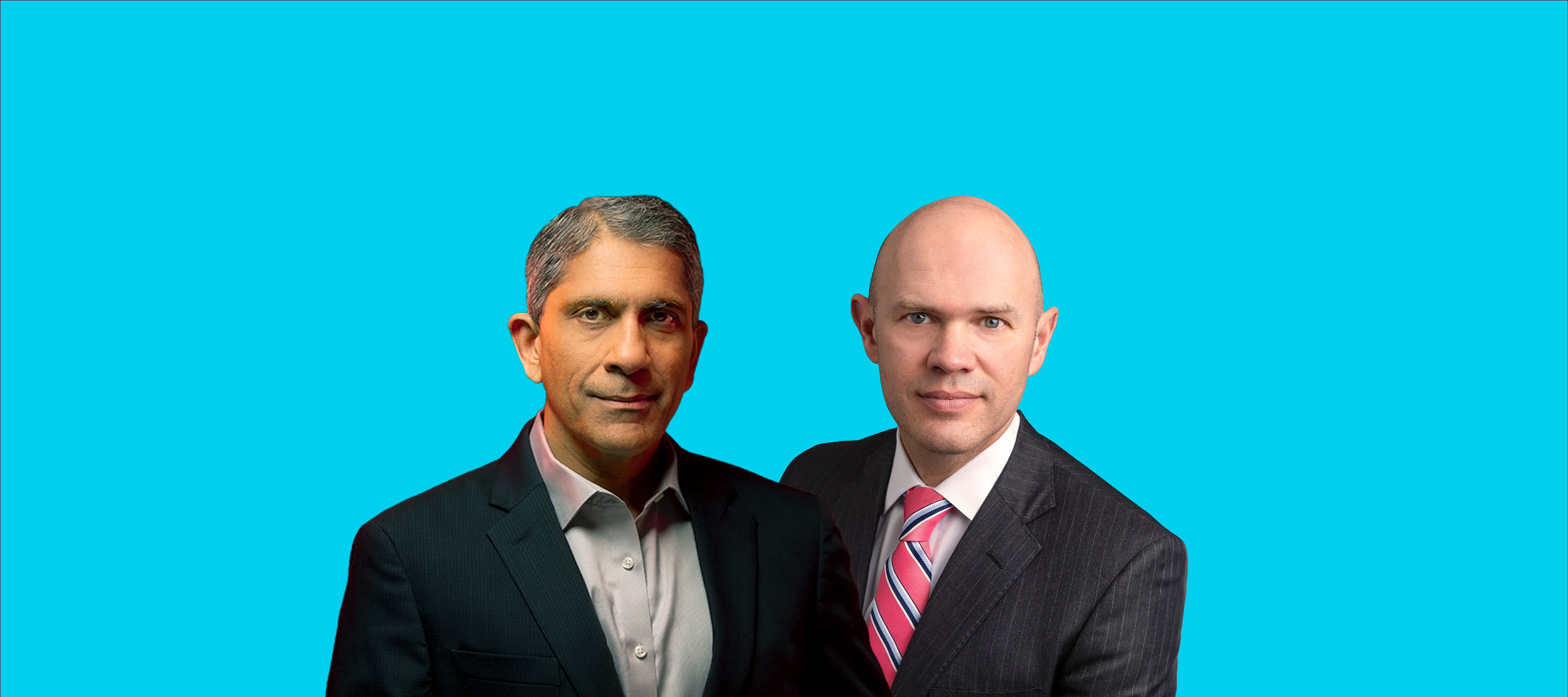
The Long View: Vimal Kapur, Chairman and CEO of Honeywell Technologies
August 2026, In the Spotlight
Overview
In “The Long View,” Eric Veiel, President, Co-head of Global Investments and Chief Investment Officer at T. Rowe Price Associates, welcomes CEOs and industry leaders to share their personal stories, leadership strategies, and lessons learned from running successful companies. The series offers a behind-the-scenes look at what it truly takes to lead in today’s fast-paced and ever-changing business environment.
In this conversation, Vimal Kapur, Chairman and CEO of Honeywell Technologies, joins Eric to discuss his more than three-decade journey at Honeywell and the company’s transformation into three focused businesses. He shares the thinking and conviction behind the separation, the opportunity he sees in industrial automation, and how AI and increasingly autonomous systems could reshape physical infrastructure.
Podcast Host
 Eric L. Veiel, CFA
President, Co-head of Global Investments and CIO
Eric L. Veiel, CFA
President, Co-head of Global Investments and CIO
Speakers
 Vimal Kapur
Chairman and CEO of Honeywell Technologies
Vimal Kapur
Chairman and CEO of Honeywell Technologies“The Angle” Music
Cold OPEN “In the end, your conviction matters. But data is there. So, it's a good old rule. When you get 98% of the data, now you're good enough to make a decision.”
Eric Veiel
Welcome back to the Angle from T. Rowe Price, a podcast for curious investors. Just a reminder that outside of the U.S. and Australia, this podcast is for investment professionals only. For this episode of The Long View, I sat down with Vimal Kapur, Chairman and CEO of Honeywell Technologies. Vimal has spent more than three decades at Honeywell, rising from an engineer in India to lead the company through one of its most significant transformations, which culminated in its separation into three distinct companies. We discussed his leadership journey, Honeywell's evolution, and how automation and AI are shaping the future of industry.
Vimal, thank you very much for coming, for being here on The Angle in our studios, only our second time using the studio. So being here, it's great to have you.
Vimal Kapur
Pleasure being here.
Eric Veiel
I'd love to start off a little bit with just your background and your journey through your, your, early professional career. It's an interesting story, starting in India and and then, you know, being at Honeywell for three decades.
Vimal Kapur
Yeah, thirty seven years now. About 2 or 3 countries. Started in Honeywell in 89 through a joint venture of Honeywell in India. At that time, India had a little, you know, tight rules and who can come in and invest so Honeywell ended up forming joint venture with Tata Group. And I worked in there for 20 years. And then I moved to UK for four years; all in Honeywell, and then I came to the U.S. about 12 years back. So same company, different roles. But the starting foundation was luckily very helpful for me because when we started, when I started, Honeywell had no revenue in India. So, it was a joint venture with two large company. Other partner was Tata Group, which is the largest company in India. So, you have two large companies owning kind of a startup, and you're pretty much off your own because you're a joint venture.
Eric Veiel
And what was the target market that you were going out for?
Vimal Kapur
So, it started with automation and in market was automation. All kind of infrastructure, be at energy infrastructure on different type of buildings. So, India was just starting off as a new economy. And you know, you kind of participate in economic build out, but as a startup. So, you have a lot of competition and you have, you know, work job definition. Your job depends on what's the problem of the day, right? So you learn a lot.
Eric Veiel
Yeah. That's a fun way to get to know a lot of the different parts of the business. So you were sort of a multi, I mean you were an engineer by training.
Vimal Kapur
Engineer by training. I grew up in commercial function, you know, selling and proposals and solution development. And then I move into project management. And I've been doing general management roles since right at the turn of the century, since 2000. I was the general manager of Honeywell in India and Honeywell acquired Tata’s share in 2004. I ran that business for about four years, and then I did different roles globally since then.
Eric Veiel
One of the things that I've observed in talking to lots of different CEOs is everybody's journey is different, but there's almost always for everybody, like one, maybe two moments where something kind of happened, like an opportunity came, might have even been lucky. And, and, you took advantage of it, you seized on in it. And that was really formative to the rest of your career. Can you point to, like, one or two events that were really crucial to your career path?
Vimal Kapur
You know, I think I think my case to make a decision at the late stage of my life to leave India, which was my original home country, of course, now a proud citizen of U.S. But that's like doing it in 40s. It's not easy.
Eric Veiel
With a family.
Vimal Kapur
With a family, yeah. So, making that tough mental decision makes you really strong as a human being. So, you can make other tough decisions because you've done to yourself. And I think given the exposure I got through different roles. So, I always tell people there is no real straight line to a career profile. You need to have a depth in what you do, but breadth matters a lot. So when you do different roles, you learn, and that learning carries forward to the next role because you learn different sectors, different industry, different business models, even 10, 20% of that applies to the next role. But you carry forward that knowledge. And I think that's benefit of working in a large industrial like Honeywell, which is multi-sector. Historically, it was of course, compressed, has been a much more focused company.
Eric Veiel
Yeah. Well, let's talk about that. So I mean, you talk about making tough decisions. So, you've, you've, been at Honeywell over 30 years. In 2023, the board asked you to become CEO. And here's this company you've worked at for a really long time, and basically your first big decision is let's, let's, unwind us, let's break this thing up into three different companies. So, I mean that's a big decision. How did you, how did you come to view the conglomerate structure as needing to change?
Vimal Kapur
So, when I started I would say there were two dynamics which were occurring here. One, of course, my own, my own feeling was we are too complex. During the interview process, I mentioned the board that we need to simplify this company into few vital things versus trying to be everything to everybody, and that was my starting point. When I came into the job, first as the CEO in June of 23’ and then as a chair and CEO in 24’, a year after the investors wanted. They felt that we are peaked out and we need to do something different.
Eric Veiel
Because your margins were great, great, and pretty much everything you could do on the margin front.
Vimal Kapur
Our overall market cap was more like US$135, US$140 billion. It did not destroy the value, but investors were not convinced there is a lot of runway for value creation. So, there was kind of say pent up demand, do something new or different.
Eric Veiel
Now what?
Vimal Kapur
Now what. Exactly. So that was input one to me. Then two things happened pretty much in I would say in in 2023 when I started. That's the time that the aero demand started growing, and then I asked my team to say let's run some numbers because it was a cyclical business. If this is a growth, how long is the growth? The first we ran the model for seven years, then for ten years. And this is the cycle is for ten years too. And the question in my mind was, can we double this business in the current structure with the supply chain creation which has to be done?
So that was one change. The second was AI came in at the same time, and we are an automation company, a large part of Honeywell, and we create a lot of data. And I'm a controls engineer by profession. So I knew, my gut feel said, that this is going to impact our industry. I don't know what specifically, but early reads is that data will get automated and it's going to impact our customer segment. So, automation is going to go through software transformation. Aerospace needs 2x supply chain creation and can this be done in existing structure or be better off to be created as two separate companies which has a lot of runway and potential. And by the way, specialty Chemical doesn't fit into any of these two. So, why don't we create a third one, and that really the decision evolved over, I would say 12 to 15 months’ time frame. You know, a lot of review with the board and optionality.
Eric Veiel
And so, you're going through all of this, doing all this work. And then an activist shows up with kind of the same playbook like, hey, you should do this. So, it ended up not being overly contentious in terms of the grand scheme of how activist campaigns can go.
Vimal Kapur
When Elliott came in, I would say at a stage when we were far along the way, we had already announced the specialty chemicals spin in October. We had not announced the aerospace spin, but we had finished 80% of the work.
Eric Veiel
But you were doing the work?
Vimal Kapur
Yeah, we already, we had not announced to anybody publicly, so our goals were quite aligned. So, it was not question of what it was, but how. And I would say Elliott was very constructive on. They were another shareholder; that's how I looked at it. We have very large shareholders. We should respect their point of view because our goals are aligned to create shareholder value. And I think we, we were able to work very constructively and find a common ground on how we should announce the separation and the pace of it and the speed of it. So, it all works out pretty well.
Eric Veiel
One of the things I don't know that people can fully appreciate is, you know, a company as large and in complex as Honeywell, as you're going through that process of thinking about spinning off the aerospace business, but you've got to keep the business running. You can't let people get distracted by that. How did you manage that part of the process?
Vimal Kapur
That's a good question. I think the way we handled that was, you know, project management, program management is core to us as a company. You know, if you see aerospace, we run long term programs. A lot of that happens in our automation system. So, program management is core to many of us as in as professional skill. Essentially, we set up a separate transformation management office and kind of barricaded those people from running the business. So business is being run by four segment leaders, and their job is to stay focus on strategic execution, deliver the quarter, deliver the year. And separation is done by separate set of people. And of course, we have external help from, you know like sort of EY, PwC, such people. So, I think doing that separation, the management team gets involved.
Now I have to be part of the process. But I would say the number of decisions I had to make were transaction wise was less, but they had a huge implication. So, because I need to think about aerospace and, you know, advanced materials, board of directors, the management team. So, we need to figure the new CEO, new CFO, new general counsel. Of course, it takes time, but not enormous amount of time. It's, you have to be thoughtful, you need to interview multiple people. But I would say by separating the two swim lanes, we were able to deliver consistently on our commitment, while we also did separation ahead of time. Both of them. We did advanced materials separation almost 3 to 4 months ahead of schedule. And aerospace also, you know, we had said second half of this year and we got it done in June.
Eric Veiel
So, so, how many people actually knew that this work was going on before you made it public?
Vimal Kapur
No, not not at all. I would say probably handful. You're talking 10 to 20 people.
Eric Veiel
Interesting. And you were able to keep it that tight, and they were able to get the information they needed to run that play?
Vimal Kapur
Because a lot of it is, you know, it's more about strategy validation, right? You know, you can run numbers of so many times. In the end, your conviction matters. But data is there. So, it's a good old rule. When you get 98% of the data, now you're good enough to make a decision.
Eric Veiel
That’s enough. Well in investing, we do it with less. You wait for 98, it's in the stock. So, you've got to, you got to make your decision.
Vimal Kapur
Yeah, I'm not going to spend another one year to find the perfection. So, I think a lot of it is your own belief on end markets, the drivers and the opportunity set. And I feel glad now. In fact, I mentioned it many times. I feel more convicted on doing this today versus when we started almost two years back. Because now the thesis is playing out. The market opportunity is actually greater. And of course, not each of the three companies have to execute to their, you know; management teams are separate now. Board of directors are separate. They all have their own capital structure.
Eric Veiel
So, so, let's talk a little bit about Honeywell Technology. So, the company you're running since you've simplified it. Maybe just start with a little bit. Building on this thread, what do you feel like you can do now as Honeywell Technologies that would have been more difficult to do if you hadn't done the split?
Vimal Kapur
It was quite intriguing to me that that there is no large, pure-play automation company in the public markets. You know, Rockwell has been there for many years, but I think, relatively speaking, you know, they are they're about US$35- US$40 billion market cap and focus on a more specific segment. So, one of my first realization was there’s an opportunity to build a true large cap, which is pure-play automation. Automation is a secular trend. It was there 30 years back. It will be here 30 years from now. So, there's no doubt that automation of end-markets we do, which is buildings for types. So, think of buildings like hospitals, airport data centers, or process industry, which is LNG {liquefied natural gas} plant, refinery, life sciences or broader industrial like utilities, semiconductor. These are so complex that they cannot run without automation system and building a business around it. And more so with AI coming in, and the power of data is going to make these facilities also more autonomous; is really the fundamental thesis. It's a secular growth trend for multi years.
Eric Veiel
It's certainly a mega trend and it's getting a lot of attention. So, Jenson Huang's talking about physical AI and moving from, you know, understanding information and the, and then acting on it in the, in the physical world. And I think you actually had a joint session with them at your user group recently. I was reading about that. So, talk a little bit about what you think the future of physical AI in the industrial automation world looks like?
Vimal Kapur
The physical AI word is quite different from the AI which we all consume. Like we all use copilots in our work, and we get excited when a word becomes PowerPoint, and.
Eric Veiel
Wow, that was so great.
Vimal Kapur
That was so great. Of course, it's very good for personal productivity, but let me kind of narrate a story to kind of have a better appreciation of physical AI, because I think story tells a lot of information. So, I met, you know, it's very recent, about a month or so back with a hospital system in North Carolina. There run about 50 hospitals in Charlotte alone, and across the state more. So, they run about half a billion a budget for basic operations, maintenance, upkeep of hospitals, and the number one problem is people to run maintenance and operations, right. Technicians to repair something, operators to keep it running. Because these jobs are becoming lesser and lesser interesting.
Now, this customer also has an in-house AI, AI leader, an in-house transformation leader, but they are working with Honeywell. The question is, how come they choose to work with us in spite of having their own in-house team? I mean, what's the driver for that? So that's kind of. The issue is that in industrial world, the data is not in public domain. So, if this is a building we are sitting in, it's being controlled by some control system for environmental control and safety. The data is in that system.
Eric Veiel
So basically trapped, it's trapped.
Vimal Kapur
Yeah. Right. The older the system the more trapped it is, because only few companies like us and my peer group companies they know how to extract the data.
Eric Veiel
Well, I imagine in this hospital system they probably built multiple they acquire multiple hospitals, different systems.
Vimal Kapur
They don't even know how to get the data. So the data friction is very high. The data is not trainable so easily. Number two, the domain knowledge matters a lot because we serve multiple industrial markets, from hospitals to data centers, to refineries, to LNG plants, to semiconductor fab. Everybody problems are different. So, you can't build a generic application and say, you know here what it is. So, scalability is not horizontal. Scalability is by vertical, by default. And you still need to keep the core control systems working. So, it works along with control system and not in absence of it. So that's kind of creates it. So, in this in this particular example I gave, we are building for this customer agents agentic system. Because automation system generates a lot of data. Over the last 40/50 years. Much of this data or large amount of the data is not rightly actionable. It's like false alarms and it's like too much data overload. So agentic systems can find out the, the things which are not required any action and reduce the work by 30 to 40%.
Eric Veiel
Interesting. So, so, you're not sending the tech to go look at something that didn't need to be looked at.
Vimal Kapur
If so, I'm giving to this customer agents for comfort, agents for energy management, agent for maintenance, agent for fire compliance. So, by giving the agentic system, we believe we can reduce work by 30 to 40%. Therefore, he needs 30 to 40% less techs. And that solves their problem. That's the problem they have. So, you have to in a classical way to create economic value. You have to solve the problem. In this example they're not here to buy AI. He has a problem to solve. And therefore.
Eric Veiel
He's trying to solve a labor problem.
Vimal Kapur
Labor problem. Which is so immense in our industry. In the critical sector, we serve, number one issue customers have is lack of skilled people. As retirements are coming, less people are coming into these roles. And let's not forget that pretty much in the entire world, the population rates are shrinking. So, the problem only get worse, right? And the best way for us to solve it, is create agentic system which are supplementing human knowledge. And that's where the automation systems working along with, you know, this agentic system, creates less of our productivity.
Eric Veiel
One area that we haven't talked too much about is the data center opportunity. Clearly an amazing amount of capital going into building data centers globally, but certainly in the U.S. Talk a little bit about your role in that. And if you, and if you could, what you're doing with Nvidia specifically around sort of the, the, data center world.
Vimal Kapur
Okay. So there are several questions in that. I mean, if we if we look at it, we look at our growth opportunity now as we came as a separate company for the last 12 to 18 months, we know we're going to be standalone company very soon. So how should we reimagine ourselves? And it was very clear that AI has a huge role to play. And we look at AI from two dimensions. One is things which are end markets important from AI, data center and semiconductor fabs too.
Eric Veiel
For sure.
Vimal Kapur
Both of them. And then to serve them you need energy. It means you need LNG plants. And then you also need to think about utilities. Because our automation is all pervasive. We are basically thinking how do we serve all these end-markets? But things are changing fast. Two things change in last six months. Number one, on-site power generation. So, it's becoming a recent trend as people are not getting interconnections. Many people are moving into generating their own power. So that's good news for us because process automation business now. So, our building automation business was automating the facility. Process automation business can automate the power plants.
Eric Veiel
And now you're putting those together.
Vimal Kapur
Megawatt oriented right versus square feet oriented. So, that's a good news. Second change which is occurring is liquid cooling. Liquid cooling is much more complex compared to air cooling because air cooling is much more, you basically have an air-cooled infrastructure. Liquid cooling is at the rack level. That's too many control points. Good news for control system provider. So, we see that data center is continue to grow, and it'll continue to become meaningful part of our business. But so is semiconductor fabs, likes of Samsung and Intel, and Micron, SK Hynix. These are our customer for safety of these facilities. They use hazardous gases. They are prone to fire risk. So we provide products to save them. So, overall, I would say the, we can feel the impact of AI into our business not only in data center but also around other sector, which is indirectly impacting, and it's going to help us. And this is going to be a big part of it because some of the base segments we serve traditional buildings, commercial buildings, they're not growing that much. Right. Refining segment and process is very static, probably low growth.
Eric Veiel
Probably should be growing faster but nobody wants to build a new refinery.
Vimal Kapur
That's right. But we mix up our business to say we want to keep our shared in the core, but as we are mixing up these high growth markets, and we want this to be 25% of our revenue, we talked about it and that 25% grow at 10%. Now you're mixing the two. Really two other trends. So we're basically counting on AI in our secular trends and energy quite to it. We also are very focused on aging.
Eric Veiel
Yeah, interesting.
Vimal Kapur
Because humans are becoming more aged, which basically impacts to end market hospitals and life sciences. So, hospitals are automated by our building automation business. That's actually our, one of our largest end markets we serve. And then life sciences facilities more and more onshoring is happening. So that's also a big part of our focus area.
Eric Veiel
Interesting. So, you know, the hospital, when you think about a hospital, the complexity of that facility for you all, I'm sure creates tremendous opportunity.
Vimal Kapur
Opportunity. And they want only one thing - uptime. They don't want any downtime of any nature because of the complexity of the system.
Eric Veiel
Well, such a high fixed cost business, they can't afford to.
Vimal Kapur
Absolutely, absolutely. And you know, you know, they want continuity of operation as, you know, as their key assurance. They also consume a lot of energy. So energy reduction can be a big saving.
Eric Veiel
It always comes back to energy.
Vimal Kapur
Yeah, it comes. Energy consumption in hospital is very very large.
Eric Veiel
When you think about what we're doing as a country from an energy production perspective. Do you see even more need, even more opportunity?
Vimal Kapur
Absolutely. I mean, energy is, is one of the biggest end markets we serve. And in that we do automation of all kind of energy infrastructure, but we also provide technology to build refineries, renewable fuel plants, LNG.
Eric Veiel
Will SMRs {Small Modular Reactor’s} be a part of your future at all.
Vimal Kapur
We don't do SMRs, but I always believe that in a world in which more energy is required, all type of energies have a role to play. It's less about debating which is good and which is bad. We need solar, we need wind, but we also need traditional energy sources like refining. But we also need renewable fuels. So everything has a space. And what can change is. I mean, if you take time change over the last ten years, coal has been replaced by gas. That's fundamental change. But if you look at next ten years, a lot of traditional fuels like diesel, gasoline, jet fuel, which are very dense fuels, they'll get replaced by renewable fuels like sustainable aviation fuel or methanol. So, we believe that the progression is happening. The rate of change depends upon the social awareness and political support, but the change is bound to occur. This is unstoppable.
Eric Veiel
And as those fuels change over as a demand for those more, you know, higher sophistication fuels, let's call them change. Is that going to be a similar content intensity opportunity for you? Like going through air cooling to liquid cooling in a in a data center?
Vimal Kapur
As we move towards. So, think about it, if the world has to move more towards. The world has spent a lot of money for building green electrons. Green electrons are wind, solar, battery. These are all electrons. World has spent less money on green molecules. Sustainable aviation fuel, cleaner fuel for running ships, cleaner fuels of those type. So, a lot of our energy infrastructure has to be upgraded to add this capability. And whenever that that motion starts, it can start a year from now, or five years from now, that becomes the incremental capital opportunity which we will benefit from.
Eric Veiel
Yeah. That's great. Let's talk a little bit about your style as a leader. So, you've got an amazing story as we talked about earlier. But I'm curious what you've taken from people that you've learned from in the past. Are there, you know, a few mentors or leadership lessons that you've, that you've really clung to from, from folks that you've worked?
Vimal Kapur
Absolutely, I think we all learn from the people who mentor you. And I think sometimes your success actually depends on sometimes; you have to be lucky to have good managers early part of your life. And I was. My first manager went on to become a global leader for SKF, one of their segment leader, and he was very capable, and he showed me a lot of ways on how to think about an early career. And I think in Honeywell, you know, I had a opportunity to work under Dave Cody for many years, and with Darius Adamczyk, my predecessor. I think you learn from them a lot in terms of operating model, each one of them their own strengths. So, your job is to kind of soak in what you think is the best practice, and that's what shapes you. You know, there's reason companies like Honeywell and GE and UTC are called academy companies. Because there's a culture and mechanism it creates, and it produces great leaders through that mechanism of formal learning in the job, but also training they provide you. And I think that really prepares strong leader and you learn from your mentors all the time.
Eric Veiel
Well, it's interesting, the three companies that you mentioned also basically all went through some kind of conglomeration to de-conglomeration in the last ten, 15 years.
Vimal Kapur
The conglomeration phase, in my view, got supported by post WTO {World Trade Organization}. When the world became more global, companies like Honeywell had opportunity to add value by globalizing the businesses, globalizing manufacturing, take talent pool across the world, and Honeywell margin went from sub 10% to 23% in 15 years. It really created a lot of value for shareholders. Now, that strategy has become more normal and anybody can do it. Therefore, you have to repay it yourself. The more specialization in the phase we are in right now.
Eric Veiel
You know, it's interesting as you think about going through a change like you did, does knowing the company as well as you did make that easier to do a big change or harder because you kind of understand what you're asking people to give up, and like have all these institutional framework?
Vimal Kapur
I think its easier because you appreciate the decisions better. You understand that once we make the decision, what's the intensity of the implication of it, how hard it is or how easy it is. So, I think certainly that's a that's an advantage. And I truly, you know, want to you know, I always ask a question to myself like, okay, working in Honeywell for 35 plus years, what's a big deal? I mean, why should anyone care about it? I think where the benefit really comes is you deeply understand the segments. So, the work you do in terms of the portfolio is with the strength of the knowledge you have of that portfolio. You're not randomly trying to learn in six months or 12 months. You have strength of decades of knowledge. And that should transform into a better portfolio because you have understanding of the end markets and the customer drivers. So, certainly, that I believe will be my contribution to build a portfolio, which is good for next 10 to 15 years because it comes with the strength of different end markets and businesses I have seen over a period of time.
Eric Veiel
How will acquisitions play into building that portfolio? And maybe just broadly, how do you think about capital allocation?
Vimal Kapur
So capital allocation. I would say it always have to be balanced between, you know, we have to pay a dividend for sure. We are a dividend paying stock. So, you know, 35% of our cash goes into that. That's our commitment. Now the balance money has to be used between. We are low-capital business, CapEx investments are not much above 2 to 3%. So, the balance money can be used either in share buyback or portfolio changes for M&A. I believe personally that the share buyback creates a short-term value, while M&A creates a long-term value. And you really need to balance the both. There's no one right answer, but M&A has to be done in a very thoughtful manner because at any point of time the earnings growth come from your portfolio, M&A is going to take a while to integrate and integration costs. So, one has to be sensitive to that. But it's also important to keep the portfolio current, because for an industrial technology company like us; our name is Honeywell Technology. So, technology is center of what we do. We can't be static. We can't be saying that everything we have is perfect. So, you have to be constantly looking at to say something new is occurring. It could be segment specific, could be technology specific, and be comfortable to acquire it but in a very thoughtful manner. It should be. It always is. Bolt-on, in our mind. We don't want to go to new spaces. We're happy with the portfolio we have. We look at acquisition size, enterprise value, anywhere from 1 to US$4 billion. That's kind of a sweet spot for us in revenue. So, you like half a billion something in that nature. We want good returns. You know, we don't want to blow away our shareholder’s money. So, once we put that criteria, we want to stay discipline but also want to be an active participant. One of the interesting we have learned over the last couple of years is we have done more carve outs than full acquisitions, so we become more of like a private.
Eric Veiel
Equity, say, a private equity firm. Yeah.
Vimal Kapur
I think what it does is, what we are known through a discipline is you don't have to acquire the full thing. If you are discipline, you should have courage to say to your counterparty to say, I only want this.
Eric Veiel
I'm a better owner of that business. Not all this other stuff. You can keep that.
Vimal Kapur
Other stuff. That's where the value destruction happens. When we kind of think through it creates value, sometime, and not all the time is, because the fit is only for a portion of it. And if that's the case, why not just do what is really having a strong fit? So we acquired LNG business from Air product, which was a carve out from Air product. We acquired security business from Carrier, which was a carve out of the air fire and security business. We recently did an acquisition from Johnson Matthey UK. Very small portion of their business we acquired. So become comfortable. Now the risk is on us because we are doing carve out, but our lesson learned is that companies like us have a strong functional capability. When we are acquiring a business, we have a strong capability in HR, in finance and legal and IT. We're not acquiring the business for that. We're acquiring for their product capability.
Eric Veiel
Some technology.
Vimal Kapur
Right, manufacturing. And if that's carved out, why we are uncomfortable with that. Right. And I think more and more you do that. That also gives us more optionality in terms of rightful use of our shareholder’s money. So, I would say we will, we will be responsible, I think, doing, you know, one or two acquisitions a year, but it's all organic.
Eric Veiel
I'm just curious out of the, let's say, ten of those types of deals that you've looked at, or done. How many of those are your team going out and finding that opportunity versus one of those companies coming to you and saying, hey, we think you might be a better owner of this business than we are?
Vimal Kapur
No, it's.
Eric Veiel
All, it's all.
Vimal Kapur
It’s always by us. And some of it is, I have to take the lead because more so when you're asking a carve out, it has to be a C-level discussion because your bankers can't really enable that. They will come into the process once both parties agree. But that cannot be an initiation point. So, I think leadership team need to understand their businesses well and make a compelling story on gaps in a portfolio where we could add more value. And certainly I think that's one of the benefit of being a pure-play, that we are much more thoughtful on what really can be adding more value into pure-play automation, was that, we just keep acquiring whatever we think could be more generic industrial business. So that's kind of narrowing down is always good for us.
Eric Veiel
The benefits of the spin come, come back again. That's great. Well, look, we like to end, we like to end these with a couple of different regular segments. So, I would love to find out a little bit about what you do personally just to relax and unwind. These are these are always stressful jobs, and everybody's got to have a different approach to that.
Vimal Kapur
Look you know, early in my career what I learned is that you have to take your job seriously. Don't take yourself too seriously, you know, because it's about the job, which makes it intense. But if you take, make yourself so much ingrained in the job, you can stress yourself out. So I think we have to separate the two. I'm very disciplined and everything I do, I, you know, regular exercise practically seven days a week. So, I think that's an important part of it. I maintain a strict time in office. You know, I spent 12 hours. I come in at seven, leave around 630. But then I don't.
Eric Veiel
Stay.
Vimal Kapur
Leave, I leave, I do leave 95% of the day, is I'll leave at six. I won't stay back. So, I think doing a, I don't come to office in the weekends. I, of course, have worked some hours in the end. So, I think drawing boundaries is critical. Understanding where do you add value and, you know, don't be over critical of yourself because you don't control everything. I think using those tools and de-stressing tools is very, very important for us to manage these complex jobs.
Eric Veiel
That's great. Yeah. Okay. So we're going to end with a segment that we, that we've really come to enjoy, which is our rapid-fire questions. So here we go. I'm going to ask you a handful of questions. Just one or two word or four to five- word answers here. What's the technology you think most people are underestimating today?
Vimal Kapur
I think outside AI, I would say energy mix input.
Eric Veiel
What's one piece of advice you still hear in your head before making a big decision?
Vimal Kapur
Listening, everybody.
Eric Veiel
When was the last time you completely changed your mind about something important?
Vimal Kapur
Very frequently. I'm very flexible. I'm not a stubborn person.
Eric Veiel
What's one skill every young engineer should develop over the next five years?
Vimal Kapur
I think human judgment is going to be critical for future success. So, while learning AI tool is important, but continue to focus on skill by which judgment becomes important.
Eric Veiel
Outside of work, what's something that you're curious enough about that you spend as much time as you can learning about it?
Vimal Kapur
Politics.
Eric Veiel
Window or aisle seat?
Vimal Kapur
Aisle seat.
Eric Veiel
Your favorite guilty pleasure food?
Vimal Kapur
Oh, chocolate.
Eric Veiel
Chocolate. All right. And then your favorite vacation spot?
Vimal Kapur
It's always a beach.
Eric Veiel
A beach. Yeah. Very good. That's great. Vimal, thank you so much. It’s been a lot of fun having you. Really appreciate the time.
Vimal Kapur
Thank you very much. Thanks for having me.
Eric Veiel
Again, I'm Eric Veiel. Thank you for listening to The Angle. We look forward to your company on future episodes. You can find more information about this and other topics on our website. Please rate and subscribe wherever you get your podcasts. The Angle. Better questions, better insights. Only from T. Rowe Price.
DISCLOSURE
This podcast episode was recorded in August of 2026 and is for general information and educational purposes only. Outside of the United States and Australia it is for investment professional use only. It is not intended to be used by persons in jurisdictions which prohibit or restrict distribution of the material herein.
This podcast does not give advice or recommendations of any nature; or constitute an offer or solicitation to buy or sell any security in any jurisdiction. Prospective investors should seek independent legal, financial, and tax advice before making any investment decision. Past performance is not a guarantee or a reliable indicator of future results. All investments are subject to risk, including the possible loss of principal.
Discussions relating to specific securities are informational only, and are not recommendations, and may or may not have been held in any T. Rowe Price portfolio. Any forward-looking statements are for discussion purposes only and are never guaranteed. There should be no assumption that the securities were or will be profitable. T. Rowe Price is not affiliated with, or a subsidiary of, any company discussed.
The views contained herein are those of the speakers as of the date of the recording and are subject to change without notice. These views may differ from those of other T. Rowe Price associates and/or affiliates. Information is from sources deemed reliable but not guaranteed. Please visit https://www.troweprice.com/en/uk/insights/the-long-view-honeywell for full global issuer disclosures. This podcast is copyright by T. Rowe Price, 2026.
Subscribe to never miss an episode
Glossary
LNG Plants - A liquefied natural gas (LNG) plant is an industrial facility that cleans raw natural gas and cools it to about –162 °C (–260 °F) to turn it into a liquid. This cooling process shrinks the volume of the gas by 600 times, making it safe and easy to move in ships or trucks where pipelines do not reach.
SMR - An SMR stands for a Small Modular Reactor. It is an advanced type of nuclear fission reactor that is physically a fraction of the size of conventional power plants and has a generating capacity of up to 300 megawatts of electricity (MWe) per module.
WTO – WTO stands for the World Trade Organization. It is the main global body that handles the rules of trade between countries. Its goal is to make sure that trade flows smoothly, freely, and predictably so nations can boost jobs and living standard.
Important Information
Outside of the United States and Australia, this is intended for investment professional use only. Not for further distribution.
This material is being furnished for informational and/or marketing purposes only and does not constitute an offer, recommendation, advice, or solicitation to sell or buy any security.
Prospective investors should seek independent legal, financial and tax advice before making any investment decision.
Past performance is not a guarantee or a reliable indicator of future results. All investments involve risk, including possible loss of principal.
Discussions relating to specific securities are informational only, are not recommendations, and may or may not have been held in any T. Rowe Price portfolio. There should be no assumption that the securities were or will be profitable. T. Rowe Price is not affiliated with, or a subsidiary of, any company discussed. Some T. Rowe Price portfolios are passively invested in Honeywell Technologies.
The views contained herein are those of the author(s), are as of August 2026 are subject to change, and may differ from the views of other T. Rowe Price Group companies and/or associates. Under no circumstances should the material, in whole or in part, be copied or redistributed without consent from T. Rowe Price.
The podcast does not give advice or recommendations of any nature; or constitute an offer or solicitation to sell or buy any security in any jurisdiction. Prospective investors should seek independent legal, financial, and tax advice before making any investment decision. Past performance is not a reliable indicator of future performance. All investments are subject to risk, including the possible loss of principal.
The views contained are those of the speakers as of the date of the recording and are subject to change without notice. These views may differ from those of other T. Rowe Price associates and/or affiliates. Information is from sources deemed reliable but not guaranteed.
Australia—Issued by T. Rowe Price Australia Limited (ABN: 13 620 668 895 and AFSL: 503741), Level 28, Governor Phillip Tower, 1 Farrer Place, Sydney NSW 2000, Australia.
Canada— Issued in Canada by T. Rowe Price (Canada), Inc. T. Rowe Price (Canada), Inc.’s investment management services are only available to non-individual Accredited Investors and non-individual Permitted Clients as defined under National Instrument 45-106 and National Instrument 31-103, respectively. T. Rowe Price (Canada), Inc. enters into written delegation agreements with affiliates to provide investment management services.
EEA—This material is issued and approved by T. Rowe Price (Luxembourg) Management S.à r.l. 35 Boulevard du Prince Henri L-1724 Luxembourg which is authorised and regulated by the Luxembourg Commission de Surveillance du Secteur Financier. For Professional Clients only.
New Zealand—Issued by T. Rowe Price Australia Limited (ABN: 13 620 668 895 and AFSL: 503741), Level 28, Governor Phillip Tower, 1 Farrer Place, Sydney NSW 2000, Australia. No Interests are offered to the public. Accordingly, the Interests may not, directly or indirectly, be offered, sold or delivered in New Zealand, nor may any offering document or advertisement in relation to any offer of the Interests be distributed in New Zealand, other than in circumstances where there is no contravention of the Financial Markets Conduct Act 2013.
Singapore—Issued by T. Rowe Price Singapore Private Ltd. (UEN: 201021137E), 501 Orchard Rd, #10-02 Wheelock Place, Singapore 238880. T. Rowe Price Singapore Private Ltd. is licensed and regulated by the Monetary Authority of Singapore. For Institutional and Accredited Investors only.
Switzerland—Issued in Switzerland by T. Rowe Price (Switzerland) GmbH, Talstrasse 65, 6th Floor, 8001 Zurich, Switzerland. For Qualified Investors only.
UK—This material is issued and approved by T. Rowe Price International Ltd, Warwick Court, 5 Paternoster Square, London EC4M 7DX which is authorised and regulated by the UK Financial Conduct Authority. For Professional Clients only.
© 2026 T. Rowe Price. All Rights Reserved. T. ROWE PRICE, INVEST WITH CONFIDENCE, the Bighorn Sheep design and related indicators (see troweprice.com/ip) are trademarks of T. Rowe Price Group, Inc. All other trademarks are the property of their respective owners. Use does not imply endorsement, sponsorship, or affiliation of T. Rowe Price with any of the trademark owners.
202608-5832510