
Why investors should prioritize durable growth when the market does not
August 2026, Equity
- Key Insights
-
- AI is evolving quickly. Navigating the boom responsibly calls for evaluating the potential magnitude and durability of a company’s growth story.
- AI disruption risk looms large. We believe caution is warranted in traditional software. However, parts of the e‑commerce ecosystem could prove resilient.
- In the AI era, companies with the potential to grow steadily and grind higher over time represent an important part of a balanced portfolio.
Rapid advances in artificial intelligence (AI) and its broad applicability can cause imaginations to run wild about the implications for products, companies, and industries.
In such a dynamic environment, the market is prone to extrapolating recent news or a datapoint into a trend. There is also a tendency to rush to judgment about whether companies are AI winners or losers at any given moment.
The resulting dislocations and bouts of volatility can feel extreme. However, the market’s bias toward chasing whatever narrative is working today can lead to opportunities for patient investors who focus on what creates value over the long term.
AI infrastructure spending: What we’re watching
So far, much of the value created by AI has accrued to the hardware layer, fueled in large part by the massive sums that the hyperscalers have plowed into datacenters (Figure 1).
Massive spending is weighing on hyperscaler1 free cash flow expectations
(Fig. 1) Hyperscaler1 capital expenditures and free cash flow, rolling four‑quarter total
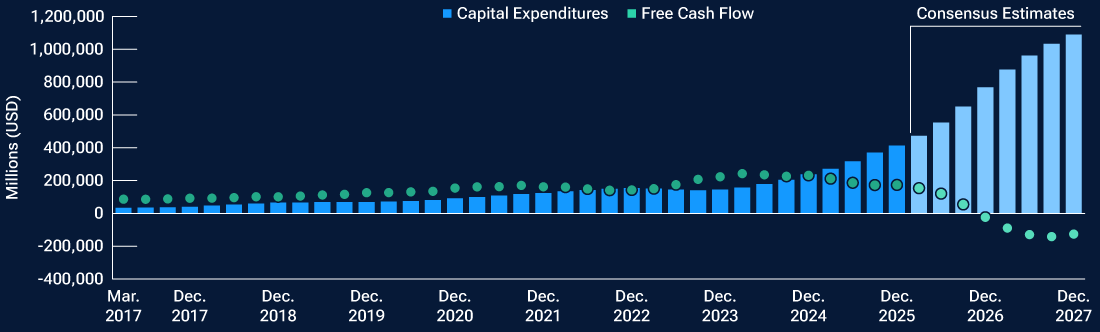
As of August 26, 2026.
For illustrative purposes only. The specific securities identified and described are for informational purposes only and do not represent recommendations. There can be no assurance that the estimates will be achieved or sustained. Actual results may vary.
Source: T. Rowe Price analysis using data from FactSet Research Systems Inc. All rights reserved. Please see Additional Disclosures page for additional legal notices and disclaimers.
1Alphabet, Amazon.com, Meta Platforms, Microsoft, and Oracle.
Key tailwinds propelling the AI spending cycle are blowing in the right direction:
- AI Scaling laws: As long as linking increasing numbers of increasingly powerful chips still yields meaningful advances in model capabilities, the impetus to pursue frontier intelligence that can unlock new use cases should be strong.
- Change agents: AI agents that can complete complex digital tasks have super‑charged demand for processing capacity. Agentic AI increases the need for memory to hold more information in context for longer and traditional CPUs to run and coordinate myriad computing tasks.
- Return on investment: The mega‑cap companies driving AI infrastructure spending have benefited from acceleration in their online advertising and cloud services businesses without meaningful headcount growth. AI agents have also experienced strong uptake among consumers and enterprise users.
- Funding environment: The hyperscalers have demonstrated a willingness to issue debt and, in some cases, equity to augment their spending plans.
Still, it’s important to respect that the AI technology stack and market are evolving quickly. Navigating this cycle responsibly, in our view, requires selectivity and thoughtfulness about the magnitude and durability of a company’s growth story.
AI‑driven growth: Magnitude matters, but so does staying power
The AI arms race has led to supply‑chain bottlenecks, turning shares of some hardware companies into bottle rockets as they benefited from supply‑demand shortfalls and strong price increases.
Outsized growth can be dazzling. But durability and business quality shouldn’t be overlooked. Customer concentration and whether a company’s pricing power has staying power are key considerations.
Innovation is relentless. Hardware prominent in current system architecture may find itself replaced in subsequent generations by more efficient or more powerful components developed by rivals.
And aggressive price increases based primarily on scarcity historically have proved less defensible. Elevated prices typically incentivize producers to invest in additional capacity while encouraging customers to seek substitutes or other workarounds over time.
Within the hardware industry, we favor companies with leadership in bleeding‑edge technology and foundry capacity for manufacturing advanced semiconductors—an area where demand and pricing power tend to be more durable through the cycle. All roads to producing high‑performance chips run through these “linchpin” companies; they typically benefit no matter which technology or system architecture appears to be winning.
Meanwhile, much has been made of the AI infrastructure players siphoning the hyperscalers’ ample cash flows.
But we believe hyperscalers’ spending can create significant value in their cloud businesses, which are adding AI‑related workflows that are likely to prove sticky, grow, and generate favorable returns over a longer time frame.
The market may not fully appreciate the potential durability of the hyperscalers’ business models while their free cash flow is under pressure and hardware companies benefiting from bottlenecks offer the prospect of impressive near‑term earnings growth. In our view, this dislocation creates a favorable risk/reward setup for patient growth investors.
AI disruption: What we have here is a failure to differentiate
As with past innovation waves, the specter of disruption looms large, with the market reassessing whether AI threatens individual companies or even entire industries.
Traditional enterprise software, for example, has emerged as the poster child for AI risk. Concerns include intensifying competition, eroding pricing power, and pressure to pivot from subscriptions that generate recurring revenue to utilization‑ or returns‑based models. Disproving these allegations could be challenging, and the range of potential outcomes has widened. We believe caution and selectivity are warranted when considering software stocks.
Worries that agentic AI could disrupt e‑commerce, on the other hand, generally strike us as misdiagnosed. The bear case holds that AI agents increasingly will handle online shopping as well as travel bookings and associated logistics.
We believe that consumer‑focused AI is likely to monetize through online advertising. In this scenario, AI is more likely to help consumers discover products and services than to replace the economic role of established marketplaces and infrastructure.
Alphabet (Google’s parent company), for example, tried to compete with the online travel agencies for decades but ultimately concluded that it was easier to route traffic to them. These businesses proved harder to disrupt than information companies because of their real‑world relationships, network effects, and their integrated payments and customer service.
Ultimately, front‑footed online travel agencies and companies that provide backbone digital services for e‑commerce may benefit to the extent that deploying AI helps them to lower costs, accelerate innovation, and improve the customer experience.
Bottom line: AI’s broad applicability can easily lead to misplaced fears of disruption, creating opportunities for portfolio managers with a differentiated view on the potential durability of a company’s growth story.
Beyond AI: The overlooked appeal of “boring” growth stories
The market’s enthusiasm for AI and appetite for speculation have resulted in an excluded middle: companies that lack an exciting story but should be able to increase their earnings at an above‑average rate for an extended period.
Companies with the potential to grow steadily and grind higher over time should represent an important part of a balanced portfolio given that sentiment and momentum around the AI trade can shift quickly.
Within financial services, for example, the dominant global payment networks historically have generated significant free cash flow and stand to benefit over time from strong pricing power and the continued migration from cash to cards and digital transactions.
The aerospace market is another area where we see high‑quality companies that should have a long runway for earnings growth.
Investing with confidence
Narrative‑driven markets and periods dominated by short‑term factor rotations often create opportunities for fundamentally driven investors.
A deep understanding of individual companies can help portfolio managers to capitalize when dislocations emerge in high‑quality companies that have the potential to sustain stronger earnings growth for longer.
 Paul Greene, II
Portfolio Manager
Paul Greene, II
Portfolio Manager

- Jul 2026
- Equity
- Article
How AI can open new avenues for systematic investment research
Risks
Active investing may have higher costs than passive investing and may underperform the broad market or passive peers with similar objectives.
Diversification cannot assure a profit or protect against loss in a declining market.
Financial services companies may be hurt when interest rates rise sharply and may be vulnerable to rapidly rising inflation.
Growth stocks are subject to the volatility inherent in common stock investing, and their share price may fluctuate more than that of a income‑oriented stocks.
Investing in technology stocks entails specific risks, including the potential for wide variations in performance and usually wide price swings, up and down. Technology companies can be affected by, among other things, intense competition, government regulation, earnings disappointments, dependency on patent protection and rapid obsolescence of products and services due to technological innovations or changing consumer preferences.
Additional Disclosure
For U.S. investors, visit troweprice.com/glossary for definitions of financial terms. Linchpin companies provide mission‑critical technology and services to an industry.
Please see vendor indices for more information, including definitions and source data: troweprice.com/marketdata.
T. Rowe Price cautions that economic estimates and forward‑looking statements are subject to numerous assumptions, risks, and uncertainties, which change over time. Actual outcomes could differ materially from those anticipated in estimates and forward‑looking statements, and future results could differ materially from any historical performance. The information presented herein is shown for illustrative, informational purposes only. Forecasts are based on subjective estimates about market environments that may never occur. Any historical data used as a basis for this analysis are based on information gathered by T. Rowe Price and from third‑party sources and have not been independently verified. Forward‑looking statements speak only as of the date they are made, and T. Rowe Price assumes no duty to and does not undertake to update forward‑looking statements.
Important Information
Outside of the United States, this is intended for investment professional use only. Not for further distribution.
This material is being furnished for informational and/or marketing purposes only and does not constitute an offer, recommendation, advice, or solicitation to sell or buy any security.
Prospective investors should seek independent legal, financial and tax advice before making any investment decision. T. Rowe Price group of companies including T. Rowe Price Associates, Inc. and/or its affiliates receive revenue from T. Rowe Price investment products and services.
Past performance is not a guarantee or a reliable indicator of future results. All investments involve risk, including possible loss of principal.
Information presented has been obtained from sources believed to be reliable, however, we cannot guarantee the accuracy or completeness. The views contained herein are those of the author(s), are as of August 2026, are subject to change, and may differ from the views of other T. Rowe Price Group companies and/or associates. Under no circumstances should the material, in whole or in part, be copied or redistributed without consent from T. Rowe Price.
All charts and tables are shown for illustrative purposes only. Actual future outcomes may differ materially from any estimates or forward‑looking statements provided.
The material is not intended for use by persons in jurisdictions which prohibit or restrict the distribution of the material and in certain countries the material is provided upon specific request.
Australia—Issued by T. Rowe Price Australia Limited (ABN: 13 620 668 895 and AFSL: 503741), Level 28, Governor Phillip Tower, 1 Farrer Place, Sydney NSW 2000, Australia. For Wholesale Clients only.
Canada—Issued in Canada by T. Rowe Price (Canada), Inc. T. Rowe Price (Canada), Inc.’s investment management services are only available to non‑individual Accredited Investors and non‑individual Permitted Clients as defined under National Instrument 45‑106 and National Instrument 31‑103, respectively. T. Rowe Price (Canada), Inc. enters into written delegation agreements with affiliates to provide investment management services.
DIFC—Issued in the Dubai International Financial Centre by T. Rowe Price International Ltd which is regulated by the Dubai Financial Services Authority as a Representative Office. For Professional Clients only.
EEA—This material is issued and approved by T. Rowe Price (Luxembourg) Management S.à r.l. 35 Boulevard du Prince Henri L‑1724 Luxembourg which is authorised and regulated by the Luxembourg Commission de Surveillance du Secteur Financier. For Professional Clients only.
New Zealand—Issued by T. Rowe Price Australia Limited (ABN: 13 620 668 895 and AFSL: 503741), Level 28, Governor Phillip Tower, 1 Farrer Place, Sydney NSW 2000, Australia. No Interests are offered to the public. Accordingly, the Interests may not, directly or indirectly, be offered, sold or delivered in New Zealand, nor may any offering document or advertisement in relation to any offer of the Interests be distributed in New Zealand, other than in circumstances where there is no contravention of the Financial Markets Conduct Act 2013.
Switzerland—Issued in Switzerland by T. Rowe Price (Switzerland) GmbH, Talstrasse 65, 6th Floor, 8001 Zurich, Switzerland. For Qualified Investors only.
UK—This material is issued and approved by T. Rowe Price International Ltd, Warwick Court, 5 Paternoster Square, London EC4M 7DX which is authorised and regulated by the UK Financial Conduct Authority. For Professional Clients only.
USA—Issued in the USA by T. Rowe Price Investment Services, Inc., distributor and T. Rowe Price Associates, Inc., investment adviser, 1307 Point Street, Baltimore, MD 21231, which are regulated by the Financial Industry Regulatory Authority and the U.S. Securities and Exchange Commission, respectively.
Unless otherwise indicated, this material is issued and approved by T. Rowe Price International Ltd, Warwick Court, 5 Paternoster Square, London EC4M 7DX which is authorised and regulated by the UK Financial Conduct Authority. For Professional Clients only.
© 2026 T. Rowe Price. All Rights Reserved. T. Rowe Price, INVEST WITH CONFIDENCE, the Bighorn Sheep design, and related indicators (see troweprice.com/ip) are trademarks of T. Rowe Price Group, Inc. All other trademarks are the property of their respective owners. Use does not imply endorsement, sponsorship, or affiliation of T. Rowe Price with any of the trademark owners.
- 202608‑5877350