
The AI Investment Cycle: What Has Changed?
November 2026, Equity
- Key Insights
-
- AI infrastructure demand remains strong, but 2028 could represent an inflection point.
- Financing conditions and sustainable free cash flow are becoming more important differentiators.
- Relative growth and valuation matter as much as absolute growth.
- AI adoption must increasingly validate infrastructure investment.
The Midterms as a Trigger
On November 4th, the S&P 500 Index rose 1.6% as investors seemed to consider whether congressional gridlock might steady federal policy. On November 5th, selling broadened as investors appeared to weigh state-level outcomes: the S&P 500 fell 4.4%, the Nasdaq Composite Index 5.5%, and the PHLX Semiconductor Index 12.2%.
In our view, the reaction was violent because the election landed on a sector already repricing. Semiconductors were close to 40% below their 2026 peak, with forward price-to-earnings multiples (how much investors pay relative to expected earnings over the next 12 months) compressed from about 32 to 17 even as estimates rose.1 Positioning turned a repricing into a liquidation.
Semiconductors were down 18% before the vote; the election accelerated it
Total return, rebased to 100 at 30 September 2026
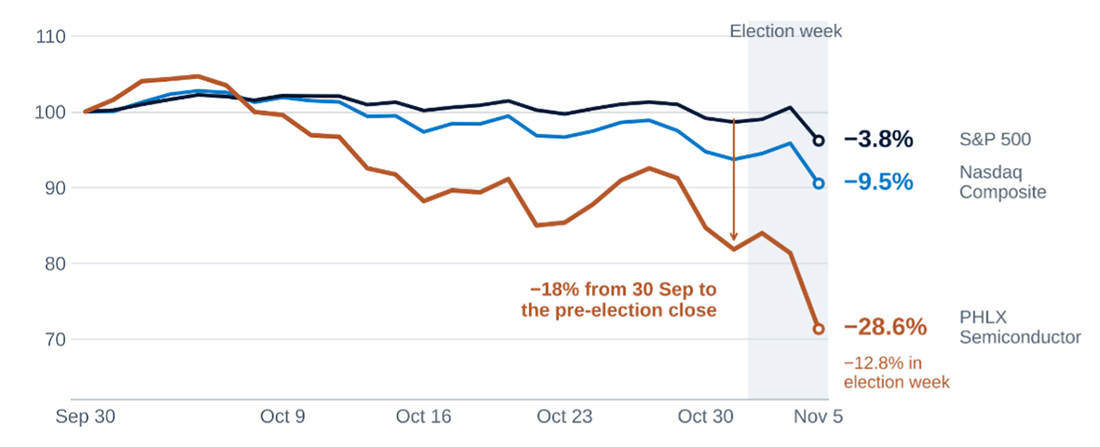
Exhibit: Past performance is not a guarantee or a reliable indicator of future performance. Index performance is for illustrative purposes only and is not indicative of any specific investment. Investors cannot invest directly in an index.
Daily total return of the PHLX Semiconductor Index, Nasdaq Composite and S&P 500, rebased to 100 at 30 September 2026, through 5 November 2026. Shading marks 3 to 5 November. Source: FactSet.
The market backdrop
Global equity markets are navigating a potentially important transition as investors reassess the pace of the artificial intelligence investment cycle, the implications of the U.S. elections, and opportunities beyond technology. While AI fundamentals remain constructive, market behavior increasingly reflects concerns about capital intensity, financing requirements, and the sustainability of exceptional growth rates.
We believe the election may signal a preference for a slower pace of economic and policy change, reinforcing pressures already evident in credit capacity and the competition for capital.
An environment characterized by rapid deregulation and full-speed AI investment may have become increasingly disruptive. A moderation could support a more sustainable equilibrium with somewhat slower growth, lower inflation and lower real rates, particularly if geopolitical tensions ease.
What has changed?
While demand for compute infrastructure remains robust, investor attention is shifting from the magnitude of capital spending toward sustainable growth, financing requirements, and returns on invested capital. This transition is contributing to increased volatility, particularly among companies that have benefited most from the infrastructure buildout.
We remain constructive on AI's long-term potential, but believe higher capital intensity, evolving growth rates, and greater dependence on external financing are creating a more selective investment environment. Increasingly, the opportunity lies in identifying where growth potential can translate into durable earnings and attractive returns.
What is shaping our market outlook?
1. AI infrastructure remains strong, but 2028 could represent an inflection point.
We continue to see substantial AI investment requirements, with 2027 hyperscaler capital expenditures potentially exceeding market expectations. Demand for CPUs, servers, and supporting infrastructure remains strong, while power availability and permitting continue to constrain deployment.
Importantly, much of the infrastructure planned for 2026 and 2027 is already permitted or under construction, supporting near-term spending visibility. However, election-related political resistance and slower permitting today could begin affecting infrastructure deployment in the second half of 2028.
At the same time, additional capacity is expected to become available in 2028. As supply constraints ease, ordering intensity could normalize, potentially triggering an inventory correction even if underlying AI adoption continues expanding.
We believe distinguishing temporary scarcity-driven demand from the ability to generate sustainable growth will become increasingly important as the cycle evolves.
2. Financing conditions are becoming increasingly important.
The first phase of AI infrastructure investment was largely supported by the internally generated cash flows of major technology companies. As capital requirements expand, the ecosystem is becoming more dependent on debt and equity financing.
This introduces a new risk. Falling equity valuations and higher financing costs can undermine project economics, potentially delaying investment even when demand remains healthy. Financial markets and infrastructure spending are becoming increasingly interconnected.
We believe balance-sheet strength, financing flexibility, and sustainable free cash flow will be critical differentiators. Companies capable of funding growth internally may be better positioned as capital becomes more expensive.
3. Relative growth rates matter as much as absolute growth.
Semiconductor fundamentals remain strong, supported by sustained AI infrastructure demand. While growth rates could eventually normalize from exceptionally elevated levels, the timing and magnitude remain uncertain.
At the same time, hyperscaler growth could accelerate, while leading AI laboratories may represent an increasingly important source of demand and economic value. This creates a more nuanced investment environment where strong absolute growth does not necessarily translate into superior relative equity returns.
We remain focused on identifying changes in relative growth, valuation, and market expectations. We have found the strongest businesses do not always generate the strongest returns when exceptional growth is already reflected in valuations.
4. AI adoption must increasingly validate infrastructure investment.
Coding agents have emerged as one of the clearest demonstrations of AI's commercial utility. The next phase will depend on whether adoption expands into enterprise workflows, personal agents, and other applications generating sustained economic value.
We believe the transition from model development toward practical applications is critical. Infrastructure investment ultimately needs to be supported by monetization, productivity improvements, and expanding usage.
The revenue trajectories of leading AI laboratories will provide important evidence of whether demand is broadening sufficiently to support the industry's capital commitments. We see opportunities extending beyond infrastructure suppliers toward businesses capturing value from AI deployment.
 Jennifer O'Hara Martin
Global Equity Portfolio Specialist

- Oct 2026
- Equity
- Article
The ChatGPT moment in transportation? Autonomous driving nears commercial inflection
1Based on the PHLX Semiconductor Sector Index as of November 5, 2026. The index hit a peak on October 6, 2026.
OUTSIDE OF THE UNITED STATES, THIS IS INTENDED FOR INVESTMENT PROFESSIONAL USE ONLY. NOT FOR FURTHER DISTRIBUTION.
Important Information
Actual outcomes may differ materially from any forward-looking statements or estimates made. The statements made are as of November 6, 2026 are those of the author, are subject to change, and T. Rowe Price assumes no duty to and does not undertake to update forward-looking statements or estimates. Other T. Rowe Price associates may have different views.
Risks: Equities can lose value rapidly for a variety of reasons and can remain at low prices indefinitely. Growth stocks are subject to the volatility inherent in common stock investing, and their share price may fluctuate more than that of income‑oriented stocks. Technology companies can be affected by, among other things, intense competition, government regulation, earnings disappointments, dependencyon patent protection, and rapid obsolescence of products and services due to technological innovations or changing consumer preferences.
T. Rowe Price cautions that economic estimates and forward‑looking statements are subject to numerous assumptions, risks, and uncertainties, which change over time. Actual outcomes could differ materially from those anticipated in estimates, and future results could differ materially from historical performance. The information presented herein is shown for illustrative, informational purposes only. Any historical data used as a basis for analysis are based on information gathered by T. Rowe Price and from third‑party sources and have not been verified. Forecasts are based on subjective estimates about market environments that may never occur.
This material is being furnished for general informational and/or marketing purposes only. The material does not constitute or undertake to give advice of any nature, including fiduciary investment advice. Prospective investors are recommended to seek independent legal, financial and tax advice before making any investment decision. T. Rowe Price group of companies including T. Rowe Price Associates, Inc. and/or its affiliates receive revenue from T. Rowe Price investment products and services. Past performance is not a guarantee or a reliable indicator of future results. The value of an investment and any income from it can go down as well as up. Investors may get back less than the amount invested.
The material does not constitute a distribution, an offer, an invitation, a personal or general recommendation or solicitation to sell or buy any securities in any jurisdiction or to conduct any particular investment activity. The material has not been reviewed by any regulatory authority in any jurisdiction.
Information and opinions presented have been obtained or derived from sources believed to be reliable and current; however, we cannot guarantee the sources’ accuracy or completeness. There is no guarantee that any forecasts made will come to pass. The views contained herein are as of the date written and are subject to change without notice; these views may differ from those of other T. Rowe Price group companies and/or associates. Under no circumstances should the material, in whole or in part, be copied or redistributed without consent from T. Rowe Price.
The material is not intended for use by persons in jurisdictions which prohibit or restrict the distribution of the material and in certain countries the material is provided upon specific request. It is not intended for distribution to retail investors in any jurisdiction.
Australia—Issued by T. Rowe Price Australia Limited (ABN: 13 620 668 895 and AFSL: 503741), Level 28, Governor Phillip Tower, 1 Farrer Place, Sydney NSW 2000, Australia. For Wholesale Clients only.
Canada—Issued in Canada by T. Rowe Price (Canada), Inc. T. Rowe Price (Canada), Inc.’s investment management services are only available to non-individual Accredited Investors and non-individual Permitted Clients as defined under National Instrument 45-106 and National Instrument 31-103, respectively. T. Rowe Price (Canada), Inc. enters into written delegation agreements with affiliates to provide investment management services.
DIFC—Issued in the Dubai International Financial Centre by T. Rowe Price International Ltd which is regulated by the Dubai Financial Services Authority as a Representative Office. For Professional Clients only.
EEA—This material is issued and approved by T. Rowe Price (Luxembourg) Management S.à r.l. 35 Boulevard du Prince Henri L-1724 Luxembourg which is authorised and regulated by the Luxembourg Commission de Surveillance du Secteur Financier. For Professional Clients only.
New Zealand— Issued by T. Rowe Price Australia Limited (ABN: 13 620 668 895 and AFSL: 503741), Level 28, Governor Phillip Tower, 1 Farrer Place, Sydney NSW 2000, Australia. No Interests are offered to the public. Accordingly, the Interests may not, directly or indirectly, be offered, sold or delivered in New Zealand, nor may any offering document or advertisement in relation to any offer of the Interests be distributed in New Zealand, other than in circumstances where there is no contravention of the Financial Markets Conduct Act 2013.
Switzerland—Issued in Switzerland by T. Rowe Price (Switzerland) GmbH, Talstrasse 65, 6th Floor, 8001 Zurich, Switzerland. For Qualified Investors only.
UK—This material is issued and approved by T. Rowe Price International Ltd, Warwick Court, 5 Paternoster Square, London EC4M 7DX which is authorised and regulated by the UK Financial Conduct Authority. For Professional Clients only.
USA—Issued in the USA by T. Rowe Price Investment Services, Inc., distributor and T. Rowe Price Associates, Inc., investment adviser, 1307 Point Street, Baltimore, MD 21231, which are regulated by the Financial Industry Regulatory Authority and the U.S. Securities and Exchange Commission, respectively.
Unless otherwise indicated, this material is issued and approved by T. Rowe Price International Ltd, Warwick Court, 5 Paternoster Square, London EC4M7DX which is authorised and regulated by the UK Financial Conduct Authority. For Professional Clients only.
© 2026 T. Rowe Price. All Rights Reserved. T. ROWE PRICE, INVEST WITH CONFIDENCE, the Bighorn Sheep design, and related indicators troweprice.com/ip) are trademarks of T. Rowe Price Group, Inc. All other trademarks are the property of their respective owners. Use does not imply endorsement, sponsorship, or affiliation of T. Rowe Price with any of the trademark owners.
- 202611-6097553